


Saint George is one of the most powerful and enduring figures in Bulgarian history, religion, and national identity. Revered as a Christian saint, warrior, and protector, he holds a unique position as both a spiritual symbol and a national icon. In Bulgaria, he is officially recognized as the patron saint of the Bulgarian Armed Forces, representing courage, sacrifice, and unwavering faith.
Every year on 6 May, Bulgaria celebrates Saint George’s Day, also known as the Day of Bravery and Bulgarian Armed Forces Day. This important national holiday blends Orthodox Christian tradition, military honor, and ancient folk customs into one of the most meaningful celebrations in Bulgarian culture.
Saint George’s legacy reflects the essence of the Bulgarian spirit—resilient, courageous, and deeply rooted in history.
This makes Saint George one of the most important figures in both Bulgarian history and Christian tradition.
👉 Learn more about Bulgaria’s cultural traditions in our complete guide to Bulgarian Cuisine → Bulgarian Cuisine: Complete Food Guide.
Why Is Saint George Important in Bulgaria?
Saint George is important in Bulgaria because he is both a religious protector and the patron saint of the Bulgarian Armed Forces. His feast day, Saint George’s Day (6 May), is one of the most important national holidays, combining faith, military tradition, and cultural customs.
He is widely associated with:
- Protection of soldiers and the nation
- Strength, bravery, and sacrifice
- Spring renewal and agricultural traditions
- Family gatherings and national identity
👉 In Bulgaria, Saint George represents both spiritual belief and patriotic pride.
Who Was Saint George?
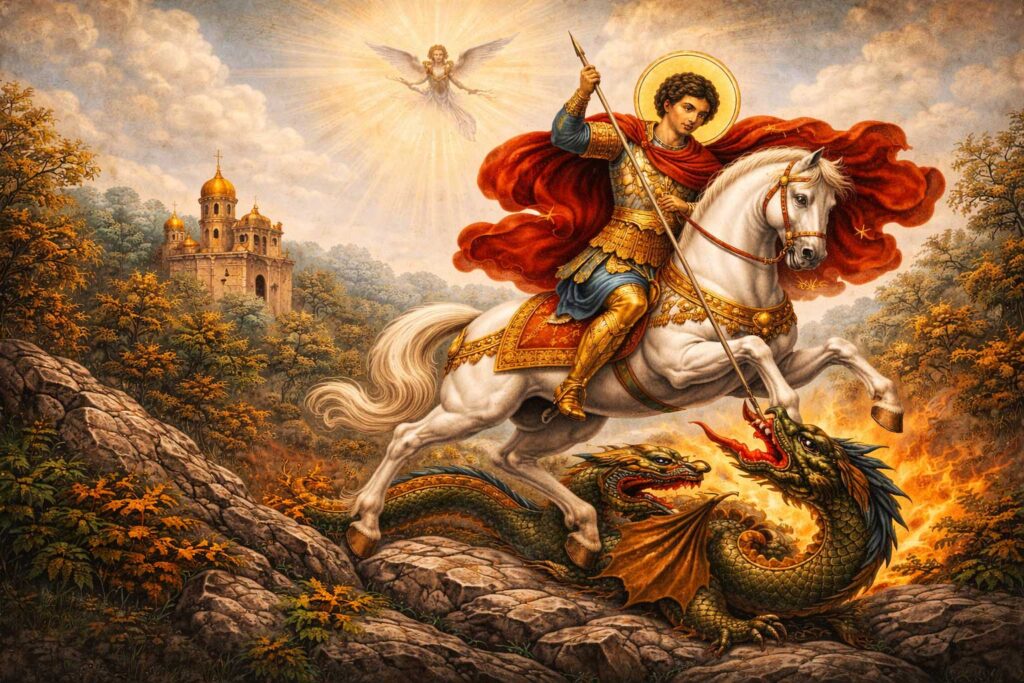
Saint George, also known as George of Lydda, was an early Christian saint believed to have lived during the late 3rd and early 4th centuries AD. He was born in Cappadocia (modern-day Turkey) into a Christian family and later became a soldier in the Roman army.
He served under Diocletian, one of the most powerful rulers of the Roman Empire. At the time, Christianity was heavily persecuted, and loyalty to the emperor often meant abandoning Christian beliefs.
Was Saint George a Real Person?
Saint George is believed to have been a real historical figure—a Roman soldier who lived during the 3rd century AD and was executed for refusing to renounce Christianity under Emperor Diocletian.
However, many famous stories about him, such as the dragon legend, are symbolic and were developed later in Christian tradition.
👉 This combination of history and legend is what made Saint George one of the most influential saints in the world.
The Martyrdom of Saint George
Saint George refused to renounce his faith, even when ordered by the emperor. This act of defiance led to his arrest, torture, and eventual execution around 303 AD.
His death was not seen as defeat—but as a triumph of faith over fear.
Because of his suffering and steadfast belief, he became known as a megalomartyr, one of the highest honors in Christian sainthood. His story spread rapidly across the Christian world, inspiring generations of believers and warriors alike.
The Legend of Saint George and the Dragon
The legendary story of Saint George slaying the dragon is one of the most famous and enduring tales in Christian tradition. Over centuries, it has been retold in countless forms—through art, literature, and religious teaching—becoming a universal symbol of courage and victory.
According to the legend, a terrifying dragon lived near a city, poisoning the land and demanding human sacrifices to be appeased. Eventually, the king’s own daughter was chosen as the next victim. At the moment of greatest despair, Saint George arrived, confronted the beast, and defeated it after a fierce battle, saving both the princess and the city.
Deeper Meaning Behind the Legend
Although widely known, this story is understood as symbolic rather than historical. Its true power lies in what it represents.
The dragon is a metaphor for:
- Evil and chaos
- Fear and oppression
- Forces that threaten humanity and moral order
Saint George represents:
- Faith and righteousness
- Courage and sacrifice
- Divine protection and moral strength
Why This Story Endures
The legend became especially powerful in medieval Europe, where it served as a moral and spiritual lesson. It illustrated the idea that faith and courage can overcome even the most terrifying forces.
Over time, this imagery helped transform Saint George into a universal archetype—the heroic protector who stands against darkness. This is one of the main reasons he became closely associated with warriors and soldiers.
In Bulgaria and across the Orthodox world, this symbolism is still alive today. Saint George is not only remembered as a saint, but also as a defender—one who protects both the faithful and the nation.
This powerful symbolism ultimately led to his recognition as the patron saint of the Bulgarian Armed Forces, where the image of the dragon-slayer reflects the ideals of bravery, duty, and sacrifice.
Why This Legend Matters
The deeper symbolism of the legend explains why Saint George became such a powerful figure across cultures. At its core, the story represents a few timeless ideas:
- Victory over evil
- Protection of the innocent
- Courage in the face of danger
👉 This symbolism played a key role in Saint George becoming a patron saint of soldiers across many cultures—including Bulgaria.
The meaning behind the legend raises an important question:
What Does Saint George Symbolize?
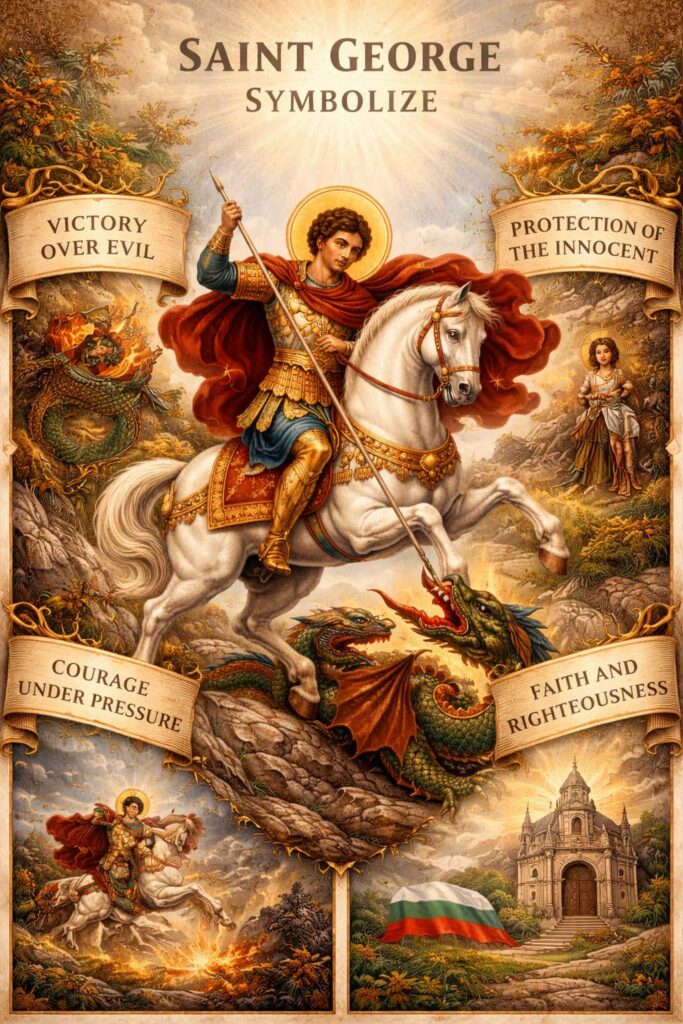
Saint George symbolizes courage, faith, and the triumph of good over evil. He represents the ideal of standing firm against fear, oppression, and injustice, even in the face of danger.
His most famous image—slaying the dragon—captures several core meanings:
- Victory over evil – defeating darkness, chaos, and moral threats
- Protection of the innocent – defending those who cannot protect themselves
- Courage under pressure – facing danger with strength and determination
- Faith and righteousness – remaining loyal to beliefs despite persecution
- Divine protection – acting as a guardian figure for people and nations
Because of these qualities, Saint George became a universal symbol of bravery and was later recognized as the patron saint of soldiers and warriors, including the Bulgarian Armed Forces.
Saint George in Bulgarian Tradition
In Bulgaria, Saint George is not just a religious figure—he is deeply embedded in everyday life, folklore, and seasonal traditions.
👉 These customs are part of a broader food culture—explore more here → Traditional Bulgarian Breakfast Foods.
His feast day, Gergyovden, marks the true arrival of spring and is associated with renewal, fertility, and prosperity.
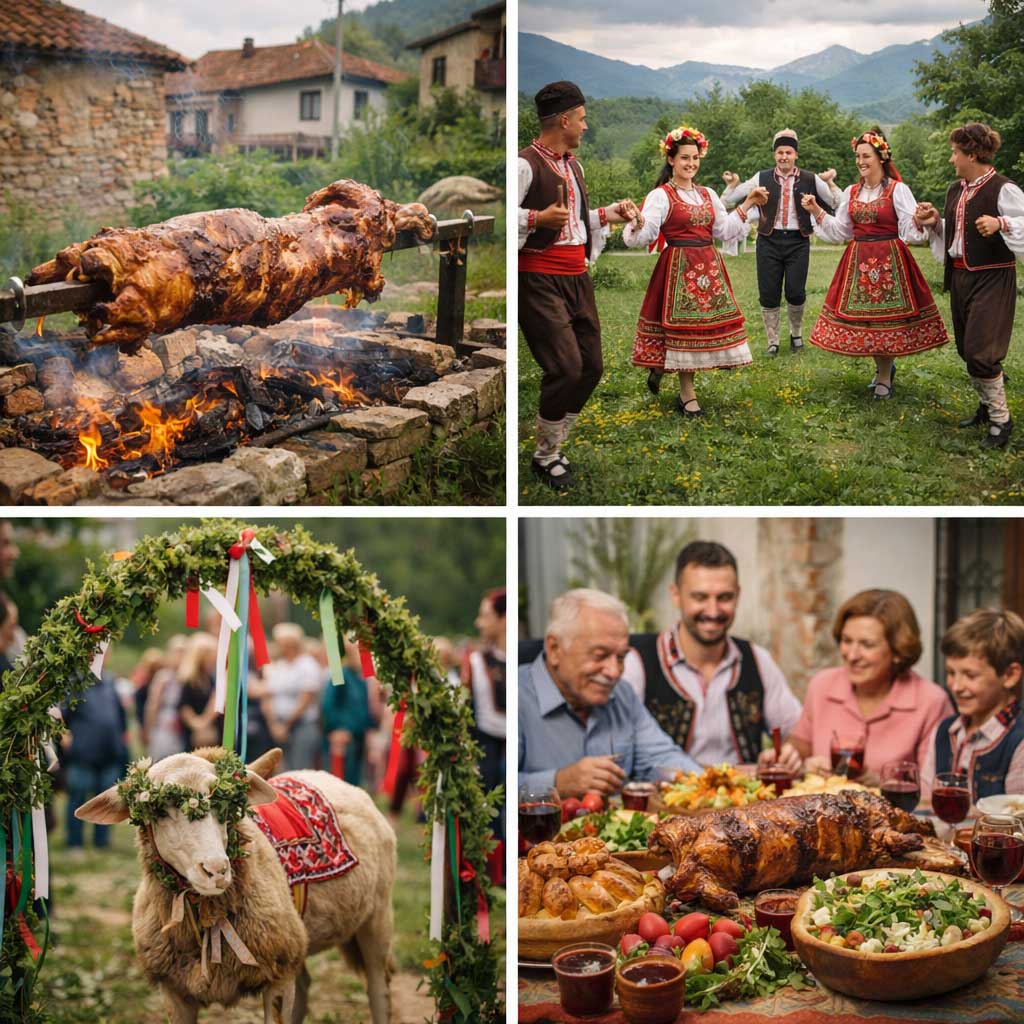
Gergyovden is celebrated with rich traditions that have been preserved for centuries:
- Roasting a whole lamb (symbol of sacrifice and abundance)
- Decorating homes with fresh greenery
- Early morning rituals involving dew for health and beauty
- Family gatherings and communal feasts
These customs connect ancient pagan agricultural traditions with Christian beliefs, creating a uniquely Bulgarian celebration.
👉 These traditions also reflect deeper cultural meanings, explored below.
👉 Explore traditional foods and customs: Bulgarian Cuisine: Complete Food Guide
Folk Traditions and Customs
Gergyovden is celebrated with rich traditions that have been preserved for centuries. These customs reflect a deep connection between nature, spirituality, and daily life in Bulgaria.
Seasonal and Ritual Practices
- Decorating homes with greenery
Fresh branches, flowers, and herbs are placed around homes and gates to symbolize health, protection, and new life. This tradition dates back to pre-Christian beliefs tied to nature worship. - Morning dew rituals
In many regions, people wash their faces with morning dew, believing it brings beauty, health, and vitality. This practice reflects ancient ideas about the healing power of nature.
Food and Celebration
- Roasting a whole lamb
The centerpiece of the celebration, lamb symbolizes sacrifice, abundance, and prosperity. It is often prepared outdoors and shared among family and friends. - Large family gatherings
Gergyovden is a time for community, bringing together relatives and neighbors to celebrate the season and give thanks.
The Deeper Cultural Meaning
What makes Gergyovden truly unique is the way it blends different layers of tradition.
These customs connect:
- Ancient pagan agricultural rituals
- Orthodox Christian beliefs
- Seasonal cycles of nature
- Community and family values
This fusion creates a celebration that is both spiritual and practical—honoring Saint George while also celebrating life, growth, and the rhythms of the natural world.
Why This Tradition Still Matters Today
Even in modern Bulgaria, Gergyovden remains one of the most widely celebrated holidays. While some rituals have evolved, the core meaning remains unchanged.
It continues to represent:
- Renewal and new beginnings
- Gratitude for nature and abundance
- Protection of family and home
- A deep connection to Bulgarian identity
Through these traditions, Saint George remains not only a religious symbol but a living part of Bulgarian culture.
What Is Gergyovden?
Gergyovden is the Bulgarian celebration of Saint George’s Day, observed on 6 May. It is one of the most important holidays in Bulgaria, combining Orthodox Christian traditions with ancient folk rituals rooted in agricultural life.
It is known for:
- Roasting lamb and festive meals
- Blessings for health, prosperity, and protection
- Spring rituals and greenery decorations
- Family gatherings and community celebrations
- Military ceremonies and national pride
👉 Gergyovden also marks the beginning of the pastoral season, when shepherds traditionally take animals out to pasture.
Why Is Lamb Eaten on Saint George’s Day?
Lamb is eaten on Saint George’s Day as a symbol of sacrifice, abundance, and new beginnings. The tradition is rooted in both Christian symbolism and ancient agricultural practices linked to spring.
👉 For more traditional dishes, see → Bulgarian Cuisine: Complete Food Guide.
It represents:
- Renewal of life and nature
- Prosperity and fertility
- Gratitude for protection and harvest
👉 In Bulgaria, roasted lamb is the centerpiece of the Gergyovden celebration.
Affiliate Disclosure: This section may contain affiliate links. As an Amazon Associate, we earn from qualifying purchases.
Gergyovden Cooking Essentials
| Product | Best For | Why It’s Useful | Rating | Check Price |
|---|---|---|---|---|
| Large Rotisserie Spit Kit | Whole lamb roasting | Traditional Gergyovden cooking method | ⭐⭐⭐⭐⭐ | 👉 Check Price on Amazon |
| Cast Iron Roasting Pan | Oven roasting | Even heat for lamb dishes | ⭐⭐⭐⭐⭐ | 👉 Check Price on Amazon |
| Digital Meat Thermometer | Perfect doneness | Prevent overcooking lamb | ⭐⭐⭐⭐⭐ | 👉 Check Price on Amazon |
| Outdoor Charcoal Grill | Authentic flavor | Ideal for traditional Bulgarian style cooking | ⭐⭐⭐⭐☆ | 👉 Check Price on Amazon |
👉 See more cooking tools.
👉Want to cook authentic Bulgarian dishes? → Explore more here: Bulgarian Cuisine: Complete Food Guide.
Why Saint George Is the Patron Saint of the Bulgarian Armed Forces
Saint George’s transformation into a military patron is rooted in his identity as a soldier and Christian Saint.
Because he:
- Served as a Roman soldier
- Showed unwavering courage
- Defended his faith despite persecution
He became a natural symbol of military virtue.
Official Military Connection
In Bulgaria, Saint George is officially recognized as the patron saint of the armed forces. This connection is celebrated every year on 6 May, which is both:
- Saint George’s Day
- The Day of Bravery and Bulgarian Armed Forces Day
This dual celebration reflects the deep connection between faith and national defense.
👉 Related reading: Bulgarian Contributions to Modern Technology
Why Is 6 May Bulgarian Armed Forces Day?
6 May is celebrated as Bulgarian Armed Forces Day because it is the feast day of Saint George, the patron saint of the military. The date was chosen to symbolize bravery, protection, and the spiritual guidance of soldiers.
The day honors:
- The courage of Bulgarian soldiers
- Military history and national defense
- The connection between faith and service
👉 It is officially known as the Day of Bravery and Bulgarian Armed Forces Day.
The Day of Bravery and Bulgarian Armed Forces Day
The Day of Bravery and Bulgarian Armed Forces Day is one of Bulgaria’s most important national holidays.
It honors:
- The courage of Bulgarian soldiers
- The history of the Bulgarian military
- The spiritual protection of Saint George
👉 Discover more achievements across industries → Bulgarian Achievements by Industry.
Modern Celebrations
Today, the holiday includes:
- Military parades in Sofia
- Blessing of battle flags
- Ceremonies attended by government officials
- Public displays of military equipment
- National broadcasts and celebrations
These events highlight Bulgaria’s respect for its armed forces and its historical legacy of bravery.
Saint George in Sofia: The Rotunda of Sveti Georgi
One of the most important landmarks connected to Saint George in Bulgaria is the Rotunda of St. George.
Located in the heart of Sofia, this ancient church dates back to the 4th century and is considered the oldest preserved building in the city.
Historical Significance
The Rotunda:
- Was built during Roman times
- Survived multiple empires
- Contains medieval frescoes
- Remains an active place of worship
👉 It stands as a powerful symbol of continuity—from ancient Rome to modern Bulgaria.
👉 Explore the history of the capital → History of Sofia.
Saint George on Google Earth
You can explore Saint George-related locations in Sofia using these coordinates:
- Rotunda of Sveti Georgi
42°41’48.96″N, 23°19’22.42″E - Presidency (Sofia)
42°41’48.56″N, 23°19’25.86″E
These locations highlight how Saint George’s legacy exists at the very center of Bulgarian political and cultural life.
Saint George Across the Christian World
Saint George is not only important in Bulgaria—he is one of the most universally recognized and venerated saints in Christianity. His legacy extends across continents, cultures, and centuries, making him a rare figure who is honored in both Eastern Orthodox and Western Christian traditions.
Over time, Saint George became associated with courage, protection, and victory, which led many nations to adopt him as their patron saint.
Countries Where Saint George Is a Patron Saint
Saint George is officially recognized as a patron saint in several countries, including:
- England – symbolized by the red cross flag known as St. George’s Cross
- Georgia – where his name itself reflects national identity
- Greece – widely honored in Orthodox tradition
- Serbia – one of the most important family patron saints (Slava)
- Ethiopia – deeply revered within Ethiopian Christianity
Symbolism of Saint George
What makes Saint George unique is his ability to transcend borders and traditions. While different cultures emphasize different aspects of his story, the core symbolism remains the same:
Saint George represents several key ideals:
- Courage – standing firm in the face of danger
- Faith – unwavering belief under pressure
- Victory – triumph of good over evil
- Protection – defender of people and nations
His widespread importance shows how powerful his story is across cultures and centuries. Whether depicted in medieval European art, Orthodox icons, or national symbols, Saint George continues to represent a timeless ideal of bravery and moral strength.
These values align perfectly with the identity of the Bulgarian Armed Forces, which is why his role as patron saint remains so relevant today.
Saint George Icons & Orthodox Items
| Product | Best For | Why It’s Useful | Rating | Check Price |
|---|---|---|---|---|
| Saint George Orthodox Icon Wall Art | Home decor | Traditional icon of Saint George slaying the dragon | ⭐⭐⭐⭐⭐ | 👉 Check Price on Amazon |
| Handmade Byzantine Saint George Icon | Authentic collectors | High-quality religious artwork | ⭐⭐⭐⭐⭐ | 👉 Check Price on Amazon |
| Orthodox Cross Necklace | Personal wear | Symbol of faith and protection | ⭐⭐⭐⭐☆ | 👉 Check Price on Amazon |
| Prayer Rope (Komboskini) | Spiritual practice | Used in Orthodox prayer tradition | ⭐⭐⭐⭐☆ | 👉 Check Price on Amazon |
👉 Explore more Orthodox items.
Cultural and National Importance in Bulgaria
Saint George’s Day is one of the most widely celebrated holidays in Bulgaria, combining:
- Religion
- Folklore
- Agriculture
- National pride
It marks a turning point in the year—the beginning of the pastoral season and a time of abundance.
This blend of meanings makes Saint George one of the most deeply rooted figures in Bulgarian identity.
Frequently Asked Questions (FAQ) About Saint George
Why is Saint George important in Bulgaria?
Saint George is important in Bulgaria because he is the patron saint of the Bulgarian Armed Forces and a symbol of courage, faith, and national identity.
When is Saint George’s Day celebrated?
Saint George’s Day is celebrated on 6 May every year in Bulgaria.
What is Gergyovden?
Gergyovden is the Bulgarian name for Saint George’s Day. It is a major national holiday that combines religious celebration with folk traditions such as lamb roasting, spring rituals, and family gatherings. It symbolizes renewal, prosperity, and protection.
What does Saint George symbolize?
Saint George symbolizes courage, faith, and victory over evil. His image as a dragon slayer represents the triumph of good over darkness, making him a universal symbol of protection and strength.
Was Saint George a real person?
Yes, Saint George is believed to have been a real historical figure—a Roman soldier who became a Christian saint. However, many of the stories about him, especially the dragon legend, are symbolic rather than historical.
What makes Saint George a military saint?
His background as a Roman soldier combined with his courage and martyrdom made him a symbol of ideal military virtue—discipline, bravery, and loyalty to higher principles.
Why is 6 May also Military Day?
6 May is Military Day in Bulgaria because it is the feast of Saint George, the patron saint of the Bulgarian Armed Forces. The date symbolizes bravery, protection, and the connection between faith and the military.
Who was Saint George?
Saint George was an early Christian saint and Roman soldier who lived in the 3rd century AD. He is believed to have served under Emperor Diocletian and was executed for refusing to renounce his Christian faith.
He later became one of the most venerated saints in Christianity and a symbol of courage, faith, and sacrifice.
What does the dragon symbolize?
In the legend of Saint George, the dragon symbolizes evil, fear, and chaos. It represents the forces that threaten humanity, while Saint George’s victory represents the triumph of good, faith, and courage over evil.
Where is the Rotunda of St. George?
One of the most important places is the Rotunda of St. George in Sofia, the oldest preserved building in the capital. His iconography is also found in churches, homes, and public monuments across the country.
Is Saint George only important in Bulgaria?
No, Saint George is one of the most widely venerated saints in the world. He is the patron saint of several countries, including England and Georgia, and is honored in both Eastern and Western Christianity.
Why is lamb eaten on Gergyovden?
Lamb is eaten as a symbol of sacrifice, abundance, and renewal. This tradition is deeply rooted in both Christian symbolism and ancient agricultural practices tied to spring.
Conclusion
Saint George stands as one of the most powerful symbols in Bulgarian culture. As a warrior, saint, and protector, he embodies the ideals of courage, faith, and sacrifice.
His role as the patron saint of the Bulgarian Armed Forces and the celebration of 6 May as the Day of Bravery demonstrate how deeply his legacy is woven into the Bulgarian identity.
From ancient legends to modern military parades, Saint George continues to inspire and protect—remaining a timeless figure of strength and honor.
His legacy continues to shape Bulgarian culture, faith, and national identity to this day.
References
- Saint George. Encyclopaedia Britannica. https://www.britannica.com/biography/Saint-George
- Saint George. Wikipedia. https://en.wikipedia.org/wiki/Saint_George
- Delehaye, Hippolyte. The Legends of the Saints. Dublin: Four Courts Press, 1998. https://archive.org/details/legendsofsaintsi00dele
- Saint George Encyclopaedia Britannica. https://www.britannica.com/biography/Saint-George
- Gergyovden (St. George’s Day in Bulgaria). Wikipedia. https://en.wikipedia.org/wiki/Saint_George%27s_Day
- Bulgarian Armed Forces Day. Wikipedia. https://en.wikipedia.org/wiki/Bulgarian_Armed_Forces_Day
- Rotunda of St. George, Sofia. Wikipedia. https://en.wikipedia.org/wiki/Church_of_Saint_George,_Sofia
- Diocletian. Encyclopaedia Britannica. https://www.britannica.com/biography/Diocletian
- Megalomartyr. OrthodoxWiki. https://orthodoxwiki.org/Martyr
- Brown, Peter. The Cult of the Saints: Its Rise and Function in Latin Christianity. Chicago: University of Chicago Press, 1981. https://press.uchicago.edu/ucp/books/book/chicago/C/bo19109018.html
- St. George. Catholic Encyclopedia. https://www.newadvent.org/cathen/06453a.htm
- Great Martyr George. Orthodox Church in America. https://www.oca.org/saints/lives/2020/04/23/101167-greatmartyr-victorybearer-and-wonderworker-george
- Saint George’s Day in Bulgaria. Office Holidays. https://www.officeholidays.com/holidays/bulgaria/day-of-the-bulgarian-army
- Slava (Serbian Tradition). Wikipedia. https://en.wikipedia.org/wiki/Slava
- Saint George’s Cross. Wikipedia. https://en.wikipedia.org/wiki/Saint_George%27s_Cross
- Saint George. Encyclopaedia Britannica. https://www.britannica.com/topic/Saint-George
- Bulgarian Academy of Sciences. https://www.bas.bg/
- The Byzantine Legacy: Rotunda of St. George. https://www.thebyzantinelegacy.com/rotunda-serdica
- Saint George History. https://stgeorgehistory.com/