


The history of Sofia is one of the most fascinating urban stories in Europe. Few cities can match its continuity of life, cultural transformation, and historical depth. From prehistoric settlements and Thracian tribes to Roman emperors, medieval kingdoms, Ottoman rule, and modern European development, Sofia has stood at the crossroads of civilizations for thousands of years.
Today, Sofia is not only the capital of Bulgaria, but also one of the oldest continuously inhabited cities in Europe. Walking through its streets reveals Roman ruins beneath modern buildings, early Christian churches next to Ottoman mosques, and socialist architecture beside contemporary glass structures.
The history of Sofia spans thousands of years, making it one of Europe’s most continuously evolving cities.
👉 To understand how Sofia fits into the broader national story, explore → History of Bulgaria.
Why the History of Sofia Matters
Sofia is more than just a capital city—it is a reflection of the broader geopolitical and cultural dynamics that have shaped the Balkans for millennia.
Its history captures the essence of a region where empires, religions, and civilizations have constantly intersected.
A strategic crossroads between Europe and Asia
Sofia’s location in the heart of the Balkan Peninsula placed it along major ancient and medieval trade routes. This made the city a key connection point between Central Europe, the Mediterranean, and the Near East—one of the main reasons it was so often contested.
A center of religious transformation
Over centuries, Sofia transitioned from pagan Thracian beliefs to Roman polytheism and eventually to Christianity. Landmarks like the Church of St. George Rotunda illustrate how deeply rooted early Christianity is in the city’s identity.
A contested city between empires
From the Roman and Byzantine Empires to the Bulgarian kingdoms and the Ottoman state, Sofia has repeatedly changed hands. Each empire left behind architectural, cultural, and political influences that still define the city today.
A symbol of Bulgarian identity and revival
During the 19th century, especially throughout the Bulgarian National Revival, Sofia became part of the cultural awakening that led to modern Bulgaria. Its selection as capital in 1879 solidified its role as the heart of the nation.
Because of all this, Sofia acts as a living historical timeline, where every era—from Serdica to the modern capital—has left visible, walkable traces.
This article may contain affiliate links. If you purchase through these links, we may earn a small commission at no extra cost to you.
Sofia Travel Essentials
👉 Planning to explore Sofia’s history in person? Make your trip smoother with these essential travel items:
| Product | Best For | Why It’s Useful | Check Price |
|---|---|---|---|
| Travel Guide to Bulgaria | First-time visitors | Covers Sofia landmarks, history, and routes | 👉 Check Price on Amazon |
| Anti-Theft Backpack | City exploration | Protects valuables in busy areas | 👉 Check Price on Amazon |
| Portable Charger | Long walking days | Keeps your phone alive for maps/photos | 👉 Check Price on Amazon |
| Comfortable Walking Shoes | Historic tours | Sofia is best explored on foot | 👉 Check Price on Amazon |
| Reusable Water Bottle | Daily travel | Stay hydrated while exploring | 👉 Check Price on Amazon |
👉 Explore more travel essentials on Amazon
Prehistoric and Thracian Origins
Long before the name Sofia existed, the area was inhabited by prehistoric communities drawn to one defining feature: mineral springs.
These natural hot springs made the region exceptionally attractive for early human settlement and long-term habitation.
Why the mineral springs mattered:
- Provided clean, warm water year-round
- Used for healing, bathing, and ritual practices
- Supported early agriculture and stable communities
Even today, Sofia is known for its mineral water sources—continuing a tradition that dates back thousands of years.
The Thracian Tribe of the Serdi
Over time, the region became home to the Thracian tribe known as the Serdi, who gave the city its earliest known identity.
From their name came Serdica, the title later adopted during Roman rule.
The Serdi were part of the broader Thracian world—an ancient civilization known for:
- Rich spiritual traditions
- Skilled metalworking
- Strong tribal organization
Why This Location Mattered
Sofia’s location was not accidental—it was strategically ideal.
- Central position in the Balkans → connecting north and south, east and west
- Access to major trade routes → linking Europe with the Aegean and beyond
- Fertile land and water sources → supporting long-term population growth
These advantages explain why the city was continuously inhabited and repeatedly developed by different civilizations.
This early phase is essential to understanding the history of Sofia from its very origins.
👉 To better understand the geography that shaped these early civilizations, see → Geography of Bulgaria.
The Birth of Serdica: From Tribal Settlement to City
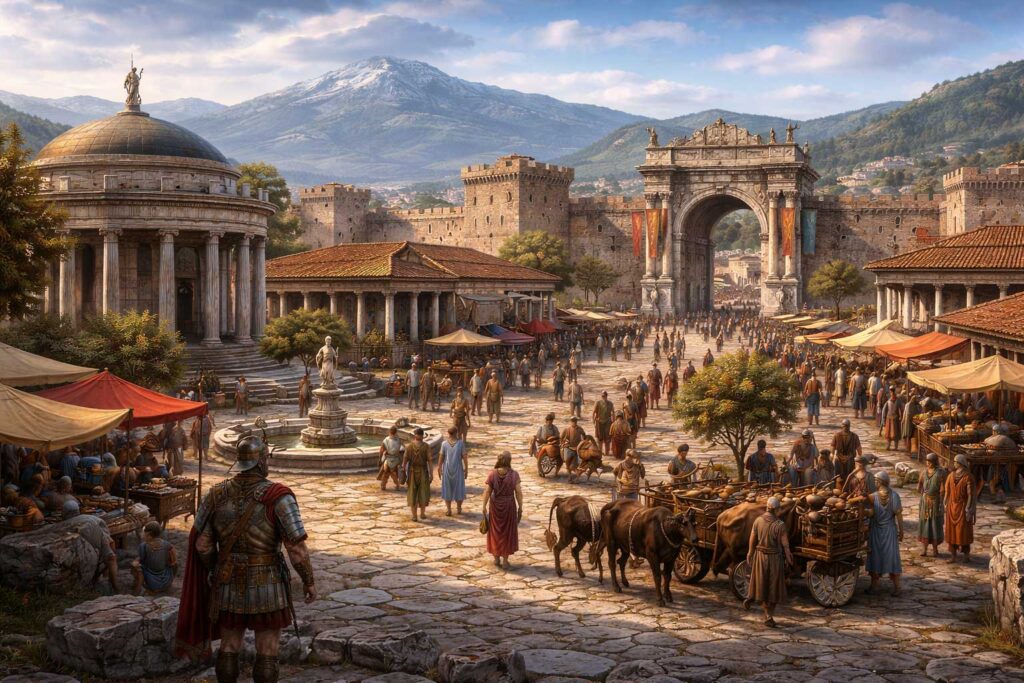
The early Thracian settlement in the Sofia Basin gradually evolved into a more organized urban center known as Serdica.
Named after the Thracian tribe Serdi, Serdica began as a fortified settlement that benefited from its strategic location, natural resources, and access to regional trade routes.
From Tribal Center to Emerging City
Before the arrival of the Romans, Serdica was already gaining importance as:
- A local administrative and tribal hub
- A center for trade and exchange in the region
- A defensive settlement, likely protected by early fortifications
Its development reflected a broader transition in the Balkans—from scattered tribal communities to more structured urban life.
A Strategic Position in the Ancient World
Serdica’s location made it especially valuable:
- Positioned along early trade corridors connecting the Danube region to the Aegean
- Surrounded by mountains that offered natural protection
- Sustained by mineral springs and fertile land
These advantages laid the groundwork for the city’s future growth and long-term importance.
Before Rome — A City in the Making
Even before Roman conquest, Serdica was already more than just a village—it was a rising urban center in the region.
However, its true transformation would begin when it became part of the Roman Empire, turning Serdica into one of the most important cities in the Balkans.
The rise of Serdica marked a defining stage in the history of Sofia.
Roman Sofia: The Rise of Serdica in the History of Sofia
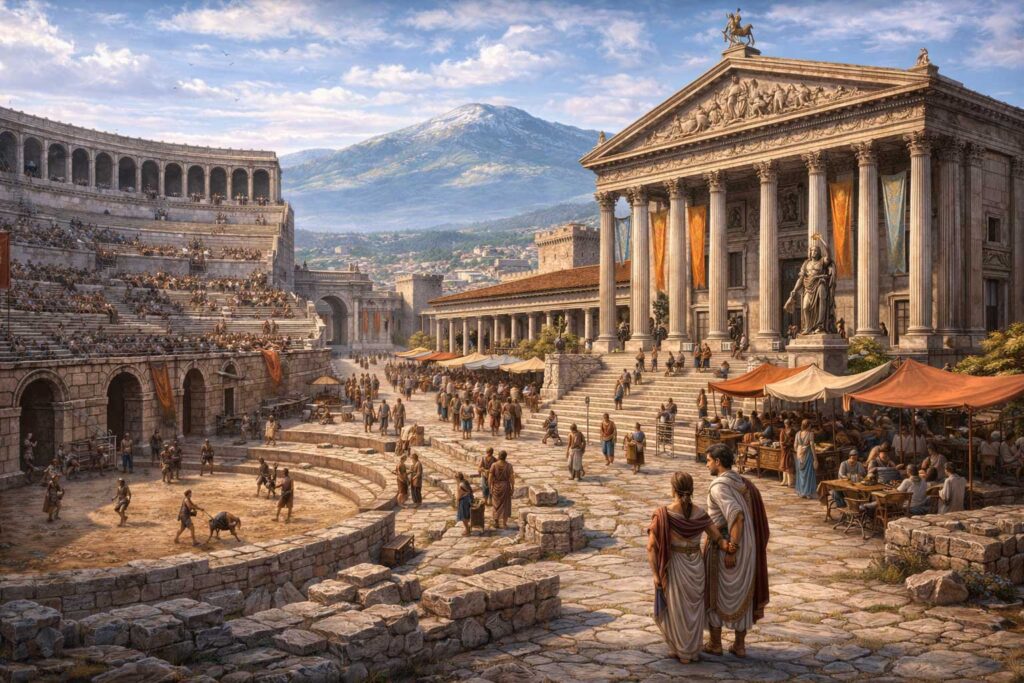
In the late 1st century BCE, the Romans incorporated Serdica into their empire. From that moment, the city entered a period of rapid growth and prosperity.
Under Roman rule, Serdica developed into a major administrative, economic, and strategic center in the Balkans, benefiting from imperial investment and its key position along important trade routes.
Urban Development and Roman Infrastructure
The Romans transformed Serdica into a well-planned city, introducing advanced infrastructure and architecture typical of Roman urban life.
Key Roman features included:
- Fortified city walls → protecting the settlement from invasions
- Public baths (thermae) → central to daily social and cultural life
- Amphitheater → used for entertainment and public gatherings
- Administrative buildings → housing local governance and officials
- Paved streets and road systems → connecting Serdica to major Roman routes
This level of development placed Serdica among the important Roman cities in Southeast Europe.
👉 Learn more about Bulgarian scientific contributions → Bulgarian Science and Technology History.
A Thriving Roman Center
Serdica became a hub for:
- Trade and commerce
- Military movement
- Cultural exchange
Its population grew, and the city gained prominence within the Roman province.
Visible Today Beneath Modern Sofia
One of the most remarkable aspects of Sofia is how much of Roman Serdica still survives.
Today, visitors can walk through:
- Underground Roman streets
- Preserved building foundations
- Archaeological complexes in the city center
The history of Sofia during the Roman period represents one of its most influential and well-documented eras.
These remains—especially around the Largo area—offer a rare opportunity to experience ancient Roman urban life beneath a modern capital.
👉 Roman Serdica is part of a broader story of innovation and influence—discover more here → Bulgarian Discoveries That Changed the World.
Bulgarian & Balkan History Books
👉 Want to go deeper into Sofia’s Roman past and its role in the Balkans? These expert-recommended books provide historical context and fascinating insights:
| Book | Best For | Why It’s Valuable | Check Price |
|---|---|---|---|
| The Balkans: A Short History – Mark Mazower | Big picture | Explains Roman → Ottoman transitions | 👉 Check Price on Amazon |
| The Later Roman Empire – Ammianus Marcellinus | Advanced readers | Primary source from Roman era | 👉 Check Price on Amazon |
| The Roman Empire: A Very Short Introduction – Christopher Kelly | Beginners | Easy intro to Roman world | 👉 Check Price on Amazon |
| Rome and the Barbarians – Peter Heather | Migration period | Explains Balkan conflicts | 👉 Check Price on Amazon |
| The Inheritance of Rome – Chris Wickham | Late Antiquity | Covers Serdica era transitions | 👉 Check Price on Amazon |
👉 Explore more travel essentials on Amazon.
Constantine the Great and the Importance of Serdica
One of the most influential figures connected to Serdica is the Roman emperor Constantine the Great.
According to historical tradition, he once famously said:
“Serdica is my Rome.”
While historians debate whether this quote is authentic, it clearly reflects the strategic and political importance of Serdica during Late Antiquity.
Why Serdica Mattered to Constantine
During Constantine’s reign, Serdica was far more than a provincial city. It was:
- A regional imperial center → hosting administration and governance
- A military hub → positioned along key defensive and logistical routes
- A strategic crossroads → linking the eastern and western parts of the Roman Empire
Its location made it a natural candidate for greater imperial focus, especially during a time when the Roman world was increasingly divided between East and West.
A City Between Two Worlds
Serdica’s importance also came from its role as a bridge:
- Between Latin West and Greek East
- Between Europe and Asia Minor
- Between older pagan traditions and emerging Christianity
This positioning made it a vital center not only politically, but also culturally and religiously.
A Missed Imperial Capital?
Some historians believe that Constantine considered Serdica as a potential imperial capital before ultimately choosing Constantinople.
Even though it was not selected, this possibility highlights just how significant Serdica had become within the Roman world.
This connection further elevates the importance of the history of Sofia in the Roman world.
Early Christianity and the Council of Serdica
As the Roman Empire evolved, Serdica emerged as an important center of early Christianity in the Balkans.
In 343 AD, the city hosted the Council of Serdica, a major gathering of bishops from across the Roman world. This council addressed key theological disputes and highlighted Serdica’s growing religious significance.
Why This Matters
- Demonstrates the early spread of Christianity in the Balkan region
- Connects Sofia to the wider history of the Christian Church
- Shows that Serdica was important not only politically, but also religiously and culturally
A Living Monument from This Era
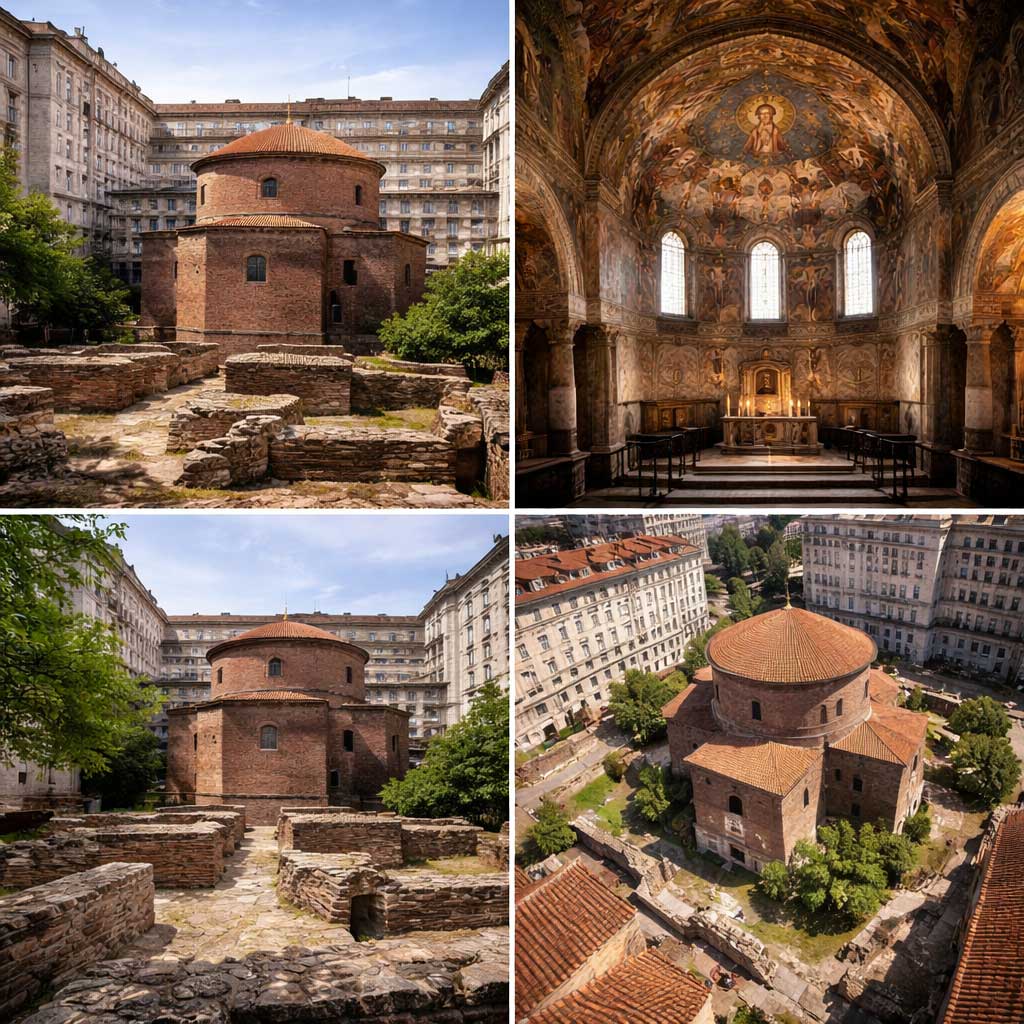
One of the most remarkable surviving structures from this period is the Church of St. George Rotunda.
Dating back to the 4th century, it is considered:
- The oldest preserved building in Sofia
- A rare example of early Christian architecture
- A symbol of the city’s deep historical continuity
Byzantine and Early Medieval Sofia
After the division of the Roman Empire, Serdica became part of the Eastern Roman Empire, also known as the Byzantine Empire.
During this period, the city remained a strategic stronghold, but also faced continuous instability.
Key Characteristics of This Era
- The city remained heavily fortified to defend against invasions
- It was frequently attacked, damaged, and rebuilt
- Control shifted multiple times between the Byzantines and Bulgarian rulers
A City in Constant Conflict
Because of its location, Serdica became a focal point in regional struggles:
- Between the Byzantine Empire and the Bulgarian states
- Along major military and trade routes
- At the crossroads of competing political powers
This made the city both valuable and vulnerable—shaping its development through cycles of destruction and renewal.
Despite these challenges, Serdica endured, setting the stage for its next transformation as Sredets under the Bulgarian Empires.
This period added another important layer to the history of Sofia, shaping its defensive and cultural development.
Sredets Under the Bulgarian Empires
During the Middle Ages, Serdica became known as Sredets, marking a new chapter in the history of Sofia under Bulgarian rule.
Sredets emerged as one of the most important cities in the First Bulgarian Empire and later the Second Bulgarian Empire.
A Key Administrative and Strategic Center
Under Bulgarian control, Sredets developed into:
- A major administrative hub → managing regional governance
- A military stronghold → protecting vital routes across the Balkans
- A commercial center → facilitating trade between north and south
Its central location ensured that it remained one of the most valuable cities in the Bulgarian state.
A Thriving Cultural and Religious Hub
Sredets was not only politically important but also a center of religious and cultural life.
Churches, monasteries, and schools played a key role in preserving Bulgarian identity, especially during times of external pressure.
One of the most remarkable surviving monuments from this period is the Boyana Church, famous for its:
- Exceptional medieval frescoes
- Early Renaissance artistic elements
- UNESCO World Heritage status
Between Empires: A Contested City
Due to its strategic importance, Sredets was frequently contested:
- It changed hands between the Bulgarian and Byzantine Empires
- It endured sieges, destruction, and rebuilding
- It remained a frontline city in regional power struggles
Despite these challenges, Sredets continued to grow and adapt.
The End of the Medieval Era
By the late 14th century, the expansion of the Ottoman Empire brought an end to Bulgarian control.
Sredets was conquered and gradually transformed into an important Ottoman administrative center—marking the beginning of a new historical phase for the city.
Sofia During Ottoman Rule in the History of Sofia
In the late 14th century, Sofia—then known as Sredets—was conquered by the Ottoman Empire. This marked the beginning of a new era that would last for nearly five centuries.
During this period, Sofia was transformed from a medieval Bulgarian stronghold into an important Ottoman provincial center, while still preserving elements of its earlier past.
Urban Transformation Under Ottoman Rule
The Ottomans reshaped the city’s structure and daily life, introducing new architectural and social elements:
- Construction of mosques → reflecting Islamic religious and cultural life
- Public bathhouses (hammams) → continuing the tradition of mineral springs
- Markets and bazaars → turning Sofia into a vibrant trade hub
- Administrative buildings → reinforcing its role as a regional center
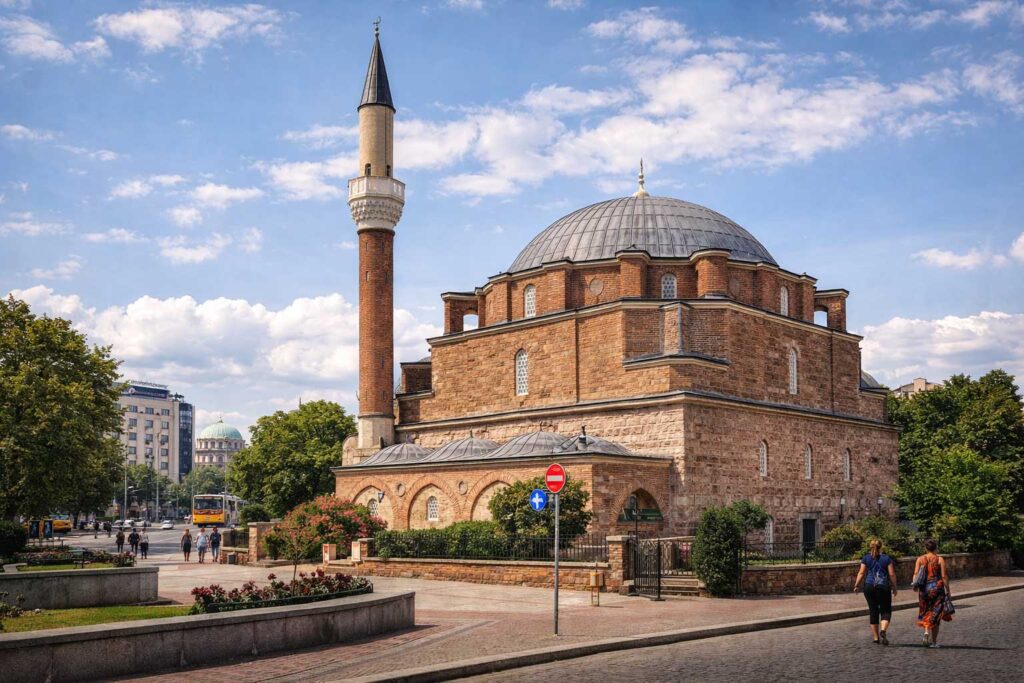
One of the most iconic surviving landmarks from this period is the Banya Bashi Mosque, built in the 16th century and still functioning today.
A Center of Trade and Administration
Under Ottoman rule, Sofia became:
- A key stop along trade routes across the Balkans
- A regional administrative hub within the empire
- A multi-ethnic city, home to diverse communities
This diversity contributed to the city’s evolving cultural identity.
Continuity Beneath Change
Despite the significant transformations, Sofia’s earlier historical layers were not erased.
- Roman foundations remained beneath the city
- Early Christian sites continued to exist
- Medieval structures influenced the urban layout
This continuity is what allows modern Sofia to reveal multiple historical periods in one place.
A Bridge to the National Revival
By the 18th and 19th centuries, Sofia became increasingly connected to the Bulgarian National Revival, a period of cultural and national awakening that would eventually lead to liberation.
The Ottoman era remains a defining chapter in the history of Sofia, influencing its architecture and urban identity.
Sofia in the Bulgarian National Revival
During the Bulgarian National Revival, Sofia began to transform from an Ottoman provincial town into a center of growing Bulgarian identity, culture, and education.
Although still under the rule of the Ottoman Empire, Sofia became increasingly influenced by the wider movement that was reshaping Bulgarian society.
👉 Explore this pivotal era in more depth → Bulgarian National Revival.
Cultural and Educational Awakening
The National Revival period focused on rebuilding Bulgarian identity through:
- Education → establishment of secular Bulgarian schools
- Language → promotion of Bulgarian in literature and public life
- Religion → strengthening of the Bulgarian Orthodox Church
These developments helped reconnect Sofia with its medieval Bulgarian roots and laid the groundwork for national independence.
Sofia’s Role in the Revival Movement
While cities like Plovdiv and Veliko Tarnovo were major cultural centers, Sofia still played an important role as:
- A regional hub for education and trade
- A meeting point for intellectuals and reformers
- A growing urban center preparing for political change
The city’s position ensured it remained connected to the broader national movement.
The Road to Liberation
By the mid-19th century, the ideas of the National Revival had spread throughout Bulgarian lands, including Sofia.
This cultural awakening eventually led to the Russo-Turkish War (1877–1878), which resulted in Bulgaria’s liberation from Ottoman rule.
In 1878, Sofia was freed, marking the end of nearly five centuries of Ottoman control.
A City Ready for a New Role
The National Revival period prepared Sofia for its future transformation:
- From Ottoman town → modern Bulgarian city
- From regional center → national capital (1879)
- From cultural awakening → state-building and modernization
This era represents the bridge between Sofia’s past and its role in modern Bulgaria.
This cultural awakening marked a turning point in the history of Sofia and its role in modern Bulgaria.
Why Sofia Became Bulgaria’s Capital
Following the Russo-Turkish War (1877–1878), Bulgaria was liberated from centuries of Ottoman rule and began the process of building a modern state.
In 1879, the newly established government made a defining decision: Sofia would become the capital of Bulgaria.
Why Sofia Was Chosen
The choice was strategic and forward-looking, based on several key advantages:
- Central geographic location → Sofia sits at the heart of the Bulgarian lands, making it ideal for administration and communication across the country
- Strategic importance → Its position along major routes and near important mountain passes made it historically significant and easy to defend
- Potential for expansion → Unlike older cities with limited space, Sofia offered room for growth, modernization, and urban planning
A Vision for the Future
At the time, Sofia was still a relatively modest town compared to cities like Plovdiv. However, leaders saw its long-term potential rather than its current state.
Choosing Sofia as the capital allowed Bulgaria to:
- Build a modern administrative center from the ground up
- Develop infrastructure aligned with European standards
- Establish a new political and cultural heart for the nation
A Decision That Changed Everything
This decision transformed Sofia completely.
Within decades, the city evolved from a former Ottoman provincial town into:
- The political center of Bulgaria
- A hub of education, culture, and governance
- A rapidly expanding European-style capital
Sofia’s designation as capital marked the beginning of its modern era—setting the stage for the dramatic growth and transformation that would define the late 19th and 20th centuries.
This decision permanently changed the history of Sofia, elevating it to national importance.
Sofia in the Early 20th Century: A Turning Point in the History of Sofia
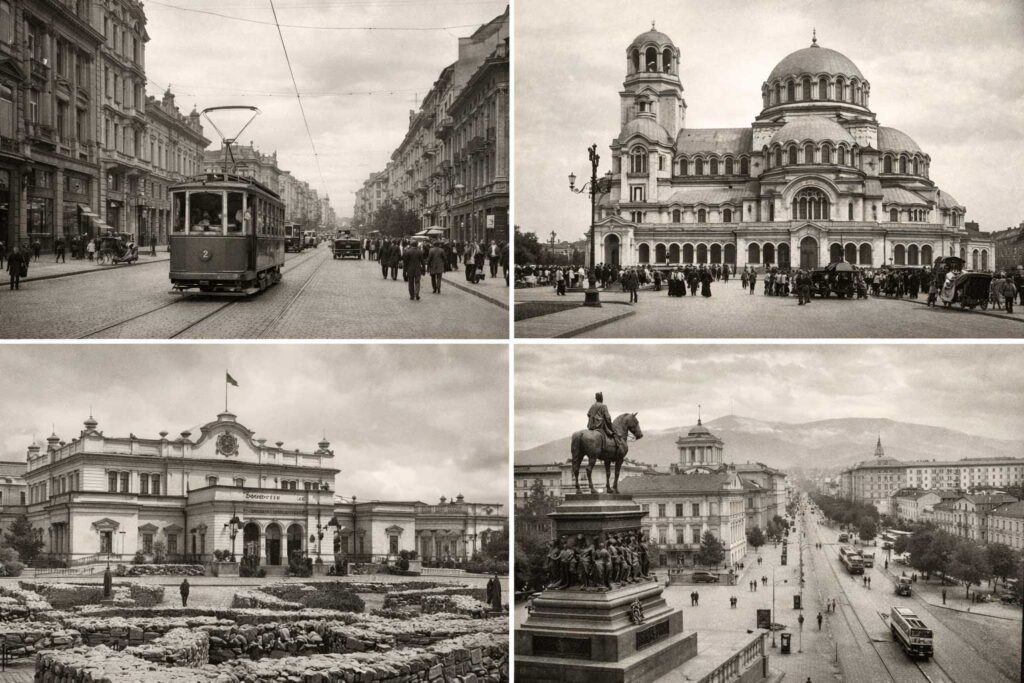
After becoming the capital in 1879, Sofia entered a period of rapid transformation. What had once been a modest Ottoman provincial town quickly evolved into a modern European capital.
Urban Expansion and European Influence
In the late 19th and early 20th centuries, Sofia underwent large-scale urban planning inspired by major European cities such as Vienna and Paris.
Key developments included:
- Wide boulevards and organized street layouts
- Construction of government buildings and institutions
- Expansion of public infrastructure, including water supply and transportation
- Introduction of modern architecture styles
This marked the beginning of Sofia’s identity as a modern, forward-looking capital.
Iconic Landmarks of the Era
Several of Sofia’s most recognizable landmarks were built during this period, shaping the city’s image to this day.
One of the most important is the Alexander Nevsky Cathedral, constructed in the early 20th century:
- A symbol of Bulgarian independence
- One of the largest Orthodox cathedrals in the world
- A defining feature of Sofia’s skyline
Other key buildings included:
- The National Assembly (Parliament)
- Universities and cultural institutions
- Bridges, parks, and public spaces
A Growing Capital
As Bulgaria developed, Sofia became:
- The political center of the country
- A hub for education and intellectual life
- A center of economic activity and trade
The population grew rapidly, and the city expanded beyond its historical core.
From Ottoman Town to European Capital
Within just a few decades, Sofia underwent a remarkable transformation:
- From Ottoman provincial town
- To modern Bulgarian capital
- To an emerging European city with national significance
This period laid the foundation for Sofia’s modern identity and set the stage for the challenges and changes of the 20th century.
This era represents one of the fastest periods of growth in the history of Sofia.
Sofia Through War, Socialism, and Urban Expansion
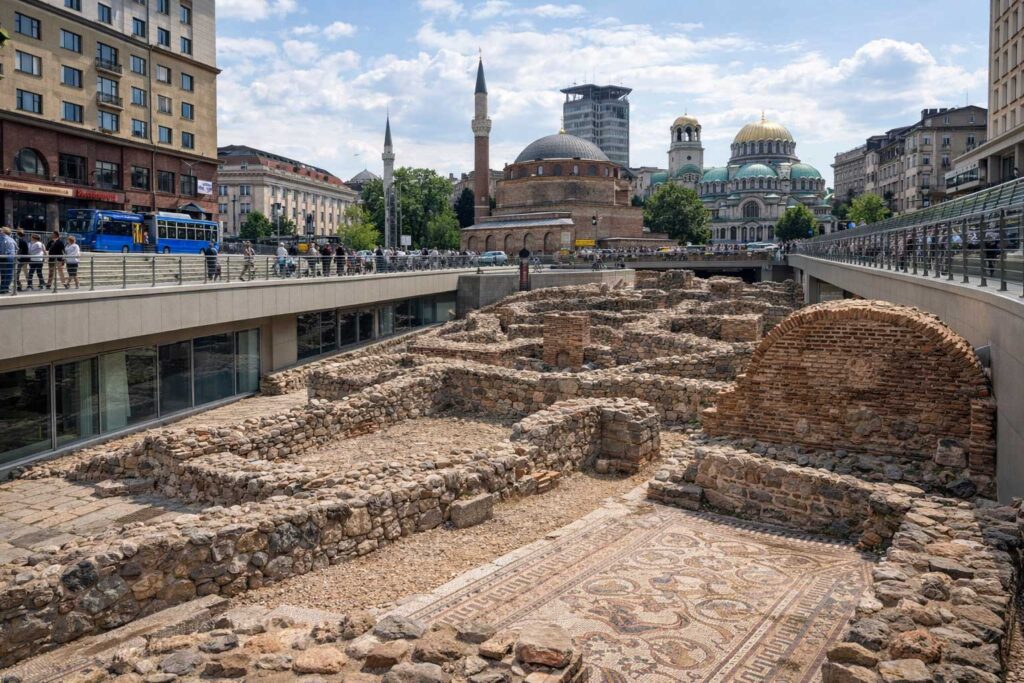
The 20th century brought profound transformation to Sofia, shaped by war, political change, and large-scale urban development.
Sofia During the World Wars
Sofia experienced significant challenges during both world wars, particularly World War II.
- The city suffered heavy bombing raids in 1943–1944, causing widespread destruction
- Many historic buildings and residential areas were damaged or destroyed
- Post-war reconstruction became a major priority
These events reshaped parts of Sofia’s urban landscape and accelerated modernization efforts.
The Socialist Era and Transformation
After 1944, Bulgaria became part of the Eastern Bloc, and Sofia entered a new phase under socialist rule.
During this period, the city underwent major structural changes:
- Construction of large residential districts (panel apartment blocks)
- Expansion of industry and infrastructure
- Development of monumental government buildings and public spaces
Iconic areas like the Largo complex became symbols of socialist architecture and centralized power.
Urban Expansion and Population Growth
Sofia’s population grew rapidly during the socialist period, requiring:
- New housing developments
- Improved transportation systems
- Expansion beyond the historic city center
Entire neighborhoods were built to accommodate workers and their families, transforming Sofia into a large metropolitan city.
A New Identity Shaped by the 20th Century
By the end of the socialist era, Sofia had evolved into:
- The largest city in Bulgaria
- The country’s industrial and administrative center
- A city defined by a mix of historic layers and modern expansion
Legacy of This Era
Today, the impact of this period is still visible:
- Socialist-era buildings stand alongside older architecture
- Urban planning from the mid-20th century shapes the city’s layout
- Reconstruction after wartime destruction influenced modern Sofia
This era marked one of the most dramatic transformations in Sofia’s history, setting the stage for its transition into a modern European capital after 1989.
The socialist period dramatically reshaped the history of Sofia, especially its urban landscape.
Post-1989 Sofia: Democracy, Growth, and Modern Identity
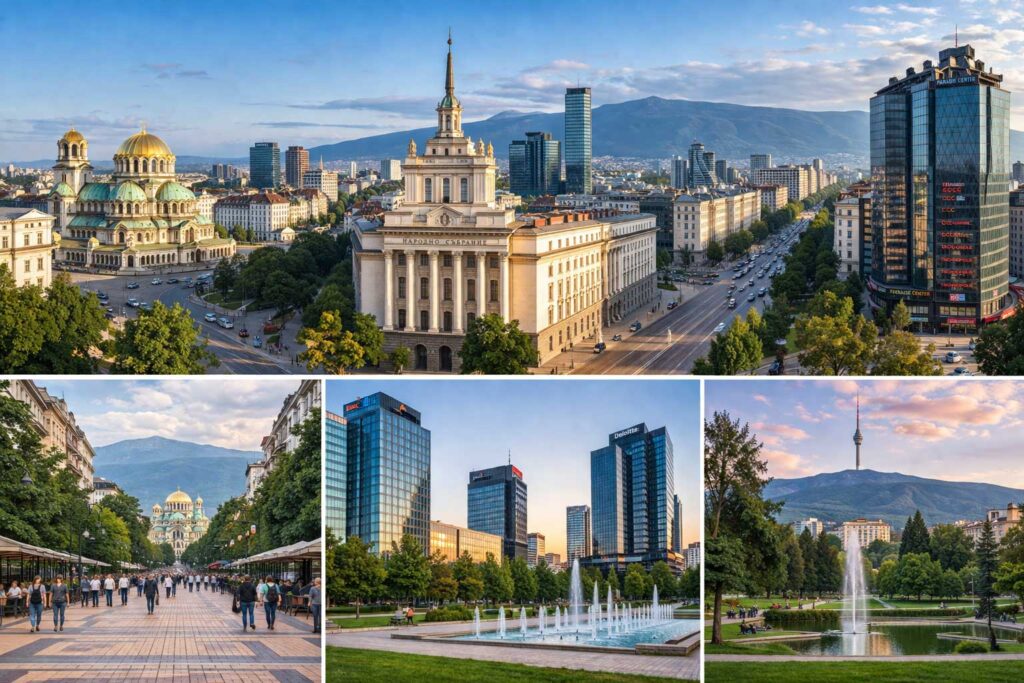
After the political changes of 1989, Sofia entered a new era defined by democracy, economic transition, and rapid modernization.
The fall of the socialist system marked the beginning of Bulgaria’s shift toward a market economy and integration into European structures, transforming Sofia into a dynamic and evolving capital.
Transition to Democracy and Market Economy
In the early 1990s, Sofia experienced:
- Political reforms and the establishment of democratic institutions
- Economic restructuring and privatization
- Challenges such as inflation, unemployment, and urban adjustment
Despite initial difficulties, the city gradually stabilized and began to grow.
Economic Growth and Global Integration
By the 2000s, Sofia had emerged as:
- Bulgaria’s economic and financial center
- A hub for international business and investment
- A growing destination for technology and outsourcing industries
Today, Sofia is considered one of the leading tech and startup hubs in Southeast Europe, attracting companies and talent from across the region.
Urban Renewal and Modern Infrastructure
Post-1989 development brought significant improvements:
- Expansion of the Sofia Metro system
- Renovation of historic areas and public spaces
- Growth of modern business districts and residential zones
Projects in the city center have also revealed and preserved ancient remains of Serdica, blending archaeology with contemporary design.
A City of Contrasts
Modern Sofia is defined by its contrasts:
- Ancient ruins next to glass office buildings
- Socialist-era districts alongside modern developments
- Historic churches near vibrant commercial streets
This combination creates a unique urban identity that reflects both continuity and change.
Sofia Today
Today, Sofia stands as:
- The political capital of Bulgaria
- A center of education, culture, and innovation
- A gateway between Europe and the Balkans
Preserving the Past While Building the Future
Perhaps the most remarkable aspect of modern Sofia is how it integrates its history into everyday life. Archaeological sites, historic landmarks, and cultural traditions remain central to the city’s identity, even as it continues to grow.
Sofia’s post-1989 transformation represents not just political change, but the evolution of a city that has adapted to every era in its long history.
Modern development continues to redefine the history of Sofia in the 21st century.
Historic Landmarks That Tell the Story of Sofia
What makes Sofia truly unique is that its entire history is visible in one place. Few cities in Europe allow you to experience so many historical layers within such a compact area.
Walking through Sofia is like moving through time, where each era has left behind physical traces that are still part of the modern city.
Layers of History You Can See Today
- Roman ruins of Serdica
→ Underground streets, walls, and buildings preserved in the city center - Early Christian landmarks
→ Including the Church of St. George Rotunda, one of the oldest buildings in the city - Medieval Bulgarian monuments
→ Such as the Boyana Church, famous for its frescoes - Ottoman-era structures
→ Including the Banya Bashi Mosque, still active today - National Revival and post-liberation architecture
→ Reflecting Bulgaria’s cultural awakening and modernization - Modern and contemporary buildings
→ Showcasing Sofia’s growth into a European capital
Few cities offer such a layered historical experience, where ancient, medieval, and modern worlds coexist within walking distance.
These landmarks visually represent the full history of Sofia in one place.
Why the History of Sofia Still Matters Today
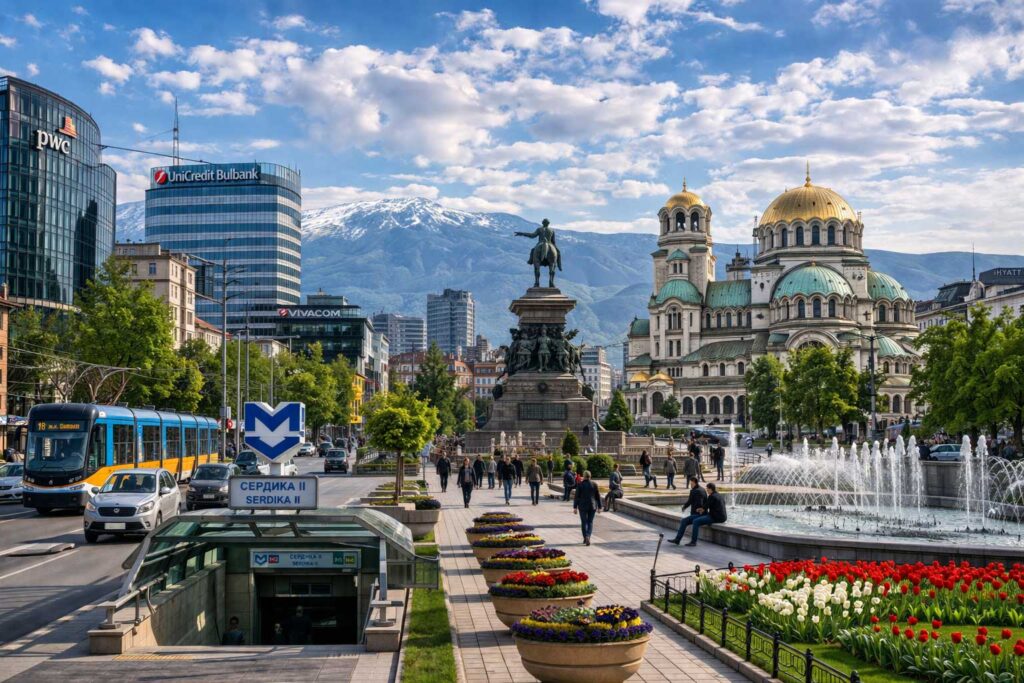
Understanding the history of Sofia helps explain not only the city itself, but also the broader story of Bulgaria.
What Sofia’s History Reveals
- Bulgaria’s cultural identity
→ A blend of Thracian, Roman, Byzantine, Slavic, and Ottoman influences - Its position between East and West
→ A crossroads where cultures, religions, and empires meet - Its resilience through centuries of change
→ A city that has survived invasions, wars, and political transformations
👉 Food plays a key role in Bulgarian identity—explore it here → Bulgarian Cuisine: Complete Food Guide.
Sofia is not just a capital—it is a living museum of Balkan history, where every street, building, and ruin tells part of a story that continues to shape the present.
FAQ: History of Sofia
Is Sofia the oldest capital in Europe?
No, Sofia is not the oldest capital in Europe, but it is one of the oldest continuously inhabited cities on the continent. Archaeological evidence shows human settlement in the Sofia Basin dating back thousands of years, long before many modern European capitals existed.
What was Sofia called in ancient times?
In ancient times, Sofia was known as Serdica, named after the Thracian tribe Serdi. During the medieval Bulgarian period, it was called Sredets, before eventually adopting the name Sofia in the late Middle Ages.
Why is Sofia historically important?
Sofia is historically important because of its strategic location in the Balkans, connecting Europe and Asia. Over the centuries, it has been part of multiple empires, including the Roman, Byzantine, Bulgarian, and Ottoman states, making it a key political, economic, and cultural center.
What are the oldest buildings in Sofia?
The oldest surviving buildings in Sofia include the Church of St. George Rotunda, which dates back to the 4th century, and the underground remains of Serdica, including streets, walls, and public structures preserved in the city center.
👉 Before you explore Sofia’s historic sites, make sure you’re equipped with these practical travel essentials:
Sofia Trip Must-Haves
👉 Top-rated picks for travelers and history lovers (updated 2026):
| Product | Best For | Why It’s Useful | Check Price |
|---|---|---|---|
| European Power Adapter | Travelers | Required for charging devices | 👉 Check Price on Amazon |
| Compact Umbrella | Weather changes | Sofia weather can shift quickly | 👉 Check Price on Amazon |
| Crossbody Travel Bag | Safety + convenience | Easy access while walking | 👉 Check Price on Amazon |
| Travel Notebook | History lovers | Perfect for notes and memories | 👉 Check Price on Amazon |
| Lightweight Jacket | Layering | Ideal for evenings and seasons | 👉 Check Price on Amazon |
👉 Explore more travel essentials on Amazon.
History of Sofia Timeline (Quick Overview)
- Ancient Period → Thracian settlements and Serdi tribe
- Roman Era → Serdica becomes major Roman city
- Byzantine Period → Strategic fortified city
- Medieval Bulgaria → Sredets under Bulgarian empires
- Ottoman Rule → 5 centuries of transformation
- National Revival → Cultural awakening
- 1879 → Sofia becomes capital
- 20th Century → Wars, socialism, expansion
- Modern Era → European capital and tech hub
Conclusion
The history of Sofia is a powerful story of survival, transformation, and cultural depth. From Thracian tribes and the rise of Serdica to medieval Bulgarian rule, Ottoman influence, and modern European development, Sofia has continuously evolved while preserving the layers of its past.
The history of Sofia continues to evolve, making it one of Europe’s most dynamic historic capitals.
What makes Sofia truly unique is its ability to blend history with everyday life. Roman ruins sit beneath modern streets, ancient churches stand beside government buildings, and centuries-old traditions continue in a rapidly growing capital.
Few cities in Europe allow you to walk through over 2,000 years of history in a single afternoon—and that is exactly what makes Sofia not just a destination, but a living timeline of the Balkans.
👉 To explore how this story fits into the bigger picture, continue with → History of Bulgaria.
References
- Encyclopaedia Britannica – Sofia https://www.britannica.com/place/Sofia
- Visit Sofia – History https://visitsofia.bg/en/history
- Sofia Municipality – History https://www.sofia.bg/en/web/sofia-municipality/history
- UNESCO – Boyana Church https://whc.unesco.org/en/list/42
- Bulgarian Academy of Sciences – Historical Studies
- World History Encyclopedia – Serdica https://www.worldhistory.org/Serdica/
- Ancient History Encyclopedia – Roman Cities in the Balkans https://www.worldhistory.org/
- Encyclopaedia Britannica – Constantine the Great https://www.britannica.com/biography/Constantine-I-Roman-emperor
- Oxford Reference – Byzantine Empire Overview https://www.oxfordreference.com/
- European Commission – Cultural Heritage in Bulgaria https://culture.ec.europa.eu/
- National Statistical Institute Bulgaria – Sofia Data https://www.nsi.bg/
- Library of Congress – Bulgaria Country Study https://www.loc.gov/item/90006422/
- UNESCO – Cultural Heritage Bulgaria Overview https://whc.unesco.org/en/statesparties/bg
- Britannica – Balkan History Overview https://www.britannica.com/place/Balkans
- Visit Bulgaria – Sofia Cultural Sites https://bulgariatravel.org/