


The key battles in Bulgarian history are not just moments of war—they are the decisive turning points that shaped the survival, expansion, collapse, and rebirth of Bulgaria across more than 1,300 years. From the victory that created the state to the battles that defended it, broke it, and ultimately restored it, these conflicts form the foundation of Bulgarian identity and historical legacy.
These major battles in Bulgarian history reveal how a relatively small nation repeatedly defeated some of the most powerful empires in Europe through strategy, terrain, and leadership.
Together, these key battles in Bulgarian history show how Bulgaria survived against some of the most powerful empires in Europe.
Positioned at the crossroads between Europe and Asia, Bulgaria has always stood on one of the most contested frontiers in history. It faced powerful and often overwhelming rivals, including the Byzantine Empire, the Ottoman Empire, Crusader states, and rising Balkan kingdoms. Yet time and again, Bulgaria defied expectations—defeating larger armies, outmaneuvering stronger empires, and preserving its presence through strategy, terrain, and resilience.
👉 To understand these battles in full context, it’s essential to explore the broader History of Bulgaria.
These battles tell a larger story. They reveal how Bulgaria was founded through strength, expanded through ambition, tested through defeat, and ultimately reborn through sacrifice. Understanding them is essential to understanding the nation itself.
👉 These conflicts span across both the First Bulgarian Empire and the Second Bulgarian Empire, two of the most important periods in Bulgarian history.
What Are the Key Battles in Bulgarian History?
The most important battles in Bulgarian history include:
- Battle of Ongal (680) — founding of Bulgaria
- Battle of Pliska (811) — destruction of a Byzantine emperor
- Battle of Achelous (917) — peak of Bulgarian power
- Battle of Kleidion (1014) — collapse of the First Empire
- Battle of Tryavna (1190) — restoration of Bulgaria
- Battle of Adrianople (1205) — defeat of Crusaders
- Battle of Klokotnitsa (1230) — Balkan dominance
- Battle of Shipka Pass (1877–1878) — liberation
👉 These battles define Bulgaria’s rise, fall, and rebirth.
Key Battles in Bulgarian History (Quick Summary Table)
| Battle | Year | Outcome | Importance |
|---|---|---|---|
| Ongal | 680 | Victory | Founding of Bulgaria |
| Pliska | 811 | Victory | Emperor killed |
| Achelous | 917 | Victory | Peak power |
| Kleidion | 1014 | Defeat | Collapse begins |
| Tryavna | 1190 | Victory | State restored |
| Adrianople | 1205 | Victory | Crusaders defeated |
| Klokotnitsa | 1230 | Victory | Balkan dominance |
| Velbazhd | 1330 | Defeat | Decline begins |
| Shipka Pass | 1877 | Victory | Liberation |
Battle of Ongal (680) — The Birth of Bulgaria
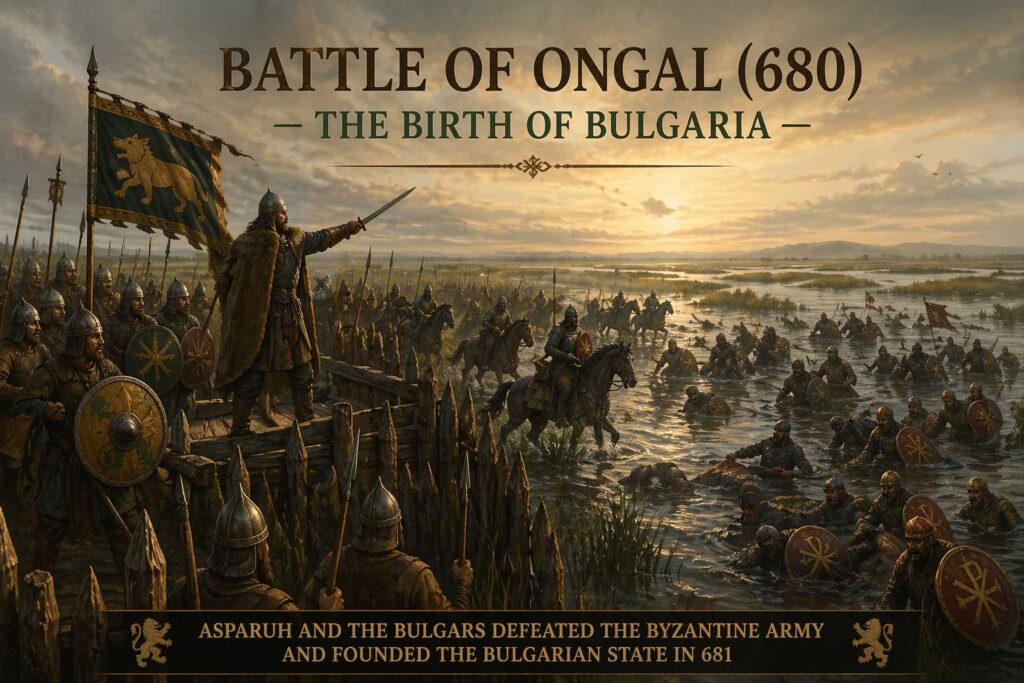
- Leader: Asparuh
- Opponent: Byzantine Empire
- Outcome: Decisive Bulgarian victory
The Battle of Ongal, fought in 680, is one of the most important key battles in Bulgarian history because it directly led to the creation of the Bulgarian state. It took place in the marshy and fortified region known as Ongal, near the Danube Delta—an environment that played a crucial role in the outcome.
After crossing the Danube, Asparuh and his forces established defensive fortifications in the wetlands, anticipating a Byzantine counterattack. Emperor Constantine IV launched a campaign to drive them back, but the difficult terrain disrupted the Byzantine army’s formations and mobility. The Bulgars, familiar with the landscape, used it to their advantage—holding their ground and forcing the Byzantines into retreat.
👉 This battle directly explains how Bulgaria was founded and the origins of the Bulgarian state.
Why it matters
- Led directly to the founding of Bulgaria in 681
- Forced the Byzantine Empire to recognize Bulgaria
- Established Bulgaria as a permanent power in the Balkans
- Marked the beginning of over 1,300 years of Bulgarian statehood
Historical Impact
Following the defeat, Byzantium was forced to sign a treaty and pay tribute—an extraordinary outcome that confirmed Bulgaria as a legitimate and independent state. This makes Ongal not just a victory, but the military foundation of Bulgaria’s existence.
👉 Led by Asparuh, the Bulgars established a powerful foothold south of the Danube.
Battle of Marcellae (792) — Bulgaria Becomes a Stable Power
- Leader: Kardam
- Opponent: Constantine VI
- Outcome: Bulgarian victory
The Battle of Marcellae, fought in 792, was one of the early key battles in Bulgarian history that confirmed Bulgaria’s position as a stable and rising power in the Balkans. Taking place near the fortress of Marcellae in Thrace, the battle came during ongoing conflicts between Bulgaria and the Byzantine Empire.
Khan Kardam confronted the Byzantine forces led by Emperor Constantine VI and managed to defeat them, forcing the Byzantines into retreat. The victory was significant not only militarily but also politically, as it demonstrated that Bulgaria could consistently challenge and defeat one of the strongest empires of the time.
👉 This victory helped strengthen the First Bulgarian Empire during its early development.
Why it matters
- Strengthened Bulgaria’s position in the Balkans
- Forced Byzantium to recognize Bulgarian military strength
- Helped stabilize the early Bulgarian state
- Proved Bulgaria could win repeated victories—not just isolated battles
Historical Impact
After the defeat, Byzantium was forced to adopt a more cautious approach toward Bulgaria, even agreeing to pay tribute for a period. This marked a shift in the balance of power, as Bulgaria was no longer seen as a temporary threat but as a permanent and formidable regional force.
👉 It also shaped the long conflict between the Byzantine Empire and Bulgaria.
Battle of Pliska (811) — The Fall of an Emperor
- Leader: Krum
- Opponent: Nikephoros I
- Outcome: Decisive Bulgarian victory
The Battle of Pliska, fought in 811, where Krum defeated Byzantium, is one of the most dramatic key battles in Bulgarian history and one of its most decisive victories. It began when the Byzantine emperor Nikephoros I invaded Bulgaria, captured and burned the capital Pliska, believing the campaign was already won.
However, as the Byzantine army retreated through the Balkan Mountains, Krum prepared a devastating counterattack. Bulgarian forces constructed defensive barriers in a narrow mountain pass, trapping the Byzantine army. During a surprise assault—likely carried out at night—the Bulgarians destroyed the enemy forces.
The result was catastrophic for Byzantium: Emperor Nikephoros I was killed, becoming one of the few Byzantine emperors to die in battle.
Why it matters
This battle remains one of the most important key battles in Bulgarian history because it marked a decisive turning point in Bulgaria’s development.
- One of the greatest Bulgarian military victories
- Death of a Byzantine emperor on the battlefield
- Demonstrated Bulgaria’s tactical superiority
- Established Bulgaria as a dominant regional power
Historical Impact
The victory at Pliska shocked the medieval world and elevated Bulgaria’s status across Europe. It proved that even the most powerful empire in the region could be defeated through strategy and terrain advantage.
The battle also became legendary due to accounts that Krum used the emperor’s skull as a ceremonial cup—symbolizing both victory and dominance.
👉 The victory at Pliska highlights the leadership of Khan Krum, one of Bulgaria’s greatest rulers.
Battle of Versinikia (813) — Total Dominance Over Byzantium
- Leader: Krum
- Opponent: Michael I Rangabe
- Outcome: Decisive Bulgarian victory
The Battle of Versinikia, fought in 813, was one of the most important victories that confirmed Bulgaria’s dominance over the Byzantine Empire during the early medieval period. The battle took place near Adrianople (modern Edirne), a key strategic location in Thrace.
Despite facing a large Byzantine force, Khan Krum demonstrated patience and strategic awareness. According to historical accounts, the Bulgarian army initially held its position while the Byzantine troops hesitated and eventually lost cohesion. When the opportunity arose, Krum launched a decisive attack that broke the Byzantine lines and forced a complete retreat.
👉 This victory further strengthened the legacy of Khan Krum.
The defeat was so severe that Emperor Michael I Rangabe was forced to abdicate shortly afterward, highlighting the scale of the disaster for Byzantium.
Why it matters
This battle remains one of the most important key battles in Bulgarian history because it marked a decisive turning point in Bulgaria’s development.
- Confirmed Bulgaria as the dominant power in the Balkans
- Forced a Byzantine emperor to abdicate
- Strengthened Krum’s legacy as a military leader
- Continued a series of major Bulgarian victories over Byzantium
Historical Impact
Versinikia was not just a victory—it was proof that Bulgaria could consistently defeat Byzantium in open battle. Following this success, Bulgaria expanded its influence deeper into Thrace and increased pressure on Constantinople itself.
This battle solidified a period of Bulgarian military superiority that would continue into the Golden Age under later rulers.
👉 These battles were part of the long conflict between the Byzantine Empire and Bulgaria.
Battle of Achelous (917) — Peak of the Bulgarian Golden Age
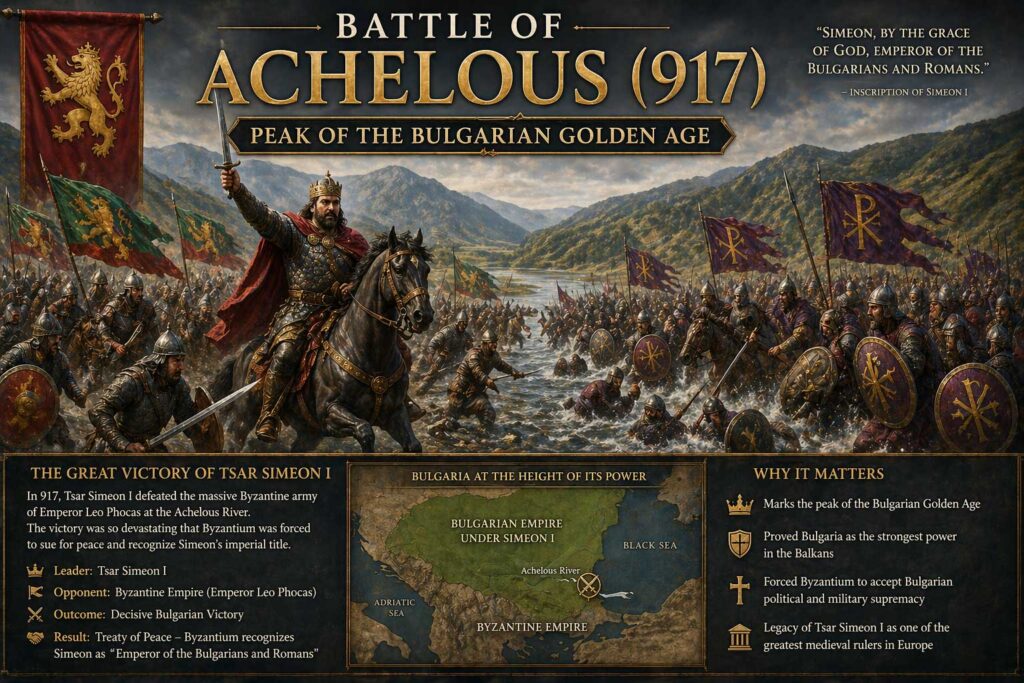
- Leader: Simeon I the Great
- Opponent: Byzantine Empire
- Outcome: Crushing Bulgarian victory
The Battle of Achelous, fought on 20 August 917 near the Achelous River (close to modern-day Pomorie), is widely considered one of the greatest victories in Bulgarian and medieval European history. It took place during the height of the conflict between Bulgaria and the Byzantine Empire, when both sides were competing for dominance in the Balkans.
Tsar Simeon I carefully prepared his forces and executed a brilliant battle plan. While engaging the Byzantine army in a frontal clash, he held back a powerful cavalry reserve. At the decisive moment, Bulgarian cavalry launched a devastating flank attack, breaking the Byzantine formation and turning the battle into a complete rout.
The Byzantine army suffered catastrophic losses, and its military presence in the region was effectively shattered.
Why it matters
- Marked the peak of the Bulgarian Golden Age
- Established Bulgaria as the dominant power in the Balkans
- Delivered one of the worst defeats in Byzantine military history
- Strengthened Simeon’s claim to imperial status
👉 This victory marked the peak of the Bulgarian Golden Age, when Bulgaria dominated the Balkans.
Historical Impact
After the victory, Bulgaria reached the height of its political, cultural, and military power. The defeat forced Byzantium into a weakened position, allowing Simeon I to expand influence across southeastern Europe.
Achelous is not just a major battle—it represents the moment when Bulgaria stood as a true great power of medieval Europe.
The Battle of Achelous under Simeon the Great showcased Bulgaria’s military dominance during its Golden Age.
👉 Under Simeon the Great, Bulgaria reached its highest level of power and influence.
Battle of Kleidion (1014) — The Collapse of the First Bulgarian Empire
- Leader: Samuil of Bulgaria
- Opponent: Basil II
- Outcome: Decisive Byzantine victory
The Battle of Kleidion, fought on 29 July 1014, was one of the most devastating defeats in Bulgarian history and a key turning point that led to the fall of the First Bulgarian Empire.
Tsar Samuil had constructed strong defensive fortifications in the narrow passes of the Belasitsa Mountains, aiming to block the advancing Byzantine army. However, Emperor Basil II executed a bold flanking maneuver, sending troops through difficult terrain to bypass the defenses and attack from the rear.
👉 The defeat of Tsar Samuel marked the beginning of the end for the First Bulgarian Empire.
Caught off guard, the Bulgarian army was surrounded and defeated.
Why it matters
- Crippled Bulgarian military resistance
- Led to the eventual collapse of the First Bulgarian Empire (1018)
- Earned Basil II the title “Bulgar-Slayer”
- One of the most tragic and symbolic defeats in Bulgarian history
Historical Impact
After the battle, thousands of captured Bulgarian soldiers were reportedly blinded on Basil II’s orders, leaving only one man in each group with a single eye to guide the others back. When Tsar Samuil saw his returning army, the shock is said to have caused his death shortly after.
Although Bulgaria did not fall immediately, Kleidion severely weakened its ability to resist Byzantine conquest. Within a few years, the empire was fully absorbed by Byzantium.
👉 It also shaped the long conflict between the Byzantine Empire and Bulgaria.
Battle of Tryavna (1190) — The Return of Bulgaria
- Leader: Ivan Asen I
- Opponent: Isaac II Angelos
- Outcome: Decisive Bulgarian victory
The Battle of Tryavna, fought in 1190, was a defining moment in Bulgarian history that secured the re-establishment of Bulgarian independence after more than a century of Byzantine rule. It took place in the narrow mountain passes near Tryavna, where Bulgarian forces used terrain to their full advantage.
👉 Led by Ivan Asen I, the Bulgarians secured their independence.
After launching a campaign to crush the Bulgarian uprising, Emperor Isaac II Angelos advanced deep into the Balkan Mountains. As the Byzantine army began its retreat, Ivan Asen I set a carefully planned ambush. Bulgarian forces attacked in the confined terrain, where the larger Byzantine army could not properly maneuver.
The result was a decisive Bulgarian victory. The Byzantines suffered heavy losses, and their emperor barely escaped.
Why it matters
- Secured the independence of Bulgaria
- Confirmed the success of the uprising against Byzantium
- Marked the effective restoration of the Second Bulgarian Empire
- Demonstrated the power of terrain-based warfare
Historical Impact
The victory at Tryavna ensured that Bulgaria would not fall back under Byzantine control. It strengthened the position of the Asen dynasty and allowed the newly restored Bulgarian state to grow into a major regional power once again.
Tryavna represents not just a military success, but a symbol of national revival and resilience—the moment when Bulgaria returned to the map of Europe.
👉 This victory secured the independence of the Second Bulgarian Empire.
Battle of Adrianople (1205) — Bulgaria Defeats the Crusaders
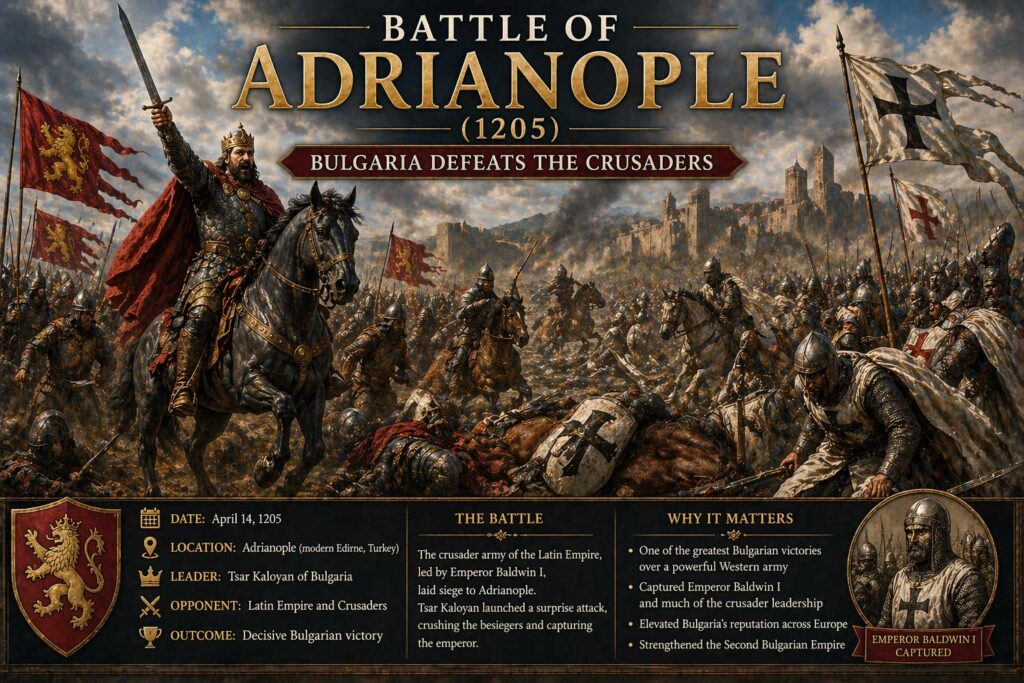
- Leader: Kaloyan of Bulgaria
- Opponent: Latin Empire
- Outcome: Decisive Bulgarian victory
The Battle of Adrianople, fought on 14 April 1205, stands as one of the most remarkable victories in medieval Bulgarian history. It pitted Bulgaria against the Crusader forces of the Latin Empire, formed after the Fourth Crusade seized Constantinople.
Facing heavily armored Western knights, Kaloyan employed a brilliant and unconventional strategy. He used allied Cuman light cavalry to harass and bait the Crusaders into pursuit. As the knights charged forward, they were drawn into unfavorable terrain, where their heavy armor and rigid formations became a liability.
At the decisive moment, Bulgarian forces launched a counterattack, surrounding and crushing the Crusader army. The result was catastrophic for the Latin Empire—its emperor, Baldwin I, was captured and later died in captivity.
Why it matters
This battle remains one of the most important key battles in Bulgarian history because it marked a decisive turning point in Bulgaria’s development.
- One of the rare major defeats of Crusader armies in Europe
- Captured a Western emperor, shocking medieval Europe
- Demonstrated Bulgaria’s ability to defeat elite heavy cavalry
- Elevated Bulgaria as a dominant Balkan power
Historical Impact
The victory at Adrianople reshaped the balance of power in southeastern Europe. It weakened the Latin Empire significantly and strengthened Bulgaria’s political and military position.
Kaloyan’s success proved that strategic thinking and adaptability could overcome even the most feared armies of the time, securing his place among Bulgaria’s greatest rulers.
The Battle of Adrianople, where Kaloyan secured a major victory for Bulgaria, shocked medieval Europe.
👉 Under Kaloyan of Bulgaria, the army achieved one of its greatest victories.
Battle of Klokotnitsa (1230) — Bulgaria Becomes a Balkan Superpower
- Leader: Ivan Asen II
- Opponent: Theodore Komnenos Doukas
- Outcome: Decisive Bulgarian victory
The Battle of Klokotnitsa, fought on 9 March 1230, is one of the most important victories in Bulgarian history and a defining moment of the Second Bulgarian Empire. The conflict took place near the village of Klokotnitsa in southern Bulgaria, where Tsar Ivan Asen II faced the forces of Theodore Komnenos Doukas, who had broken a prior alliance and invaded Bulgarian territory.
Instead of waiting, Ivan Asen II moved quickly—leading his army on a rapid march to intercept the invading forces. The Bulgarians attacked before the enemy could properly organize, catching them off guard and decisively defeating them. Theodore himself was captured, effectively ending his ambitions in the region.
A powerful symbol from this battle is Ivan Asen II reportedly carrying the broken treaty on his spear, demonstrating both the cause of the war and the justice of his response.
👉 The victory was led by Ivan Asen II, one of Bulgaria’s greatest rulers.
Why it matters
- Established Bulgaria as the dominant power in the Balkans
- Expanded Bulgarian territory significantly
- Captured a major rival ruler
- Marked the peak of the Second Bulgarian Empire
Historical Impact
Following Klokotnitsa, Bulgaria reached one of its greatest heights. Its influence stretched across large parts of the Balkans, and it became the central political force in southeastern Europe. Unlike many rulers of the time, Ivan Asen II also demonstrated diplomatic skill—integrating conquered territories without unnecessary destruction.
This victory was not just a battlefield success—it was a turning point that reshaped the balance of power in the region.
Battle of Velbazhd (1330) — A Turning Point in Decline
- Leader: Michael Shishman
- Opponent: Stefan Uroš III Dečanski
- Outcome: Bulgarian defeat
The Battle of Velbazhd, fought on 28 July 1330 near present-day Kyustendil, was one of the most decisive defeats in medieval Bulgarian history. It occurred during a period of intense rivalry between Bulgaria and Serbia, both competing for dominance in the Balkans.
Despite having a strong and well-positioned army, Bulgaria suffered from poor coordination and delayed engagement. While negotiations were still ongoing, Serbian reinforcements unexpectedly arrived. Seizing the opportunity, the Serbian forces launched a sudden and powerful attack that caught the Bulgarians unprepared.
The battle quickly turned into a disaster. Bulgarian lines collapsed, and Tsar Michael Shishman was mortally wounded, leaving the army without leadership at a critical moment.
👉 This battle was part of the broader medieval Balkan conflicts that reshaped the region.
Why it matters
- Marked a major turning point in Bulgaria’s decline
- Shifted regional power toward Serbia
- Weakened Bulgaria politically and militarily
- Contributed to future vulnerability against the Ottoman Empire
Historical Impact
The defeat at Velbazhd reshaped the balance of power in the Balkans. Serbia emerged as a dominant regional force, while Bulgaria entered a period of internal instability and reduced influence.
Although Bulgaria would achieve some later successes, the loss at Velbazhd significantly weakened its ability to resist external threats. This decline played a key role in the eventual expansion of the Ottoman Empire into the region.
Battle of Rusokastro (1332) — The Last Great Medieval Victory
- Leader: Ivan Alexander
- Opponent: Andronikos III Palaiologos
- Outcome: Bulgarian victory
The Battle of Rusokastro, fought in 1332, is widely regarded as one of the last major victories of medieval Bulgaria against the Byzantine Empire. Taking place near the fortress of Rusokastro in southeastern Bulgaria, the battle was part of a broader struggle for control over Thrace.
Tsar Ivan Alexander acted decisively, reinforcing his army and coordinating movements to confront the Byzantine forces before they could fully consolidate their position. The battle resulted in a Bulgarian victory, forcing Byzantium to negotiate and recognize Bulgarian territorial gains.
👉 This victory represents one of the final successes of late medieval Bulgaria.
Why it matters
- One of the final significant victories before Ottoman expansion
- Strengthened the rule of Ivan Alexander
- Secured territorial advantages in Thrace
- Demonstrated that Bulgaria remained a capable military power even in its later medieval period
Historical Context
Although Rusokastro was a success, it came during a time of growing instability in the Balkans. Internal divisions and rising external threats—particularly from the advancing Ottoman forces—would soon overshadow Bulgaria’s military achievements.
This makes the victory at Rusokastro especially important: it represents a final moment of strength before a period of decline and conquest.
The Ottoman Conquest of Bulgaria (1393–1396) — The Fall of Medieval Bulgaria
- Conflict: Expansion of the Ottoman Empire into the Balkans
- Key Events: Fall of Tarnovo (1393), defeat at Battle of Nicopolis
- Outcome: End of Bulgarian independence
The Ottoman conquest of Bulgaria was not a single battle but a series of decisive campaigns that led to the collapse of the medieval Bulgarian state. By the late 14th century, Bulgaria was politically fragmented and weakened, divided into smaller kingdoms and principalities that struggled to coordinate resistance.
The most critical moment came in 1393, when the Ottomans besieged and captured Tarnovo, the capital of the Second Bulgarian Empire. Despite strong fortifications and resistance, the city fell after a prolonged siege, marking a symbolic and political collapse.
👉 This marked the beginning of Ottoman rule in Bulgaria, which lasted nearly five centuries.
Three years later, in 1396, the final attempt to stop Ottoman expansion came at the Battle of Nicopolis, where a coalition of European crusaders and regional forces was decisively defeated. This defeat effectively ended organized resistance and confirmed Ottoman control over Bulgarian lands.
Why it matters
- Marked the end of the Second Bulgarian Empire
- Beginning of nearly 500 years of Ottoman rule
- Reshaped the political and cultural landscape of Bulgaria
- Set the stage for later resistance and national revival
Historical Impact
The Ottoman conquest changed Bulgaria in fundamental ways:
- Loss of political independence
- Integration into the Ottoman administrative system
- Preservation of culture through religion, language, and tradition
Despite the loss of statehood, Bulgarian identity survived through centuries of foreign rule, ultimately leading to the national revival and liberation in the 19th century.
Battle of Shipka Pass (1877–1878) — The Symbol of Liberation
- Conflict: Russo-Turkish War (1877–1878)
- Forces: Bulgarian volunteers (Opalchentsi) + Russian army vs Ottoman Empire
- Outcome: Defensive victory
The Battle of Shipka Pass is one of the most iconic and emotionally powerful events in Bulgarian history. Fought in the harsh conditions of the Balkan Mountains, it was not a single battle but a series of fierce clashes centered around control of the strategically vital Shipka Pass.
👉 This battle was part of the larger Russo-Turkish War, which led to Bulgaria’s liberation.
Bulgarian volunteers, known as the Opalchentsi, fought alongside Russian forces to defend the narrow mountain pass against repeated Ottoman assaults. Despite being outnumbered and facing extreme weather, they held their ground using high-ground advantage, improvised defenses, and extraordinary determination.
At critical moments, when ammunition ran low, defenders reportedly used stones and anything available to repel attacks—turning the battle into a symbol of sacrifice and resilience.
👉 The Battle of Shipka Pass during the Russo-Turkish War in Bulgaria became a symbol of national liberation and sacrifice.
Why it matters
- Played a decisive role in blocking Ottoman reinforcements
- Key turning point in Bulgaria’s liberation
- Became a national symbol of courage, unity, and sacrifice
- Led to the re-establishment of the Bulgarian state in 1878
14. Siege of Adrianople (1912–1913) — Modern Military Power
- Conflict: First Balkan War
- Forces: Bulgarian Army (with Serbian support) vs Ottoman Empire
- Outcome: Bulgarian victory
The Siege of Adrianople (modern Edirne) was one of the most significant military operations of the Balkan Wars and a defining moment for modern Bulgaria. The city was one of the Ottoman Empire’s strongest fortified positions in Europe, protected by advanced defensive systems, artillery, and entrenched forces.
Bulgarian troops launched a coordinated siege using modern artillery, engineering tactics, and night assaults—marking a shift from medieval-style warfare to modern military strategy. The final assault in March 1913 successfully broke through Ottoman defenses and captured the city.
This victory shocked Europe. It demonstrated that Bulgaria was not just historically strong—but also a modern, capable military power able to defeat a major empire using advanced tactics.
Why it matters
- Major success in the Balkan Wars
- Showed modern Bulgarian military strength
- Demonstrated effective use of artillery and coordinated assaults
- Boosted Bulgaria’s status as a leading regional power
👉 This battle was one of the most important victories of the Balkan Wars.
15. Battle of Doiran (WWI) — Discipline Under Fire
- Leader: Vladimir Vazov
- Opponent: Allied Powers (primarily British and Greek forces)
- Outcome: Defensive Bulgarian victory
The Battle of Doiran stands as one of the most impressive defensive operations in modern Bulgarian military history. Fought between 1916 and 1918 near Lake Doiran, it reached its peak during the Allied offensives of 1917 and 1918, when Bulgarian forces under General Vladimir Vazov successfully held their positions against repeated attacks.
👉 The defense at Doiran remains one of the most impressive moments in World War I and Bulgaria.
The Allies launched large-scale assaults supported by heavy artillery, expecting to break through Bulgarian lines. Instead, they encountered one of the most well-prepared defensive systems on the Balkan Front. Bulgarian troops used fortified trenches, strategic positioning, and disciplined coordination to repel wave after wave of attacks, inflicting heavy casualties.
Why it matters
- Demonstrated exceptional defensive strategy and discipline
- Inflicted significant losses on Allied forces
- Preserved Bulgarian military reputation during World War I
Despite Bulgaria’s eventual defeat in World War I, the defense at Doiran became a symbol of professionalism, resilience, and tactical excellence. General Vladimir Vazov was later honored even by former enemies, including British officers, for his leadership and effectiveness—an extraordinary recognition in military history.
These battles—including Ongal, Pliska, Achelous, Klokotnitsa, Adrianople, and Shipka Pass—are among the most important moments in Bulgarian history.
Timeline of Key Battles in Bulgarian History
This timeline highlights the most important key battles in Bulgarian history, showing how Bulgaria evolved across centuries.
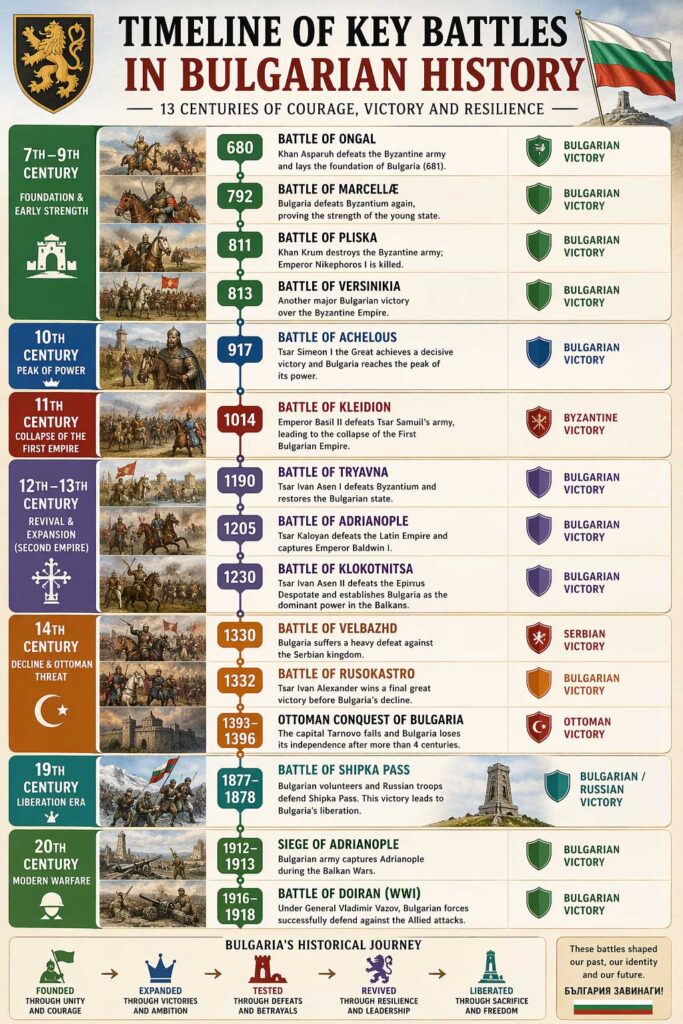
Here is a clear chronological timeline of the key battles in Bulgarian history, showing how the nation evolved from its founding to modern times:
7th–9th Century: Foundation & Early Strength
- 680 – Battle of Ongal
Victory by Asparuh leads to the founding of Bulgaria (681) - 792 – Battle of Marcellae
Bulgaria defeats Byzantium again, proving long-term stability - 811 – Battle of Pliska
Krum destroys the Byzantine army; Emperor Nikephoros I killed - 813 – Battle of Versinikia
Another major Bulgarian victory over Byzantium
10th Century: Peak of Power
- 917 – Battle of Achelous
Simeon I the Great secures one of the greatest victories in medieval Europe
11th Century: Collapse of the First Empire
- 1014 – Battle of Kleidion
Basil II defeats Samuil of Bulgaria, leading to the fall of the First Bulgarian Empire
12th–13th Century: Revival & Expansion (Second Empire)
- 1190 – Battle of Tryavna
Ivan Asen I secures the restored Bulgarian state - 1205 – Battle of Adrianople
Kaloyan of Bulgaria defeats the Latin Empire and captures Emperor Baldwin I - 1230 – Battle of Klokotnitsa
Ivan Asen II establishes Bulgaria as the dominant Balkan power
14th Century: Decline & Ottoman Threat
- 1330 – Battle of Velbazhd
Bulgaria suffers a major defeat against Serbia - 1332 – Battle of Rusokastro
Final major Bulgarian victory before decline - 1393–1396 – Ottoman Conquest of Bulgaria
Fall of Tarnovo and end of independence
19th Century: Liberation Era
- 1877–1878 – Battle of Shipka Pass
Critical defense during the Russo-Turkish War (1877–1878) leads to Bulgaria’s liberation
20th Century: Modern Warfare
- 1912–1913 – Siege of Adrianople
Major Bulgarian victory in the Balkan Wars - 1916–1918 – Battle of Doiran
Vladimir Vazov leads a successful defense against Allied forces
Why This Timeline Matters
This timeline shows a clear historical cycle:
- Foundation → Expansion → Collapse → Revival → Liberation
It highlights how Bulgaria:
- Emerged as a powerful medieval empire
- Survived devastating defeats
- Rebuilt itself multiple times
- Ultimately regained independence
👉 This makes Bulgarian history one of the most resilient and dynamic in Europe.
Why These Battles Still Matter Today
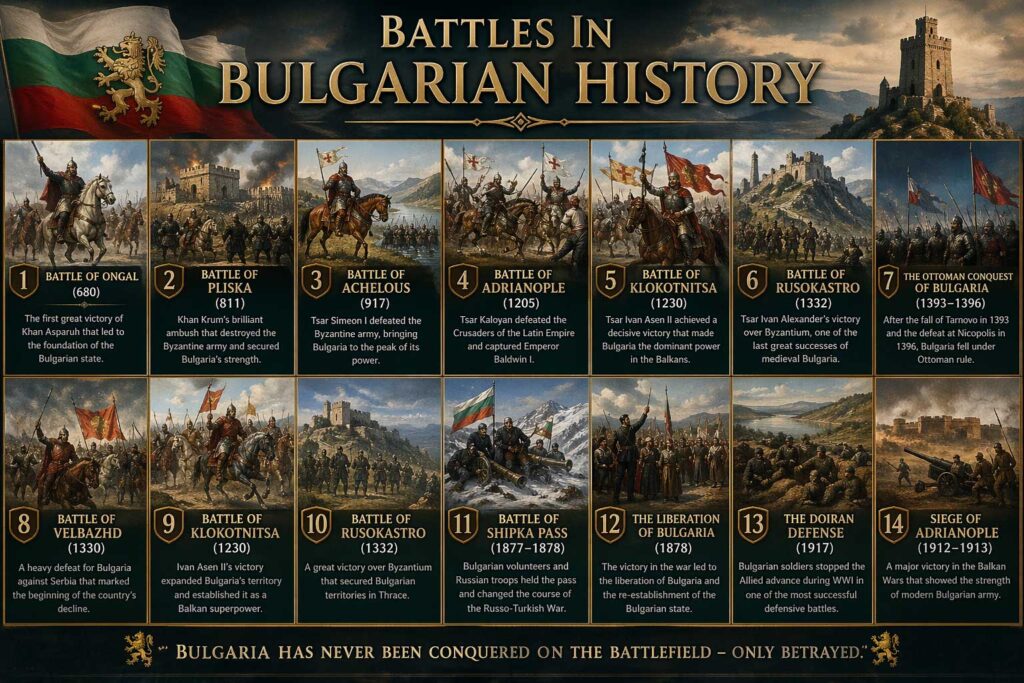
The key battles in Bulgarian history are not just events from the past—they continue to shape Bulgaria’s identity, culture, and global perception today. Their importance goes far beyond military outcomes, influencing how Bulgarians understand their history, resilience, and place in Europe.
1. They Define National Identity
Battles such as Ongal, Achelous, Klokotnitsa, and Shipka Pass are deeply embedded in Bulgarian national consciousness. They represent moments when the nation was created, defended, or reborn. Figures like Asparuh, Simeon I the Great, and Ivan Asen II are remembered not only as rulers, but as symbols of strength and leadership.
2. They Show a Pattern of Resilience
Bulgarian history is not a straight line of success—it is a cycle of rise, fall, and revival:
- Rise during the First Bulgarian Empire
- Collapse after battles like Kleidion
- Revival during the Second Bulgarian Empire
- Liberation after centuries of Ottoman rule
This pattern makes Bulgaria’s story one of the most resilient in Europe.
3. They Influence Modern Culture and Traditions
Many of these battles are still honored through:
- National holidays
- Monuments like Shipka Pass
- Literature and folklore
- School education and historical memory
For example, the defense of Shipka Pass is taught as a symbol of sacrifice and unity.
4. They Demonstrate Strategic and Military Excellence
Bulgarian victories often came against stronger enemies:
- Krum’s ambush tactics at Pliska
- Simeon’s strategy at Achelous
- Kaloyan’s defeat of Crusaders
- Defensive mastery at Doiran
These battles are still studied as examples of:
- Terrain advantage
- Strategic planning
- Military discipline
5. They Explain Bulgaria’s Role in European History
Bulgaria was not a passive region—it was a major force shaping Europe:
- A key rival of the Byzantine Empire
- A barrier to Ottoman expansion into Central Europe
- A participant in major European conflicts
Understanding these battles helps explain Bulgaria’s historical importance beyond the Balkans.
6. They Inspire Modern Generations
These battles continue to inspire pride and national awareness. They remind people that:
- Bulgaria survived powerful empires
- It rebuilt itself multiple times
- Its independence was earned through sacrifice
This legacy is especially important in today’s global world, where cultural identity remains a key part of national strength.
The key battles in Bulgarian history still matter because they are not just about war—they are about survival, identity, and resilience. They explain how Bulgaria was built, how it endured, and why it continues to exist as a nation today.
👉 Without these battles, there would be no Bulgaria as we know it.
Bulgarian Military Strategy: How Bulgaria Defeated Stronger Empires
The key battles in Bulgarian history show that Bulgaria’s victories were not based on size or numbers—they were based on strategy, terrain, and adaptability. Across centuries, Bulgarian commanders consistently defeated stronger enemies by using smarter and more efficient military tactics.
1. Terrain Advantage
Bulgarian leaders carefully chose battlegrounds where enemy numbers meant less.
- Ongal (680) — marshland neutralized Byzantine formations
- Pliska (811) — mountain pass ambush destroyed a retreating army
- Shipka Pass (1877–1878) — high-ground defense stopped Ottoman advance
👉 Understanding the Geography of Bulgaria is essential to explaining these victories.
2. Ambush and Deception
Surprise was a defining element of Bulgarian warfare.
- Krum used traps and timing at Pliska
- Kaloyan lured Crusaders into overextension at Adrianople
3. Mobility and Cavalry
Early Bulgarian armies relied on speed.
- Fast cavalry disrupted formations
- Flanking attacks decided battles like Achelous
4. Defensive Mastery
When outnumbered, Bulgarians excelled in defense.
- Fortified passes
- Natural barriers
- Advanced trench systems (Doiran)
5. Leadership and Adaptability
Strong leadership turned tactics into victories.
- Simeon the Great → coordinated large-scale attacks
- Ivan Asen II → fast decisive strikes
- Vladimir Vazov → modern defensive warfare
Bulgaria did not win by being stronger—it won by being smarter, faster, and strategically superior.
👉 These tactics are a key part of Bulgarian military history and explain many of its victories.
Geography and Warfare: Why Bulgaria’s Terrain Was Critical
Bulgaria’s greatest victories were rarely about numbers—they were about strategy, timing, and intelligent use of terrain. Against larger powers like the Byzantine Empire and later the Ottoman Empire, Bulgarian commanders consistently turned disadvantages into decisive advantages.
1. Mastery of Terrain
Bulgarian leaders chose battlegrounds carefully—marshes, mountain passes, and narrow valleys where enemy numbers meant less.
- Ongal (680) — marshland neutralized Byzantine formations
- Pliska (811) — mountain pass ambush destroyed a retreating army
- Shipka Pass (1877–1878) — high ground defense stopped Ottoman advance
2. Ambush and Deception
Surprise was a core element of Bulgarian warfare.
- Krum used traps and timing to destroy superior forces
- Kaloyan of Bulgaria lured Crusader knights into overextension at Adrianople
3. Mobile Cavalry Advantage
Early Bulgarian armies relied heavily on fast-moving cavalry.
- Hit-and-run tactics disrupted larger formations
- Mobility allowed quick flanking and encirclement
4. Strong Defensive Systems
Bulgarian forces excelled in defense when needed:
- Fortified mountain passes
- Layered trench systems (especially at Doiran in WWI)
- Use of natural barriers like rivers and ridges
5. Leadership and Adaptability
Great rulers adapted tactics to their enemies:
- Simeon I the Great used large-scale coordination and decisive strikes
- Ivan Asen II combined diplomacy with military precision
- Vladimir Vazov modernized defensive warfare
👉 Key takeaway: Bulgaria didn’t win by being stronger—it won by being smarter, faster, and more strategic.
👉 Understanding the Geography of Bulgaria is essential to explaining how these battles were won.
Most Important Bulgarian Rulers in Battle History
Bulgaria’s military success in the key battles in Bulgarian history is closely tied to the leadership of its rulers. These figures shaped the outcome of the key battles in Bulgarian history.
Asparuh — The Founder
- Victory at Ongal (680)
- Established the Bulgarian state
- Set the foundation for future power
Krum — The Fearless Strategist
- Victories at Pliska (811) and Versinikia (813)
- Known for decisive and brutal warfare
- Elevated Bulgaria to major regional power
Simeon I the Great — The Empire Builder
- Victory at Achelous (917)
- Led Bulgaria during its Golden Age
- Combined military and cultural dominance
Samuil of Bulgaria — The Defender
- Fought prolonged wars against Byzantium
- Despite defeat at Kleidion, symbol of resistance
Ivan Asen I — The Restorer
- Victory at Tryavna (1190)
- Helped restore Bulgarian independence
Kaloyan of Bulgaria — The Crusader Slayer
- Victory at Adrianople (1205)
- Defeated Western Crusaders
- Elevated Bulgaria internationally
Ivan Asen II — The Peak of Power
- Victory at Klokotnitsa (1230)
- Made Bulgaria dominant in the Balkans
Ivan Alexander — The Last Strong Ruler
- Victory at Rusokastro (1332)
- Maintained stability before Ottoman conquest
Vladimir Vazov — The Modern Defender
- Defense at Doiran (WWI)
- Respected even by enemies
- Symbol of modern military excellence
These rulers prove that Bulgaria’s victories were not accidental—they were the result of leadership, strategy, and deep understanding of warfare. Their decisions shaped not only battles, but the entire course of Bulgarian history.
FAQ: Key Battles in Bulgarian History
What is the most important battle in Bulgarian history?
The most important battle in Bulgarian history is generally considered the Battle of Ongal (680), one of the earliest key battles in Bulgarian history that led to the founding of Bulgaria. This victory forced the Byzantine Empire to recognize Bulgaria, leading directly to the founding of the Bulgarian state in 681.
Which Bulgarian ruler won the Battle of Klokotnitsa?
The Battle of Klokotnitsa (1230) was won by Ivan Asen II. His victory established Bulgaria as the dominant power in the Balkans during the height of the Second Bulgarian Empire.
Why was the Battle of Adrianople (1205) important?
The Battle of Adrianople (1205) was important because Kaloyan of Bulgaria defeated the Latin Empire and captured Emperor Baldwin I. This proved that Bulgaria could defeat elite Crusader armies and significantly increased its influence in Europe.
What battle led to Bulgaria’s liberation from Ottoman rule?
The defense of Shipka Pass (1877–1878) during the Russo-Turkish War (1877–1878) was crucial for Bulgaria’s liberation. Bulgarian volunteers and Russian forces successfully held the pass against Ottoman attacks, helping secure the re-establishment of Bulgaria in 1878.
What was Bulgaria’s greatest medieval victory?
One of Bulgaria’s greatest medieval victories was the Battle of Achelous (917), led by Simeon I the Great. It resulted in a devastating defeat for the Byzantines and marked the peak of Bulgaria’s power during the Bulgarian Golden Age.
Which battle caused the fall of the First Bulgarian Empire?
The Battle of Kleidion (1014), where Basil II defeated Samuil of Bulgaria, significantly weakened Bulgaria and led to the eventual collapse of the First Bulgarian Empire in 1018.
What battle secured the Second Bulgarian Empire?
The Battle of Tryavna (1190), led by Ivan Asen I, secured the independence of Bulgaria after the uprising against Byzantium and helped establish the Second Bulgarian Empire.
Did Bulgaria defeat Crusaders in history?
Yes, Bulgaria defeated Crusader forces at the Battle of Adrianople (1205) under Kaloyan of Bulgaria. This was one of the few major defeats of Crusader armies in Eastern Europe.
What is the last major medieval Bulgarian victory?
The Battle of Rusokastro (1332), led by Ivan Alexander, is considered one of the last major victories before the Ottoman conquest.
Why are these battles important today?
These battles are important because they shaped Bulgaria’s borders, identity, and independence. They represent key moments of survival, power, and national revival that continue to influence Bulgarian culture and historical memory.
Conclusion: Bulgaria Forged Through Battle
The key battles in Bulgarian history reveal a clear national pattern of struggle, survival, and revival. Each major victory or defeat marked a turning point in the story of the Bulgarian state.
- Ongal gave birth to Bulgaria.
- Achelous showed its peak power.
- Kleidion marked a devastating collapse.
- Tryavna and Klokotnitsa proved Bulgaria could rise again.
- Shipka Pass became the symbol of liberation and national rebirth.
Together, these battles show that Bulgaria was not shaped only by rulers, treaties, or dynasties, but by moments when the nation’s fate was decided on the battlefield. They remain more than historical events—they are lasting symbols of Bulgarian identity, endurance, and pride.
These battles are not just history—they are proof that even a smaller nation, through strategy and resilience, can shape the course of an entire region.
Bulgaria’s history proves that resilience, strategy, and leadership can overcome even the greatest empires.
👉 These battles help explain why Bulgaria’s culture is so unique and deeply rooted in resilience.
Best Books on Bulgarian History
Affiliate Disclosure: Some links above may be affiliate links. This means we may earn a small commission at no extra cost to you.
| Product | Best For | Why It’s Useful | Check Price |
|---|---|---|---|
| History of Bulgaria Book | Beginners | Covers all major battles | Check Price |
| Medieval Balkans Guide | Deep research | Context for wars | Check Price |
| European Battle Atlas | Visual learners | Maps & battle locations | Check Price |
| Bulgarian War Documentary | Casual viewers | Easy learning format | Check Price |
References
- Encyclopaedia Britannica. “Bulgaria.” https://www.britannica.com/place/Bulgaria
- Encyclopaedia Britannica. “Battle of Adrianople (1205).” https://www.britannica.com/biography/Baldwin-I-Byzantine-emperor
- Encyclopaedia Britannica. “Siege of Adrianople (1912–1913).” https://www.britannica.com/event/Siege-of-Adrianople-1912-13
- Encyclopaedia Britannica. “Shipka Pass.” https://www.britannica.com/place/Shipka-Pass
- Wikipedia. “Battle of Ongal.” https://en.wikipedia.org/wiki/Battle_of_Ongal
- Wikipedia. “Battle of Marcellae.” https://en.wikipedia.org/wiki/Battle_of_Marcellae
- Wikipedia. “Battle of Pliska.” https://en.wikipedia.org/wiki/Battle_of_Pliska
- Wikipedia. “Battle of Versinikia.” https://en.wikipedia.org/wiki/Battle_of_Versinikia
- Wikipedia. “Battle of Achelous.” https://en.wikipedia.org/wiki/Battle_of_Achelous
- Wikipedia. “Battle of Kleidion.” https://en.wikipedia.org/wiki/Battle_of_Kleidion
- Wikipedia. “Battle of Tryavna.” https://en.wikipedia.org/wiki/Battle_of_Tryavna
- Wikipedia. “Battle of Adrianople (1205).” https://en.wikipedia.org/wiki/Battle_of_Adrianople_(1205)
- Wikipedia. “Battle of Klokotnitsa.” https://en.wikipedia.org/wiki/Battle_of_Klokotnitsa
- Wikipedia. “Battle of Velbazhd.” https://en.wikipedia.org/wiki/Battle_of_Velbazhd
- Wikipedia. “Battle of Rusokastro.” https://en.wikipedia.org/wiki/Battle_of_Rusokastro
- Wikipedia. “Battle of Shipka Pass.” https://en.wikipedia.org/wiki/Battle_of_Shipka_Pass
- Wikipedia. “Siege of Adrianople.” https://en.wikipedia.org/wiki/Siege_of_Adrianople_(1912%E2%80%931913)
- Wikipedia. “Battle of Doiran.” https://en.wikipedia.org/wiki/Battle_of_Doiran