


Forgotten Bulgarian space achievements represent a fascinating yet often overlooked chapter in the history of global space exploration. While superpowers like the United States and the Soviet Union dominate most narratives, smaller nations like Bulgaria made meaningful scientific contributions that helped expand humanity’s understanding of space. These achievements, developed during the Cold War era, played a role in advancing research in biology, medicine, and technology beyond Earth.
Despite their importance, many of these accomplishments remain largely unknown outside specialized circles. Through international collaboration, innovative experiments, and the work of dedicated scientists, Bulgaria contributed to key developments in microgravity research, astronaut nutrition, and space medicine. This article uncovers those forgotten Bulgarian space achievements and highlights their lasting impact on modern space science.
When discussing the history of space exploration, most people think of major space powers such as the United States or Russia. However, several smaller countries also made important contributions to scientific research in space. Among them is Bulgaria, a nation that played a meaningful role in space science during the Cold War.
👉 These discoveries are part of a broader legacy of Bulgarian Scientific Achievements, innovations, and technological breakthroughs that continue to influence modern science.
Through its participation in international programs and the work of Bulgarian scientists, the country contributed to space medicine, biological research, astronaut nutrition, and microgravity experiments. Yet many of these accomplishments remain largely forgotten outside specialized scientific circles.
👉 From astronaut missions to cutting-edge scientific experiments, these forgotten Bulgarian space achievements reveal how a small nation made a lasting impact on global space exploration.
These forgotten Bulgarian space achievements highlight how Bulgaria contributed to global space exploration in ways that are still relevant today.
This article explores forgotten Bulgarian space achievements that demonstrate the country’s role in humanity’s exploration of space.
Bulgaria Became One of the Few Countries with Astronauts
One of Bulgaria’s most notable achievements was becoming one of the relatively small number of nations to send astronauts into space. During the Cold War era, spaceflight was limited to only a handful of countries, making Bulgaria’s participation a remarkable milestone in global space history.
The first Bulgarian astronaut was Georgi Ivanov, who flew aboard the Soyuz 33 in 1979. His mission was part of the Interkosmos Program, which enabled scientists and astronauts from allied countries to participate in space exploration.
Although a technical malfunction prevented the spacecraft from docking with the Salyut 6, the mission remains a historic achievement. Ivanov’s successful journey into orbit demonstrated Bulgaria’s ability to participate in advanced space missions and marked the country’s official entry into human spaceflight.
👉 Learn more → Georgi Ivanov – Bulgaria’s First Astronaut.
Nearly a decade later, Bulgaria reached another milestone when Alexander Alexandrov became the second Bulgarian astronaut. In 1988, he traveled aboard the Soyuz TM-5 to the Mir Space Station, where he conducted a range of scientific experiments in microgravity.
👉 Explore his mission → Alexander Alexandrov – Bulgaria’s Second Cosmonaut
This mission was far more successful in terms of scientific output, as Alexandrov participated in experiments related to biology, physics, and materials science. His work contributed valuable data to ongoing research efforts and highlighted Bulgaria’s growing role in international space science.
These missions remain among the most important forgotten Bulgarian space achievements in history.
👉 Discover more → Bulgarian Space and Science Contributions.
Bulgarian Scientific Experiments in Orbit
One of the most important yet lesser-known achievements of Bulgarian space research involved the development of scientific experiments conducted in microgravity.
Bulgarian scientists designed experiments focusing on:
- biological processes in space
- plant growth without gravity
- cellular changes in microgravity
- material crystallization
These experiments helped scientists understand how living organisms and materials behave in space environments.
Bulgaria’s Space Food Innovations
Bulgarian researchers also made important contributions to the development of space food technologies.
Scientists created specialized foods that were designed to:
- remain stable during long missions
- provide balanced nutrition
- occupy minimal storage space aboard spacecraft
These foods included freeze-dried meals and nutrient-rich food tubes.
Technologies developed during this research later influenced food preservation systems used in:
- astronaut meals
- emergency food supplies
- military rations
- outdoor survival food
Many of these forgotten Bulgarian space achievements laid the foundation for modern space research.
These innovations are another example of forgotten Bulgarian space achievements that continue to impact modern technology.
👉 These innovations connect to broader advancements in → Bulgarian Contributions to Medicine and Science.
Cold War Context of Bulgarian Space Achievements
Bulgaria’s role in space exploration cannot be fully understood without considering the broader context of the Cold War. During this period, space exploration became a powerful symbol of technological superiority and national prestige.
The rivalry between the United States and the Soviet Union drove rapid advancements in space technology. As a close ally of the Soviet Union, Bulgaria gained access to scientific programs and collaborative initiatives that allowed it to participate in this global competition.
Rather than developing an independent space program, Bulgaria contributed through specialized research, engineering, and scientific experimentation. This approach allowed the country to focus on high-impact areas such as space medicine, materials science, and food technology.
👉 Learn more → Bulgarian Science and Technology History.
This strategic collaboration enabled Bulgaria to achieve results that would have been difficult to accomplish alone, placing it among the notable contributors to space exploration during the 20th century.
The Interkosmos Program
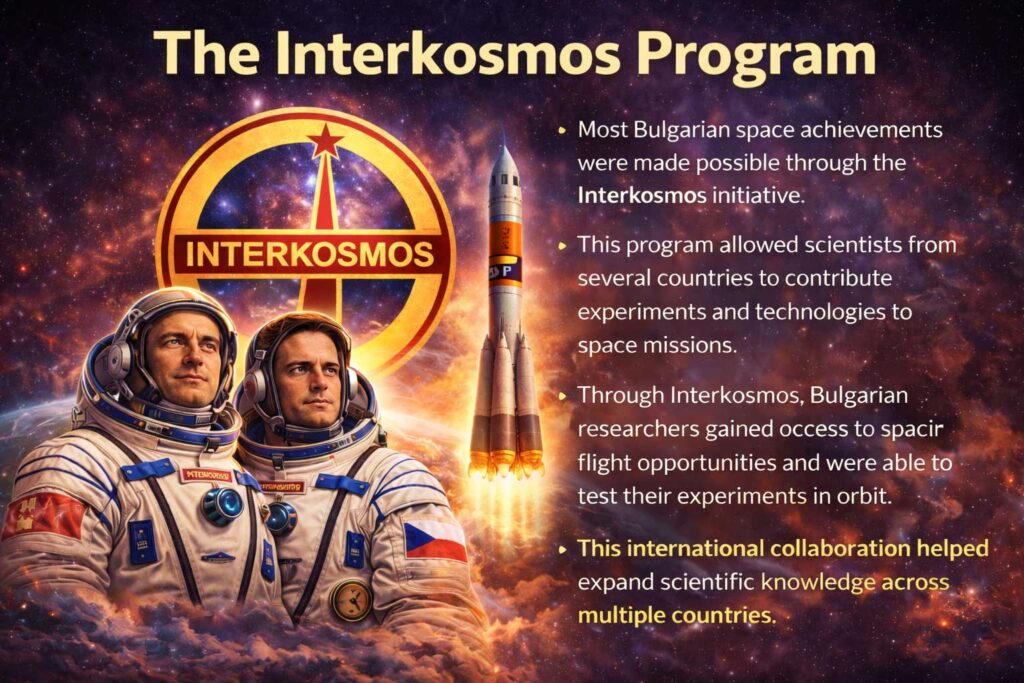
Most Bulgarian space achievements were made possible through the Interkosmos initiative, a Soviet-led international program that enabled collaboration in space exploration among allied nations during the Cold War.
This program allowed scientists, engineers, and astronauts from multiple countries to contribute experiments, technologies, and research to joint space missions. Instead of developing independent space programs, participating nations like Bulgaria were able to integrate their expertise into larger Soviet missions.
Through Interkosmos, Bulgarian researchers gained access to real spaceflight opportunities—something that would have been nearly impossible otherwise. They were able to design and test scientific experiments in orbit, particularly in areas such as biology, medicine, and materials science.
This collaboration not only accelerated Bulgaria’s scientific development but also helped expand global knowledge about how life and materials behave in space. By combining the efforts of multiple countries, the program created a shared foundation of research that benefited the entire scientific community.
👉 Discover how the Interkosmos Program enabled countries like Bulgaria to participate in space missions and contribute to global scientific progress.
Without this program, many forgotten Bulgarian space achievements would not have been possible.
Bulgarian Contributions to Space Medicine
Another often overlooked achievement involves Bulgaria’s important role in the development of space medicine—a field focused on understanding how spaceflight affects the human body. During the Cold War era, Bulgarian scientists played a key part in researching the physiological challenges astronauts face in microgravity environments.
Through participation in the Interkosmos Program, Bulgarian researchers were able to conduct experiments in real space conditions, contributing valuable data to international studies on human health in orbit.
Key Areas of Research
Bulgarian scientists focused on several critical aspects of human physiology, including:
- Cardiovascular changes – studying how the heart and blood circulation adapt in microgravity
- Muscle strength – analyzing muscle loss due to reduced physical load
- Bone density – understanding calcium loss and skeletal weakening in space
- Metabolic processes – examining how the body processes nutrients and energy in orbit
These studies helped scientists better understand the risks associated with long-duration space missions and how to mitigate them.
Why This Research Matters
In a microgravity environment, the human body undergoes significant changes that can impact astronaut health and mission success. Without gravity, muscles weaken, bones lose density, and bodily fluids shift toward the upper body.
Bulgarian contributions to space medicine provided insights that helped:
- Improve astronaut training programs
- Develop countermeasures such as exercise routines
- Enhance nutritional planning for space missions
- Support long-term human presence in space
👉 Explore related breakthroughs → History of Bulgarian Scientific Achievements
Lasting Impact on Modern Space Exploration
The research conducted by Bulgarian scientists continues to influence modern space medicine today. As space agencies prepare for missions to the Moon, Mars, and beyond, understanding how the human body adapts to extreme environments remains a top priority.
Data gathered through early experiments has contributed to ongoing advancements in:
- Space health monitoring systems
- Rehabilitation techniques for astronauts
- Medical protocols for long-duration missions
👉 Learn more about the broader scientific legacy → Bulgarian Scientists Who Changed Medicine.
From Space to Earth Applications
Interestingly, many discoveries in space medicine have also had practical applications on Earth. Research on muscle atrophy and bone density loss has contributed to medical treatments for conditions such as osteoporosis and physical rehabilitation.
This demonstrates how Bulgarian contributions to space science extend beyond exploration and into everyday healthcare improvements.
These discoveries remain some of the most valuable forgotten Bulgarian space achievements in medical research.
👉 Continue exploring → Bulgarian Contributions to Medicine and Science
Bulgarian Materials Science Experiments
Bulgarian researchers also made significant contributions to materials science by investigating how different substances behave in the absence of gravity. Through participation in the Interkosmos Program, Bulgarian scientists were able to conduct experiments in microgravity—an environment that cannot be fully replicated on Earth.
In microgravity conditions, materials often behave very differently. Without the influence of gravity, processes such as convection, sedimentation, and phase separation are minimized, allowing scientists to observe more uniform and controlled material formation. This makes space an ideal laboratory for studying the fundamental properties of matter.
Key Areas of Research
Bulgarian experiments focused on several important areas, including:
- Crystal formation – studying how crystals grow more uniformly in space, leading to higher purity and fewer defects
- Metal solidification – analyzing how metals cool and solidify without gravitational distortion
- Molecular structure changes – observing how molecules arrange and interact in microgravity environments
These experiments provided valuable insights into the physical and chemical behavior of materials under unique conditions.
Why This Research Matters
Understanding how materials behave in space has major implications for both science and industry. The findings from Bulgarian-led experiments contributed to advancements in:
- Semiconductor manufacturing – improving the quality of electronic components
- Pharmaceutical development – enabling better crystal structures for drug design
- Advanced materials engineering – creating stronger, lighter, and more efficient materials
👉 Explore more innovations → Bulgarian Technology Used in Space Missions.
Lasting Impact
The knowledge gained from these experiments continues to influence modern technologies. Many of the principles discovered through microgravity research are now applied in industries ranging from electronics to medicine.
By contributing to this field, Bulgarian scientists helped lay the groundwork for future advancements in materials science—both in space and on Earth.
These experiments represent key forgotten Bulgarian space achievements in the field of materials science.
👉 Learn more about the broader impact → Bulgarian Science and Technology History.
Bulgarian Research Institutions Behind the Achievements
The scientific experiments conducted during space missions were developed by leading Bulgarian research institutions, which played a central role in advancing the country’s contributions to space exploration. These organizations brought together scientists, engineers, and specialists who worked to design experiments, instruments, and technologies suited to the unique conditions of space.
One of the most important organizations involved in these efforts was the Bulgarian Academy of Sciences. As the country’s premier scientific institution, the academy coordinated much of Bulgaria’s research in fields such as physics, biology, medicine, and engineering—many of which were directly applied to space missions.
Collaboration and Innovation
Scientists from the Bulgarian Academy of Sciences collaborated closely with international partners, particularly through the Interkosmos Program. These collaborations enabled Bulgarian researchers to contribute to the development of specialized equipment and experimental modules capable of operating in microgravity environments.
Their work included:
- Designing scientific instruments for orbital experiments
- Developing biological and medical research protocols
- Creating materials and components capable of withstanding space conditions
👉 Explore related innovations → Bulgarian Space Food and Experiments
Integrating Bulgaria into Global Space Science
Through these efforts, Bulgarian research institutions helped integrate the country into the broader international scientific community. Their contributions were not isolated—they became part of a shared body of knowledge that supported advancements in space medicine, materials science, and technology.
This collaboration demonstrated that even countries without independent space programs could make meaningful contributions through expertise, innovation, and partnership.
👉 Learn more about this broader legacy → Bulgarian Science and Technology History
Lasting Legacy
The impact of these institutions extends beyond the Cold War era. The foundation built by organizations like the Bulgarian Academy of Sciences continues to support modern research and international cooperation in science and technology.
👉 Continue exploring → Bulgarian Innovations That Changed the World.
Today, their legacy lives on in ongoing collaborations, educational programs, and scientific advancements that keep Bulgaria connected to the global space research community.
👉 Much of this research was led by the Bulgarian Academy of Sciences.
Why These Achievements Are Often Forgotten
Many forgotten Bulgarian space achievements remain underrecognized due to historical and political factors. Despite their significance, Bulgaria’s contributions to space exploration are not widely known internationally. While the country played a meaningful role in scientific research during the 20th century, its achievements were often overshadowed by the dominant narratives of larger space powers. As a result, many of these accomplishments remained confined to regional recognition rather than becoming part of the global scientific story.
Several key factors contributed to this lack of visibility, each rooted in historical, political, and cultural circumstances.
Cold War Political Divisions
During the Cold War, the world was divided into two major spheres of influence, which heavily affected the flow of information. Scientific achievements from countries aligned with the Soviet Union, including Bulgaria, were often underrepresented or ignored in Western media and academic institutions.
At the same time, much of the scientific output from Eastern Bloc countries was published within controlled or limited-access systems. This meant that even important discoveries and innovations struggled to reach a broader international audience. As a result, Bulgarian contributions to space science were frequently overshadowed by the more widely publicized achievements of the United States and the Soviet Union.
Limited Global Promotion
Another important factor was the relatively low level of international promotion of Bulgarian scientific work. Unlike major space powers that actively showcased their achievements through global media campaigns, publications, and diplomatic efforts, Bulgaria placed less emphasis on promoting its role in space exploration to the wider world.
Scientific successes were often documented in technical reports or regional publications rather than being translated into widely accessible formats. This lack of strategic communication limited global awareness and recognition of Bulgaria’s contributions, even when they were significant.
Language Barriers
Language also played a major role in limiting the global reach of Bulgarian research. Many scientific papers, reports, and findings were published primarily in Bulgarian or Russian, which reduced accessibility for international researchers who worked mainly in English.
Without widespread translation or dissemination in global scientific journals, these contributions remained difficult to discover and cite. Over time, this created a gap in recognition, where valuable research existed but was not fully integrated into the global body of scientific knowledge.
Overshadowed by Superpower Narratives
The global narrative of space exploration has historically focused on the “space race” between the United States and the Soviet Union. This intense rivalry captured media attention and shaped how space history has been taught and remembered.
In this context, the contributions of smaller nations like Bulgaria—despite being scientifically valuable—were often viewed as secondary or overlooked entirely. Their work was frequently embedded within larger Soviet missions, making it less visible as an independent achievement.
Limited Commercial and Media Presence
Unlike modern space programs that benefit from strong branding, media coverage, and commercialization, earlier scientific efforts from countries like Bulgaria were not widely marketed or documented for public audiences. There were fewer documentaries, books, or global media features highlighting these contributions.
This lack of visibility meant that future generations had fewer opportunities to learn about Bulgaria’s role in space exploration, contributing to the perception that its contributions were minimal or nonexistent.
Gradual Rediscovery in Modern Times
In recent years, there has been growing interest in uncovering and recognizing lesser-known contributions to space exploration. As historical records become more accessible and global collaboration increases, Bulgaria’s role in scientific research during the space age is beginning to receive more attention.
This renewed interest highlights the importance of revisiting overlooked histories and acknowledging the contributions of all nations involved in humanity’s journey into space.
Explore Space History Books on Amazon
| Book Title | Author | Focus Area | Check Price |
|---|---|---|---|
| The Right Stuff | Tom Wolfe | Early space missions & astronauts | 👉 Check Price |
| Carrying the Fire | Michael Collins | Personal astronaut experience | 👉 Check Price |
| The Overview Effect | Frank White | Psychological impact of space | 👉 Check Price |
| Space Race | Deborah Cadbury | Cold War space competition | 👉 Check Price |
| Packing for Mars | Mary Roach | Space science & human survival | 👉 Check Price |
👉 Explore more about space missions and Cold War exploration → Browse Space History Books on Amazon.
Bulgaria’s Continuing Role in Space Research

Although the Interkosmos Program ended decades ago, Bulgarian scientists continue to participate in international research projects, maintaining the country’s connection to global space exploration. While Bulgaria no longer sends astronauts into orbit, its contributions have evolved into specialized scientific and technological fields that support modern missions.
👉 This ongoing progress is part of a broader legacy explored in Bulgarian Science and Technology History.
Today, Bulgaria remains involved through partnerships with organizations such as the European Space Agency and other international collaborations. These partnerships provide access to advanced technologies, research funding, and global scientific networks.
Satellite Technologies
One of the most important areas of modern Bulgarian space involvement is satellite technology. Bulgarian engineers contribute to the development of systems used for communication, navigation, and Earth observation.
These technologies support:
- GPS and navigation
- Weather forecasting
- Environmental monitoring
- Telecommunications
👉 Explore more innovations → Bulgarian Scientific Discoveries that Changed the World.
This field builds on decades of expertise developed during earlier space missions, showing how historical research continues to influence modern technology.
Astrophysics and Space Observation
Bulgarian scientists remain active in astrophysics, studying cosmic phenomena and contributing to international research projects. Their work helps expand our understanding of the universe and supports global scientific discovery.
👉 Learn more about the scientists behind these advancements → Bulgarian Scientists Who Changed the World.
This connection highlights how Bulgaria’s contributions extend beyond space missions into fundamental scientific research.
Aerospace Engineering
In aerospace engineering, Bulgarian specialists contribute to the development of spacecraft components, sensors, and materials designed to operate in extreme conditions.
Their work includes:
- Advanced materials research
- Space instrumentation
- Engineering systems for harsh environments
👉 Related research fields → Bulgaria’s Contributions to Global Science and Technology.
This demonstrates how Bulgarian innovation spans multiple scientific disciplines that intersect with space technology.
Remote Sensing and Earth Observation
Remote sensing is one of the most practical applications of space technology. Bulgarian researchers use satellite data to monitor environmental and geographic changes on Earth.
Applications include:
- Climate monitoring
- Agriculture optimization
- Disaster management
- Urban planning
👉 See how science impacts everyday life → Bulgarian Innovations That Changed the World.
This area highlights the real-world benefits of space research beyond exploration.
A Transition from Exploration to Innovation
Bulgaria’s role has shifted from sending astronauts into space to focusing on innovation and collaboration. This transition reflects global trends where countries contribute through specialized expertise rather than independent missions.
👉 Historical context → Bulgarian Astronauts and Space Scientists.
This internal connection reinforces the continuity between past achievements and present contributions.
Looking Toward the Future
As humanity prepares for future missions to the Moon and Mars, Bulgaria continues to participate through research and collaboration. Its strong scientific foundation ensures that it remains part of the global space community.
👉 Continue exploring → Bulgarian Scientific Achievements.
Key Takeaways
- Bulgaria is one of the few countries to send astronauts into space
- Bulgarian scientists contributed to space medicine, food, and materials science
- The Interkosmos Program enabled international collaboration in space
- Many Bulgarian innovations are still used in modern technology
- These achievements remain underrecognized globally
Why Bulgaria’s Space Legacy Matters Today
Even today, the impact of Bulgarian space research continues to influence modern science and technology. From satellite systems to medical research, many innovations developed during the Interkosmos era laid the groundwork for advancements still used today.
As space exploration enters a new phase with missions to Mars and beyond, the importance of international collaboration—pioneered by programs like Interkosmos—remains more relevant than ever.
Frequently Asked Questions About Forgotten Bulgarian Space Achievements
How many Bulgarian astronauts have flown in space?
Two Bulgarian astronauts have traveled to space:
- Georgi Ivanov (1979)
- Alexander Alexandrov (1988)
What were Bulgaria’s biggest space achievements?
Some of Bulgaria’s most notable achievements include sending astronauts into space, conducting microgravity experiments, and developing space food technologies.
Did Bulgaria contribute to space science?
Yes. Bulgarian scientists contributed research in biology, medicine, materials science, and food technology used during space missions.
What was Bulgaria’s role in the Interkosmos program?
Bulgaria played an active scientific role in the Interkosmos Program by developing experiments, instruments, and technologies used in space missions. Bulgarian researchers contributed to biology, medicine, and materials science studies conducted aboard Soviet spacecraft and space stations.
Did Bulgaria send any experiments to space?
Yes, Bulgarian scientists designed and sent multiple experiments into orbit. These focused on microgravity effects on living organisms, plant growth, and material structures. These experiments were carried out on missions such as Soyuz and space stations like Mir.
What is microgravity and why is it important?
Microgravity is a condition where objects appear to be weightless, such as in orbit around Earth. It is important because it allows scientists to study how physical and biological processes behave without gravity, leading to discoveries in medicine, physics, and materials science.
How did Bulgarian space food differ from regular food?
Bulgarian space food was specially designed to be lightweight, long-lasting, and nutritionally balanced. It included freeze-dried meals and compact food tubes that could be easily stored and consumed in space without creating waste or contamination.
Why is Bulgarian space research not widely known?
Bulgarian contributions are less known due to Cold War politics, limited international promotion, and language barriers. Many scientific publications were not widely translated or distributed globally, reducing their visibility.
Did Bulgaria contribute to modern space missions?
Yes, Bulgaria continues to participate in international collaborations related to satellite technology, space research, and scientific experimentation, although on a smaller scale compared to major space agencies.
What space stations were Bulgarian astronauts involved with?
Bulgarian astronauts participated in missions connected to Soviet space stations such as Salyut 6 and Mir, where scientific experiments and research were conducted.
What fields benefited from Bulgarian space research?
Bulgarian space research contributed to several fields, including:
- Space medicine
- Biology
- Food technology
- Materials science
- Aerospace engineering
These contributions helped improve both space exploration and technologies used on Earth.
Were Bulgarian scientists involved in astronaut health research?
Yes, Bulgarian researchers studied how spaceflight affects the human body, including muscle loss, bone density reduction, and cardiovascular changes. This research is essential for long-duration missions.
How did Bulgarian research impact life on Earth?
Many technologies developed for space missions were later applied on Earth, including advancements in food preservation, medical research, and materials engineering.
What makes Bulgarian space achievements unique?
Bulgaria’s achievements are unique because they demonstrate how a smaller country contributed meaningful scientific advancements through international collaboration, particularly during the Cold War.
Are there museums or places in Bulgaria dedicated to space history?
Yes, Bulgaria has museums and exhibitions dedicated to aviation and space history, showcasing the country’s contributions and honoring its astronauts and scientists.
Conclusion
Although often overlooked, Bulgaria’s contributions to space exploration demonstrate how international collaboration can allow scientists from many countries to participate in humanity’s exploration of space.
These forgotten Bulgarian space contributions prove that Bulgaria played a meaningful role in the history of space exploration.
Through its astronauts, experiments, and technological innovations, Bulgaria helped expand knowledge about life and technology beyond Earth.
These forgotten achievements remain an important part of Bulgaria’s scientific legacy and continue to inspire future generations of researchers and explorers.
👉 Continue exploring → Bulgarian Science and Technology History.
References
- Georgi Ivanov (1979). Soyuz 33 Mission and Bulgarian Participation in Interkosmos. https://www.esa.int/
- Alexander Alexandrov (1988). Soyuz TM-5 Mission and Scientific Experiments on Mir Space Station. https://www.esa.int/
- Interkosmos Program (1967–1991). International Cooperation in Space Research During the Cold War. https://www.britannica.com/topic/Interkosmos
- Bulgarian Academy of Sciences. Space Research and Technology Institute Publications. https://www.bas.bg/
- National Aeronautics and Space Administration (NASA). Human Health and Performance in Space. https://www.nasa.gov/
- European Space Agency (ESA). Life and Physical Sciences in Space Research. https://www.esa.int/Science_Exploration
- Roscosmos State Corporation. Soyuz Missions and Interkosmos Program Documentation. https://www.roscosmos.ru/
- United Nations Office for Outer Space Affairs (UNOOSA). International Space Cooperation Reports. https://www.unoosa.org/
- Tom Wolfe (1979). The Right Stuff. https://www.amazon.com/
- Michael Collins (1974). Carrying the Fire: An Astronaut’s Journeys. https://www.amazon.com/
- Deborah Cadbury (2006). Space Race: The Epic Battle Between America and the Soviet Union. https://www.harpercollins.com/
- Mary Roach (2010). Packing for Mars: The Curious Science of Life in the Void. https://wwnorton.com/