


Lactobacillus bulgaricus is the key bacterium behind yogurt, responsible for fermentation, flavor, and many of its health benefits.
Lactobacillus bulgaricus is a powerful probiotic bacterium best known for its role in yogurt production and digestive health. While many people associate it with Bulgarian yogurt, its importance goes far beyond traditional food. It is widely regarded as one of the most important bacteria involved in natural food fermentation.
This microorganism is part of a group called lactic acid bacteria, which convert sugars into lactic acid. This process not only creates yogurt but also helps preserve food and support gut health.
👉 If you want the full cultural and historical background, see our main guide on Lactobacillus bulgaricus.
Behind every spoon of authentic Bulgarian yogurt lies one of the most important bacteria in food science:
👉 Lactobacillus delbrueckii subsp. bulgaricus
This microorganism is not just part of yogurt—it is one of the main reasons yogurt exists in its recognizable form today. Without it, milk would not transform into the thick, tangy, long-lasting food that people around the world enjoy.
It is:
- Named after Bulgaria
- Discovered in Bulgarian yogurt
- Essential to fermentation
👉 And it plays a key role in why Bulgarian yogurt is famous worldwide.
What makes it even more remarkable is that very few microorganisms are so closely tied to a specific country. This connection highlights Bulgaria’s unique contribution to global food science and nutrition.
The Bacteria Behind Bulgarian Yogurt

What makes this bacterium truly remarkable is how consistently it performs across generations of fermentation. Even in traditional settings without modern equipment, it reliably transforms milk into yogurt using only natural processes. This consistency is one of the reasons yogurt has remained a staple food for thousands of years.
Additionally, its presence in yogurt represents a perfect example of how microorganisms can shape entire food cultures. A single bacterial strain has influenced diets, traditions, and even scientific research worldwide—making it one of the most impactful microbes in everyday life.
What Is Lactobacillus Bulgaricus?
Lactobacillus delbrueckii subsp. bulgaricus is a type of:
This group of bacteria is known for its ability to ferment sugars into lactic acid, a process that is essential in many traditional foods.
It is responsible for:
- Fermenting lactose (milk sugar)
- Producing lactic acid
- Creating yogurt texture and taste
In simple terms, this bacterium transforms plain milk into a completely different food—one that is thicker, more flavorful, and easier to digest.
Beyond yogurt, lactic acid bacteria are widely used in food preservation because the acid they produce helps prevent harmful microorganisms from growing.
Another important characteristic of this bacterium is its ability to thrive in warm, slightly acidic environments. These conditions are ideal for fermentation, allowing it to multiply rapidly and carry out its function efficiently during yogurt production.
It is also highly specialized for dairy environments, meaning it performs best in milk-based systems. This specialization is what makes it so effective at producing yogurt compared to other types of bacteria that may not be as adapted to lactose-rich environments.
How It Works in Yogurt

The fermentation process is not only about thickening milk—it also transforms its chemical composition. As lactose is broken down, the resulting lactic acid creates a safer environment by inhibiting harmful microorganisms.
Another key factor is time. The longer the fermentation process continues (within optimal conditions), the more developed the flavor becomes. This is why traditional yogurt often has a richer, more complex taste compared to quickly produced commercial versions.
Lactobacillus bulgaricus does not work alone. It functions in a symbiotic relationship with:
Together, these two bacteria create the perfect environment for yogurt fermentation.
Process:
- Bacteria consume lactose
- Produce lactic acid
- Lower the pH of milk
- Milk proteins coagulate
- Yogurt forms
👉 This is natural fermentation—no chemicals needed.
Streptococcus thermophilus typically starts the process by quickly producing initial acidity, while Lactobacillus bulgaricus continues and intensifies fermentation, developing the final taste and texture.
This partnership is what makes traditional yogurt both efficient to produce and rich in flavor.
👉 See Bulgarian Yogurt: History, Benefits, and How It’s Made.
Scientific Classification and Characteristics
Lactobacillus bulgaricus belongs to a broader group of microorganisms known as lactic acid bacteria, which are widely used in food fermentation.
Classification:
- Domain: Bacteria
- Genus: Lactobacillus
- Species: delbrueckii
- Subspecies: bulgaricus
This bacterium is:
- Rod-shaped
- Anaerobic (thrives without oxygen)
- Heat-tolerant
- Acid-resistant
Its ability to survive and function in acidic environments makes it ideal for yogurt production.
In addition to its basic classification, this bacterium has evolved to function efficiently in nutrient-rich environments like milk, where it can rapidly multiply and dominate other microorganisms. Its metabolic activity is highly specialized, allowing it to convert lactose into lactic acid at a consistent and reliable rate.
Another important trait is its ability to work under controlled fermentation conditions, which is why it is widely used in both traditional and industrial settings. Its predictable behavior makes it ideal for producing consistent results, whether in homemade yogurt or large-scale dairy production.
👉 These characteristics allow it to dominate fermentation and prevent harmful microbes from growing.
Lactobacillus Bulgaricus vs Other Probiotic Bacteria
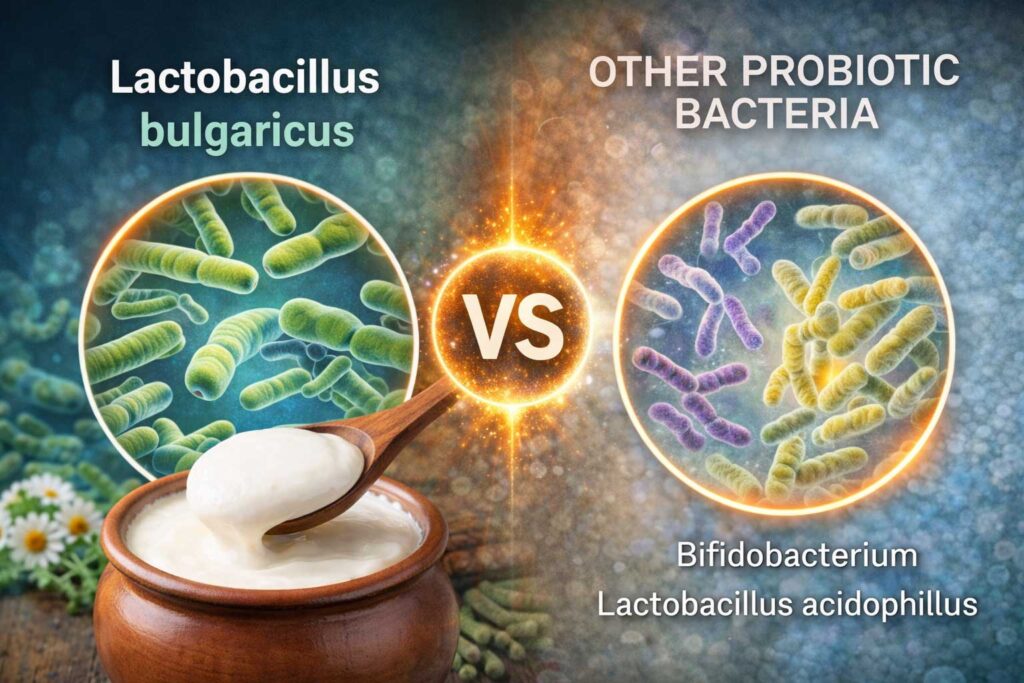
While many probiotic bacteria are known for their ability to colonize the gut long-term, Lactobacillus bulgaricus plays a more functional and process-driven role. Its primary strength lies in transforming food rather than permanently residing in the digestive system.
This distinction is important because it highlights how different probiotics serve different purposes. Some are designed to stay in the gut, while others—like this bacterium—are essential in creating foods that support overall digestive health when consumed regularly.
Not all probiotic bacteria are the same. Lactobacillus bulgaricus has unique properties that distinguish it from others.
Comparison:
| Feature | L. bulgaricus | Other probiotics |
|---|---|---|
| Function | Yogurt fermentation | Gut colonization |
| Strength | Strong acid production | Mild |
| Taste impact | High | Low |
| Longevity in gut | Temporary | Some permanent |
👉 It is more functional for food fermentation than long-term gut colonization.
This makes it different from bacteria like:
- Bifidobacterium
- Lactobacillus acidophilus
Each has its own role in human health.
Role in Fermentation Science
Fermentation involving this bacterium is often studied as a model system because it demonstrates how microorganisms can cooperate to produce stable and predictable results. The interaction between bacterial strains during fermentation is a key area of research in microbiology.
Additionally, this process is considered one of the most efficient natural methods of food preservation. By lowering the pH through lactic acid production, it creates an environment where harmful bacteria cannot thrive, making fermented foods safer and longer-lasting.
Lactobacillus bulgaricus is one of the most studied bacteria in food microbiology.
It is used as a model organism to understand:
- Fermentation processes
- Bacterial symbiosis
- Acid production
- Food preservation
Scientists often study how it interacts with:
👉 Streptococcus thermophilus
Together, they form one of the most efficient fermentation systems in nature.
👉 This makes yogurt production both predictable and scalable.
Industrial and Commercial Applications
In modern food production, maintaining consistency is critical, and this bacterium plays a major role in achieving that goal. Manufacturers rely on carefully controlled strains to ensure that each batch of yogurt meets the same standards in taste, texture, and safety.
At the same time, there is a growing demand for products that preserve traditional qualities. This has led to increased interest in maintaining authentic bacterial cultures even in industrial settings, blending modern technology with traditional fermentation methods.
Today, Lactobacillus bulgaricus is used globally in the dairy industry.
Applications:
- Yogurt production
- Cheese fermentation
- Probiotic products
- Dairy preservation
In industrial settings:
- Controlled temperature is used
- Pure cultures are maintained
- Fermentation is standardized
👉 This ensures consistent taste and safety.
Despite modernization, the core process remains the same as traditional methods.
Why It Is So Important
Its importance is also reflected in how widely it is used across the global dairy industry. From small homemade batches to large-scale production, this bacterium remains a central component of yogurt manufacturing.
Furthermore, it serves as a bridge between traditional food practices and modern science. Researchers continue to study it not only for its role in food but also for its broader implications in microbiology and nutrition.
This bacterium is special because it goes beyond simple fermentation—it defines what yogurt truly is.
It is important because:
- It defines true yogurt
- It gives yogurt its characteristic flavor
- It is linked to probiotic benefits
- It carries Bulgaria’s name globally
👉 Few foods have bacteria named after a country.
Its importance also extends into science and industry. It has been studied for over a century and remains a key organism in microbiology, food production, and probiotic research.
Without this bacterium, yogurt would lose its authenticity and become just another processed dairy product.
Health Benefits (What Science Says)

Another reason this bacterium is valuable is its role in supporting a balanced digestive system. By contributing to a healthier gut environment, it may help reduce digestive discomfort and improve overall gut function.
There is also growing interest in how fermented foods influence the gut-brain connection, suggesting that regular consumption of yogurt could have wider effects beyond digestion, including overall well-being.
Lactobacillus bulgaricus has been widely studied for its potential health benefits, especially in relation to digestion and gut health.
👉 Learn more in our guide to Bulgarian yogurt health benefits
Potential benefits:
- Supports digestion
- Helps balance gut microbiome
- May improve lactose tolerance
- Contributes to overall gut health
This bacterium helps break down lactose during fermentation, which is why yogurt is often easier to digest than milk for many people.
👉 Important: Not all claims are fully proven—but scientific research continues to explore its role in human health.
Modern studies focus on how it interacts with the gut microbiome and how fermented foods contribute to overall well-being.
Lactobacillus Bulgaricus and the Gut Microbiome
The human gut contains trillions of bacteria, known as the gut microbiome.
Lactobacillus bulgaricus plays a temporary but beneficial role in this system. Although it does not permanently colonize the gut, it still plays a meaningful temporary role during digestion.
It contributes to a temporary environment that favors beneficial bacteria and discourages harmful microbes.
This interaction highlights the importance of regularly consuming fermented foods. Instead of relying on a single dose, consistent intake helps maintain a dynamic and balanced gut ecosystem over time.
It helps by:
- Producing beneficial compounds
- Competing with harmful bacteria
Foods That Contain Lactobacillus Bulgaricus

The concentration and activity of this bacterium can vary depending on how the food is produced and stored. Fresh, traditionally fermented yogurt typically contains the highest levels of active cultures.
It is also important to note that some commercially processed foods may contain the bacteria initially, but heat treatment or extended storage can reduce their activity. This is why choosing products labeled with “live and active cultures” is often recommended.
You can find this bacterium in several foods:
Common sources:
- Bulgarian yogurt
- Traditional yogurt
- Fermented milk
- Some cheeses
The highest concentration is found in:
👉 Authentic yogurt made with live cultures
Not all store-bought yogurts contain active bacteria, especially if they are heat-treated after fermentation.
Common Myths About Lactobacillus Bulgaricus
Misunderstandings about probiotics are common, especially as interest in gut health continues to grow. Many people assume that all bacteria labeled as “beneficial” work in the same way, which is not the case.
Clarifying these myths helps consumers make better dietary choices and understand the specific role this bacterium plays. It also highlights the importance of quality, authenticity, and proper fermentation methods in obtaining real benefits.
❌ Myth: All yogurt contains it
👉 Truth: Only traditional or properly cultured yogurt does
❌ Myth: It permanently lives in your gut
👉 Truth: It is temporary but still beneficial
❌ Myth: More bacteria = always better
👉 Truth: Balance matters more than quantity
❌ Myth: All probiotics are the same
👉 Truth: Each strain has a different function
Future Research and Innovation
As technology advances, scientists are exploring how this bacterium can be optimized for even better performance in food production. This includes improving its resistance to environmental stress and enhancing its fermentation efficiency.
There is also growing interest in how it can be integrated into new types of functional foods beyond traditional dairy products. These developments suggest that its role in nutrition and science will continue to expand in the coming years.
Modern science continues to explore new uses for Lactobacillus bulgaricus.
Researchers are studying:
- Genetic optimization
- Enhanced probiotic effects
- Improved fermentation efficiency
- Applications beyond dairy
There is also interest in how it can be used in:
- Functional foods
- Personalized nutrition
- Gut health therapies
👉 This shows its importance is still growing.
Why Bulgarian Yogurt Is Different Because of It
The uniqueness of Bulgarian yogurt is also tied to the way this bacterium develops flavor over time. Its activity creates a deeper, more complex taste that cannot be easily replicated with generic bacterial cultures.
In addition, traditional methods preserve the natural balance between bacteria, ensuring that the final product retains its authentic qualities. This balance is often lost in industrial production, which is why traditional yogurt is still highly valued.
Lactobacillus bulgaricus is the main reason Bulgarian yogurt stands out from other types of yogurt around the world.
This bacterium gives Bulgarian yogurt:
- Stronger, more pronounced taste
- Authentic natural fermentation
- Thick and creamy texture
- Cultural identity tied to tradition
Unlike many commercial yogurts that use mixed or modified cultures, Bulgarian yogurt relies on this specific bacterium to maintain its authenticity.
👉 Without it, Bulgarian yogurt would not exist in its traditional form.
This is why Bulgarian yogurt is often considered one of the most genuine and naturally fermented dairy products available.
Fun Fact
This naming tradition highlights the global impact of Bulgarian scientific contributions. Even people who have never visited Bulgaria encounter its name through this bacterium in everyday food products.
It also serves as a reminder of how local discoveries can achieve worldwide recognition, especially when they are tied to something as universal as food and health.
The name “bulgaricus” literally comes from Bulgaria.
👉 That means every time scientists study this bacterium, Bulgaria is part of the conversation.
This naming is not accidental—it reflects the origin of the discovery and the importance of Bulgarian yogurt in identifying this microorganism.
It is one of the rare cases where a country’s name is permanently embedded in scientific terminology used worldwide.
FAQs
What does Lactobacillus bulgaricus do?
It ferments milk by converting lactose into lactic acid, which creates yogurt’s texture and flavor.
Is it a probiotic?
Yes, it is considered a beneficial bacterium that can support digestion and gut health.
Is it found only in Bulgaria?
It was first discovered in Bulgaria, but today it is used worldwide in yogurt and dairy production.
Why is it important for yogurt?
It is one of the main bacteria responsible for turning milk into yogurt and giving it its unique properties.
Can yogurt exist without it?
Technically yes, but it would not be authentic yogurt as traditionally defined.
How is Lactobacillus bulgaricus different from other bacteria?
It is specifically adapted to ferment milk and produce strong lactic acid, giving yogurt its unique taste and texture.
Does heating yogurt kill this bacteria?
Yes, high temperatures can destroy beneficial bacteria, which is why live cultures are found only in properly fermented and non-overheated yogurt.
Why does yogurt taste sour?
The sour taste comes from lactic acid produced during fermentation by Lactobacillus bulgaricus.
Is it used outside dairy products?
It is mainly used in dairy, but it is also studied in laboratories for its role in fermentation and microbiology.
Final Insight
Lactobacillus bulgaricus is more than just a bacterium—it is the foundation of one of the world’s most important fermented foods.
It connects:
- Science
- Tradition
- Nutrition
👉 And it proves that even the smallest organisms can have a massive impact on global food culture.
As interest in natural foods and probiotics continues to grow, Lactobacillus bulgaricus remains one of the most important bacteria in both traditional and modern nutrition. Its role in fermentation, digestion, and food culture ensures it will remain relevant for generations to come.
References
Sources include scientific studies, microbiology research, and international health organizations to ensure accuracy and credibility.
- Stamen Grigorov. “The Discovery of Lactobacillus bulgaricus.” Early 20th-century microbiology research.
- Ilya Metchnikoff. The Prolongation of Life: Optimistic Studies. London: Heinemann, 1907.
- Food and Agriculture Organization / World Health Organization. Guidelines for the Evaluation of Probiotics in Food. 2002.
- Lactobacillus delbrueckii subsp. bulgaricus. Journal of Applied Microbiology – Studies on lactic acid bacteria and dairy fermentation.
- Streptococcus thermophilus. Research on symbiotic fermentation in yogurt cultures.
- Tamime, A. Y., & Robinson, R. K. Yoghurt: Science and Technology. Woodhead Publishing, 2007.
- Probiotics. Harvard Medical School. Probiotics and digestive health.
- National Institutes of Health. Probiotics: What You Need To Know.
- Marco, M. L., et al. Health benefits of fermented foods: microbiota and beyond. Current Opinion in Biotechnology, 2017.
- Bulgaria. Traditional yogurt production and microbial heritage.
- Bulgarian yogurt. Cultural and culinary significance in Bulgaria.