


Lactobacillus bulgaricus is one of the most famous microorganisms associated with Bulgaria and one of the key bacteria responsible for the production of traditional yogurt. Today, its full scientific name is Lactobacillus delbrueckii subsp. bulgaricus, but it is still widely known by its older and more popular name, Lactobacillus bulgaricus. It plays a major role in fermenting milk, producing lactic acid, and creating the taste, texture, and preservation qualities that make yogurt such an important food.
The bacterium was first identified in 1905 by the Bulgarian doctor Stamen Grigorov, who isolated it from yogurt. This discovery became one of the most important Bulgarian contributions to microbiology and food science. Later, the work of scientists such as Ilya Metchnikoff helped make fermented milk and lactic acid bacteria internationally famous, especially because of growing interest in their possible connection to gut health and longevity.
It is widely regarded as one of the most important probiotic-related bacteria in traditional foods.
What Is Lactobacillus bulgaricus?
Lactobacillus bulgaricus is one of the most important bacteria in the world of food science and nutrition. Known scientifically today as Lactobacillus delbrueckii subsp. bulgaricus, it is a key microorganism responsible for transforming milk into yogurt.
Lactobacillus bulgaricus is the key bacterium behind traditional Bulgarian yogurt, known for its role in fermentation, health benefits, and connection to longevity.
This bacterium belongs to a group of lactic acid bacteria, which ferment sugars into lactic acid. In the case of milk, Lactobacillus bulgaricus consumes lactose (milk sugar) and produces lactic acid, giving yogurt its:
- Tangy flavor
- Thick texture
- Natural preservation qualities
It is classified as:
- Gram-positive
- Non-motile
- Non-spore-forming
- Acid-loving (acidophilic)
- Anaerobic (thrives without oxygen)
It grows best at temperatures between 40–44°C, which is why traditional yogurt is made in warm conditions.
👉 This bacterium is not just a food ingredient — it is a cornerstone of Bulgarian culinary heritage and one of the most recognized contributions of Bulgaria to global science.
The Bulgarian Discovery by Stamen Grigorov
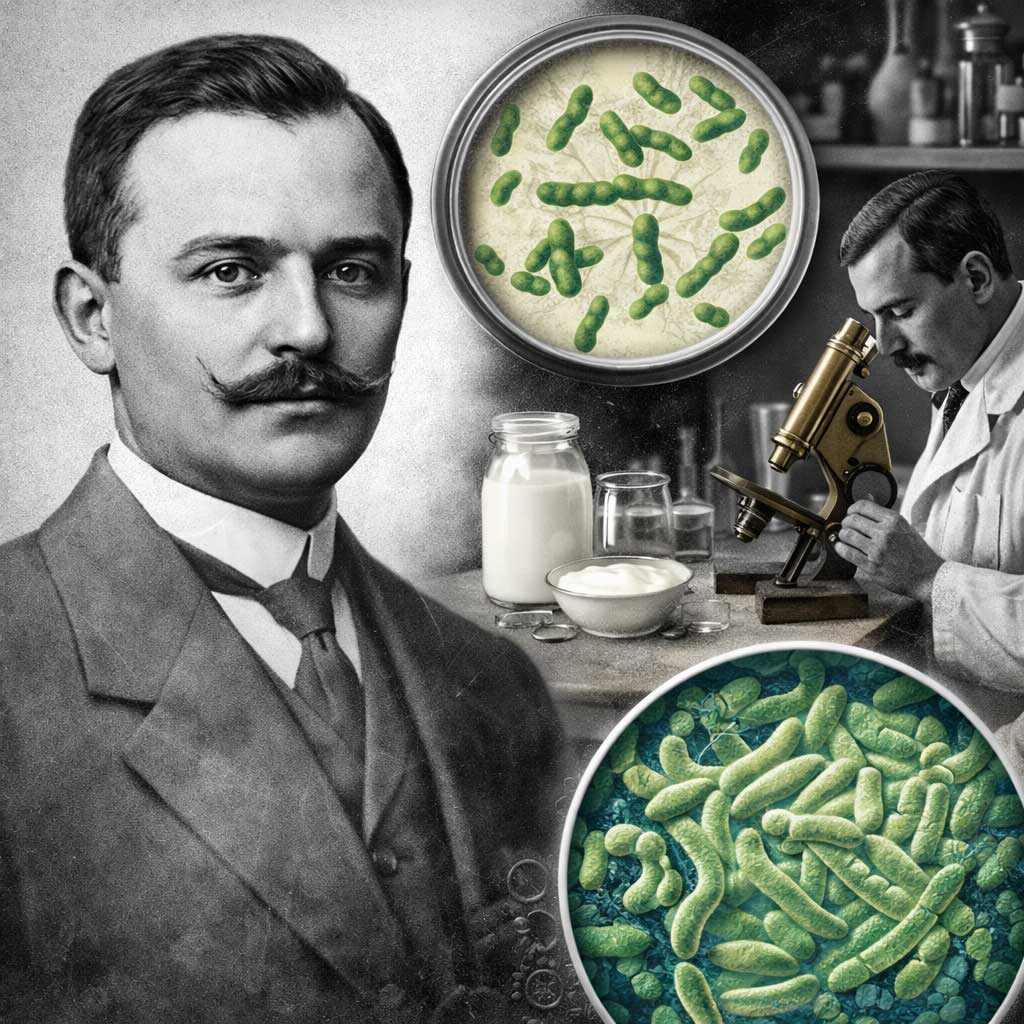
The story of Lactobacillus bulgaricus begins in 1905, when Bulgarian doctor Stamen Grigorov made a groundbreaking discovery.
While studying yogurt samples, he identified the specific bacterium responsible for fermentation and initially named it Bacillus bulgaricus.
👉 Learn more about Bulgarian scientific achievements in our guide to Bulgarian Discoveries That Changed the World.
This discovery:
- Marked one of Bulgaria’s first major contributions to microbiology
- Helped establish yogurt as a scientifically understood food
- Opened the door to modern probiotic research
Lactobacillus delbrueckii subsp. bulgaricus was first identified in 1905 by Stamen Grigorov, who named it Bacillus bulgaricus.[11]
Grigorov’s work was later supported and expanded by scientists across Europe, helping turn yogurt into a globally recognized health food.
👉 Today, his discovery is considered a milestone in both food science and microbiology.
How Lactobacillus bulgaricus Works
The power of Lactobacillus bulgaricus lies in its ability to transform milk into yogurt through a highly efficient and natural biological process known as lactic acid fermentation.
This process is simple in principle but incredibly powerful in its effects on food structure, taste, and preservation.
Step-by-Step Fermentation Process
- Consumption of Lactose
Lactobacillus bulgaricus feeds on lactose, the natural sugar found in milk. This sugar acts as its primary energy source. - Conversion to Lactic Acid
Through fermentation, the bacterium converts lactose into lactic acid, a key compound responsible for yogurt’s signature tangy flavor. - Drop in pH Levels
As lactic acid accumulates, the pH of the milk decreases, creating an acidic environment that is essential for fermentation. - Protein Coagulation
The acidic conditions cause milk proteins, mainly casein, to coagulate. This is what thickens the milk and gives yogurt its creamy consistency. - Formation of Yogurt Texture and Flavor
The combination of acidity, protein structure changes, and bacterial activity produces the smooth texture and distinct taste of authentic yogurt.
Benefits of Acidification
The lactic acid produced during fermentation provides several natural advantages:
- ✔ Prevents harmful bacteria growth by creating an inhospitable environment
- ✔ Extends shelf life without artificial preservatives
- ✔ Improves digestibility, especially for people sensitive to lactose
👉 This is why fermented dairy products are often easier to digest than fresh milk.
Symbiotic Relationship in Yogurt
Lactobacillus bulgaricus does not work alone. It forms a powerful symbiotic partnership with Streptococcus thermophilus, another essential yogurt bacterium.
Together, they enhance each other’s activity:
- Streptococcus thermophilus starts the fermentation process quickly
- Lactobacillus bulgaricus intensifies acid production and flavor development
- Both bacteria exchange nutrients and growth factors
👉 This cooperation results in faster fermentation, improved texture, and a more balanced taste.
Why This Process Matters
This natural fermentation process is the foundation of:
- Traditional Bulgarian yogurt
- Modern dairy production
- Probiotic food science
👉 Without Lactobacillus bulgaricus, yogurt would lack its authentic flavor, structure, and many of its health-related properties.
Why Lactobacillus bulgaricus Is Essential for Bulgarian Yogurt

Bulgarian yogurt is globally recognized for its exceptional quality and distinctive characteristics. Unlike mass-produced yogurt varieties, it has a natural richness and depth of flavor that comes from centuries of tradition and precise microbial balance.
👉 Learn more about this in our full guide to Bulgarian Yogurt – History, Benefits, and Recipes.
What Makes Bulgarian Yogurt Unique?
Bulgarian yogurt stands out because of its:
- Unique taste – slightly sour, fresh, and balanced
- Thick consistency – naturally creamy without artificial thickeners
- Health benefits – linked to gut health and digestion
At the heart of all these qualities is one key microorganism:
👉 Lactobacillus bulgaricus
The Role of Lactobacillus bulgaricus
Unlike generic yogurt cultures used in industrial production, traditional Bulgarian yogurt depends on a specific symbiotic relationship between bacteria, where Lactobacillus bulgaricus plays the dominant role.
This bacterium is responsible not only for fermentation but also for defining the identity of Bulgarian yogurt itself.
✔ Key Contributions:
- ✔ Creates the characteristic sour taste
The lactic acid produced during fermentation gives Bulgarian yogurt its signature tangy flavor—stronger and more authentic than most commercial yogurts. - ✔ Produces natural thickness
Through protein coagulation, it forms the dense, creamy texture without the need for stabilizers or additives. - ✔ Supports long fermentation cycles
Traditional yogurt is often fermented slowly, allowing deeper flavor development and higher bacterial activity. - ✔ Maintains authenticity of Bulgarian yogurt
The presence of Lactobacillus bulgaricus ensures that the yogurt remains true to its traditional roots, preserving its cultural and culinary identity.
Traditional vs. Industrial Yogurt
One of the biggest differences between authentic Bulgarian yogurt and many modern alternatives lies in the quality and purity of bacterial cultures.
Traditional Bulgarian yogurt:
- Uses natural starter cultures
- Relies on fewer bacterial strains
- Preserves original fermentation methods
- Avoids artificial thickeners and additives
Industrial yogurt often:
- Uses standardized or modified cultures
- Includes stabilizers and preservatives
- Focuses on speed over flavor development
👉 This is why authentic Bulgarian yogurt often tastes richer, more complex, and more natural.
Cultural and Scientific Importance
Lactobacillus bulgaricus is not just a functional ingredient—it is a symbol of Bulgarian heritage and scientific achievement.
For generations, Bulgarian families have passed down yogurt-making techniques, often using a small portion of previous batches as a natural starter culture. This practice preserves the unique bacterial composition that defines Bulgarian yogurt.
At the same time, modern science recognizes this bacterium as:
- A key player in fermentation technology
- A subject of probiotic research
- A contributor to food preservation
Lactobacillus bulgaricus and Longevity

One of the most fascinating aspects of Lactobacillus bulgaricus is its long-standing connection to human longevity and overall health.
This idea dates back to the early 20th century, when Ilya Metchnikoff, a Nobel Prize-winning biologist working at the Pasteur Institute, began studying aging and diet.
Metchnikoff’s Observations
Ilya Metchnikoff, a professor at the Pasteur Institute in Paris, researched the relationship between the longevity of Bulgarians and their consumption of yogurt. He had the idea that aging is caused by putrefactive activity, or proteolysis, by microbes that produce toxic substances in the intestine.
Metchnikoff’s research also noted that rural populations in Southeastern Europe and the Russian steppes daily consume milk fermented with lactic acid bacteria and live relatively longer than other populations. Based on these data Metchnikoff proposed that consumption of fermented milk seeds the intestine with harmless lactic acid bacteria increasing intestinal acidity and suppressing the growth of proteolytic bacteria.
Metchnikoff noticed a unique pattern among populations in Bulgaria and Eastern Europe:
- People consumed large amounts of fermented milk and yogurt daily
- Rural communities often showed higher life expectancy
- Digestive health appeared stronger and more stable
These observations led him to explore the connection between diet, gut bacteria, and aging.
The Longevity Hypothesis
Metchnikoff proposed that aging was partly caused by harmful bacteria in the gut producing toxic substances through protein breakdown.
According to his theory:
- Putrefactive bacteria in the intestines release toxins
- These toxins contribute to aging and disease
- Lactic acid bacteria, like Lactobacillus bulgaricus, could suppress these harmful microbes
👉 By increasing intestinal acidity through fermentation, beneficial bacteria could potentially improve gut health and slow aging.
While this concept—known as “intestinal auto-intoxication”—is now considered scientifically outdated, it laid the foundation for modern research into the gut microbiome.
Fermented Foods and Healthy Aging
The traditional Bulgarian diet, rich in fermented foods like yogurt, continues to attract scientific interest.
Regular consumption of such foods may:
- Improve digestion and nutrient absorption
- Support a healthy gut environment
- Reduce harmful bacterial activity
- Contribute to overall metabolic balance
👉 These factors are now widely recognized as important components of long-term health.
A Legacy That Shaped Modern Nutrition
Lactobacillus bulgaricus became one of the first bacteria ever linked to human health and aging, helping to shape the early concept of probiotics.
Metchnikoff’s work:
- Popularized yogurt consumption across Europe
- Sparked global interest in fermented foods
- Influenced the development of modern probiotic science
👉 While longevity depends on many factors—genetics, lifestyle, environment, and diet—Lactobacillus bulgaricus remains an important symbol of how traditional foods and microbiology intersect.
It represents one of the earliest scientific attempts to understand:
- The connection between gut health and aging
- The role of beneficial bacteria in the human body
- The long-term impact of diet on overall well-being
Industrial and Scientific Importance
Beyond traditional yogurt, Lactobacillus bulgaricus plays a major role in modern industry.
Uses in Industry:
- Yogurt production worldwide
- Cheese fermentation and ripening
- Dairy preservation
- Probiotic supplements
- Biotechnology research
It is widely used because:
- It produces consistent fermentation
- It survives acidic environments
- It adapts to industrial processes
Research also explores:
- Freeze-drying survival techniques
- Genetic adaptation to stress
- Optimization of bacterial cultures
👉 These advances help improve food quality, shelf life, and production efficiency.
Scientific Characteristics
To fully understand Lactobacillus bulgaricus, it’s important to look at its biological traits.
Key Properties:
| Characteristic | Description |
|---|---|
| Type | Lactic acid bacterium |
| Shape | Rod-shaped |
| Oxygen | Anaerobic |
| Movement | Non-motile |
| Temperature | 40–44°C optimal |
| pH Preference | Acidic (4.6–5.4) |
| Function | Converts lactose → lactic acid |
It is also:
- Aciduric (survives acidic environments)
- Nutritionally complex (needs amino acids, vitamins, fats)
- Highly specialized for dairy environments
👉 These characteristics make it ideal for controlled fermentation processes.
More from Discoveries
Recommended
Global Spread and Recognition

Although Lactobacillus bulgaricus originated in Bulgaria, it has evolved into a microorganism of global importance, widely used in both traditional and industrial food production.
Following its discovery in 1905, the bacterium quickly gained attention among scientists and dairy producers across Europe. As yogurt consumption spread worldwide, Lactobacillus bulgaricus became a standard component in fermentation processes, helping shape the modern dairy industry.
Interesting Global Facts
- It can be found naturally in the gastrointestinal tract of animals living in Bulgaria
- A unique strain (GLB44) was isolated from the snowdrop flower (Galanthus nivalis), highlighting its natural presence beyond dairy environments
- It is widely used in laboratories, probiotic formulations, and dairy production across the world
- In 2012, it was declared the national microbe of India, demonstrating its global recognition and scientific importance
From Local Tradition to Global Science
What began as a traditional Bulgarian fermentation process has become a cornerstone of modern microbiology and food science.
Today, Lactobacillus bulgaricus is:
- Studied in research institutions worldwide
- Used in industrial-scale yogurt and cheese production
- Included in probiotic and functional food products
- Recognized as a model organism for fermentation studies
👉 Its journey from rural Bulgarian households to global laboratories reflects the powerful connection between traditional knowledge and modern science.
Modern Research and Health Studies
In recent years, advances in microbiology and biotechnology have allowed scientists to study Lactobacillus bulgaricus at the genetic and molecular level. Researchers are now able to analyze how specific strains behave under different environmental conditions, including temperature changes, acidity, and nutrient availability. This has led to improved starter cultures for the dairy industry, ensuring more consistent yogurt quality while preserving the bacterium’s traditional characteristics.
At the same time, there is growing interest in how the yogurt bacteria interacts with the human gut microbiome. Although it does not always permanently colonize the intestine, it can still have temporary beneficial effects by supporting the balance of gut bacteria during digestion. Ongoing studies are also exploring its potential role in reducing inflammation, supporting immune responses, and contributing to overall digestive health—making it a continued focus in both food science and probiotic research.
Although Lactobacillus bulgaricus alone is not a “longevity cure,” it plays a role in the broader ecosystem of beneficial gut bacteria.
- Reduction of milk protein allergenicity
- Gut microbiome interaction
- Immune system response
- Preservation techniques (freeze-drying)
- Stress resistance and survival
Some studies suggest that fermentation with this bacterium can:
- Reduce certain milk allergens
- Improve digestion
- Enhance food safety
👉 While not all claims are definitive, its importance in nutrition science continues to grow.
Quantifying Lactobacillus bulgaricus in Dairy Products
Modern research has also focused on improving how scientists detect and measure Lactobacillus bulgaricus in dairy products. In a 2017 study, researchers developed a method using real-time polymerase chain reaction (qPCR) to accurately identify and quantify this bacterium alongside Streptococcus thermophilus in cow’s milk cheese.
This technique allows scientists and food producers to monitor the presence and activity of these essential bacteria during fermentation and cheese ripening. By ensuring the correct bacterial balance, producers can maintain consistent quality, flavor, and safety in dairy products.
👉 This type of research is especially important for large-scale dairy production, where precision and consistency are critical.
Cultural Importance in Bulgaria
This bacterium is not just a scientific discovery — it is a symbol of Bulgarian identity.
In Bulgaria:
- Yogurt is consumed daily
- Recipes are passed through generations
- Fermentation is a traditional skill
- Yogurt is seen as a natural, healthy food
👉 It represents the connection between nature, science, and tradition.
Recommended Reads (Internal Linking)
- Traditional Bulgarian Dairy Products
- Bulgarian Yogurt – History, Benefits, and Recipes
- Bulgarian Cuisine: Traditional Food, Dishes, and Culture
- Bulgarian Discoveries That Changed the World
- Stamen Grigorov and His Scientific Legacy
FAQs About Lactobacillus bulgaricus
What is Lactobacillus bulgaricus?
Lactobacillus bulgaricus is a lactic acid bacterium that plays a key role in fermenting milk into yogurt. It converts lactose into lactic acid, giving yogurt its characteristic sour taste, thick texture, and natural preservation properties.
Who discovered Lactobacillus bulgaricus?
It was discovered in 1905 by Stamen Grigorov, a Bulgarian scientist who identified the bacterium while studying traditional yogurt.
Is Lactobacillus bulgaricus a probiotic?
Yes, Lactobacillus bulgaricus is commonly considered a probiotic bacterium. While it may not permanently colonize the gut, it can support digestive health and help maintain a balanced gut microbiome during consumption.
Why is Lactobacillus bulgaricus important?
It is essential for yogurt production, as it drives the fermentation process that creates yogurt’s flavor and texture. It also contributes to food preservation, digestion, and potential health benefits related to gut bacteria balance.
Does Lactobacillus bulgaricus exist outside Bulgaria?
Yes, although it was first discovered in Bulgaria, it is now used worldwide in dairy production, probiotics, and scientific research. It is a standard component in many commercial yogurt cultures.
What makes Bulgarian yogurt unique?
Bulgarian yogurt is unique because it relies on a specific bacterial combination, where Lactobacillus bulgaricus plays a dominant role. This gives it a richer taste, thicker consistency, and more authentic fermentation compared to many commercial yogurts.
How is Lactobacillus bulgaricus different from other yogurt bacteria?
Unlike many generic strains, Lactobacillus bulgaricus produces a stronger flavor and more pronounced acidity. It also works in symbiosis with Streptococcus thermophilus, creating a unique fermentation process specific to traditional yogurt.
Is Lactobacillus bulgaricus safe?
Yes, it is considered safe and non-pathogenic. It has been used in food production for over a century and is widely recognized as beneficial in controlled amounts.
Can Lactobacillus bulgaricus help with lactose intolerance?
It may help some people with lactose intolerance because it breaks down lactose during fermentation, making yogurt easier to digest than regular milk.
Where is Lactobacillus bulgaricus found naturally?
It can be found in fermented dairy products, and certain strains have also been identified in natural environments such as plants and animals in Bulgaria.
More From Inventors
You May Be Interested To Read About
Forgotten Bulgarian Space Achievements
Ivan Stranski
Snezhanka Salad Recipe
Final Insight
As interest in natural foods and gut health continues to grow, Lactobacillus bulgaricus remains more relevant than ever. It stands at the intersection of tradition and science, proving that ancient food practices can still offer valuable insights for modern health and nutrition.
👉 Lactobacillus bulgaricus is more than just a yogurt bacterium—it is a symbol of how a local Bulgarian discovery transformed into a global scientific and nutritional asset, influencing food systems, health research, and dietary habits around the world.
This makes Lactobacillus bulgaricus one of the most important bacteria in both traditional and modern nutrition.
References
- Wittouck, Stijn; Wuyts, Sander; Meehan, Conor J.; van Noort, Vera; Lebeer, Sarah (2019-09-03). Gibbons, Sean M. (ed.). “A Genome-Based Species Taxonomy of the Lactobacillus Genus Complex”. mSystems. 4 (5): e00264–19, /msystems/4/5/msys.00264–19.atom. doi:10.1128/mSystems.00264-19. ISSN 2379-5077. PMC 6722421. PMID 31481601.
- Stachelska, Milena Alicja; Foligni, Roberta (2018). “Development of a time-effective and highly specific quantitative real-time polymerase chain reaction assay for the identification of Lactobacillus delbrueckii subsp. bulgaricus and Streptococcus thermophilus in artisanal raw cow’s milk cheese”. Acta Veterinaria Brno. 87 (3): 301–308. doi:10.2754/avb201887030301. ISSN 0001-7213.
- “Lactobacillus delbrueckii – microbewiki”. microbewiki.kenyon.edu. Retrieved 2019-11-14.
- School of Food and Biological Engineering, Shaanxi University of Science and Technology Xi?an,China; Shaanxi Heshi Dairy, China; Chen, He; Huang, Jie; Shi, Xiaoyu; Li, Yichao; Liu, Yu (2017-12-30). “Effects of six substances on the growth and freeze-drying of Lactobacillus delbrueckii subsp. bulgaricus [pdf]”. Acta Scientiarum Polonorum Technologia Alimentaria. 16 (4): 403–412. doi:10.17306/J.AFS.2017.0512.
- Hao, Pei; Zheng, Huajun; Yu, Yao; Ding, Guohui; Gu, Wenyi; Chen, Shuting; Yu, Zhonghao; Ren, Shuangxi; Oda, Munehiro; Konno, Tomonobu; Wang, Shengyue (2011-01-17). Ahmed, Niyaz (ed.). “Complete Sequencing and Pan-Genomic Analysis of Lactobacillus delbrueckii subsp. bulgaricus Reveal Its Genetic Basis for Industrial Yogurt Production”. PLoS ONE. 6 (1): e15964. doi:10.1371/journal.pone.0015964. ISSN 1932-6203.
- Courtin, P.; Rul, F. O. (2003). “Interactions between microorganisms in a simple ecosystem: yogurt bacteria as a study model”. Le Lait. 84 (1–2): 125–134. doi:10.1051/lait:2003031.
- Archived from the original on 2010-12-20. Retrieved 2011-03-19.
- Zourari, A.; Accolas, J. P.; Desmazeaud, M. J. (1992). “Metabolism and biochemical characteristics of yogurt bacteria. A review” (PDF). Le Lait. 72: 1–34. doi:10.1051/lait:199211.
- ^ Simova, E. D.; Beshkova, D. M.; Angelov, M. P.; Dimitrov, Z. P. (2008). “Bacteriocin production by strain Lactobacillus delbrueckii ssp. Bulgaricus BB18 during continuous prefermentation of yogurt starter culture and subsequent batch coagulation of milk”. Journal of Industrial Microbiology & Biotechnology. 35 (6): 559–567. doi:10.1007/s10295-008-0317-x. PMID 18273656.
- Priest, FG (2002). Brewing Microbiology. Springer. pp. 185–202.
- Anukam, Kingsley C.; et al. “Probiotics: 100 years (1907–2007) after Elie Metchnikoff’s Observation” (PDF). Archived from the original(PDF) on 2012-10-04. Retrieved 2013-01-08.
- Ghouri, Yezaz A; Richards, David M; Rahimi, Erik F; Krill, Joseph T; Jelinek, Katherine A; DuPont, Andrew W (9 December 2014). “Systematic review of randomized controlled trials of probiotics, prebiotics, and synbiotics in inflammatory bowel disease”. Clin Exp Gastroenterol. 7: 473–487. doi:10.2147/CEG.S27530. PMC 4266241. PMID 25525379.
- “Education for Biodiversity Conservation CoP-11, Hyderabad”. Press Information Bureau Government of India. Press Information Bureau Government of India Ministry of Environment, Forest and Climate Change. 18 October 2012. Retrieved 3 May 2019.
The Minister also announced the National Microbe for India which was selected by children who had visited the Science Express Biodiversity Special, a train which has been visiting various stations across the country. Voting for the National Microbe took place in these stations and the children have selected the Lactobacillus (Lactobacillus delbrueckii subsp. bulgaricus) to be the National Microbe for India
- Zheng, Zhe; Liao, Ping; Luo, Yongkang; Li, Zheng (June 2014). “Effects of Fermentation by Lactobacillus delbrueckii subsp. bulgaricus , Refrigeration and Simulated Gastrointestinal Digestion on the Antigenicity of Four Milk Proteins: Effects on Milk Protein Antigenicity”. Journal of Food Processing and Preservation. 38 (3): 1106–1112. doi:10.1111/jfpp.12069.
- Meneghel, Julie; Passot, Stéphanie; Cenard, Stéphanie; Réfrégiers, Matthieu; Jamme, Frédéric; Fonseca, Fernanda (September 2017). “Subcellular membrane fluidity of Lactobacillus delbrueckii subsp. bulgaricus under cold and osmotic stress”. Applied Microbiology and Biotechnology. 101 (18): 6907–6917. doi:10.1007/s00253-017-8444-9. ISSN 0175-7598. PMID 28780605.
- Wikipedia article.
The contents of this page are sourced from Wikipedia article. The contents are available under the CC BY-SA 4.0 license.