


Bulgaria International Mathematical Olympiad 2003 marked one of the greatest achievements in the nation’s educational history, as all six members of the Bulgarian team won gold medals and captured the team world championship.
In the summer of 2003, six Bulgarian teenagers accomplished one of the greatest feats in the history of academic competition. Facing the world’s brightest young mathematicians from more than 80 countries, every member of Bulgaria’s national team won a gold medal at the International Mathematical Olympiad (IMO), securing the team world championship.
The achievement captured the attention of the international mathematics community. While countries such as China, Russia, and the United States had long ranked among the competition’s strongest nations, Bulgaria delivered an extraordinary performance that secured its place among the most memorable teams in IMO history.
More than two decades later, the success of the 2003 Bulgarian team remains one of the most remarkable accomplishments in the history of Bulgarian education. It demonstrated the strength of the country’s mathematical tradition and showcased the extraordinary talent nurtured by Bulgaria’s specialized mathematics schools and dedicated educators.
This is the story of Bulgaria’s perfect team.
What Is the International Mathematical Olympiad?
The International Mathematical Olympiad (IMO) is the world’s most prestigious mathematics competition for high school students. Often described informally as a world championship of mathematics for secondary school students, the IMO brings together the brightest young mathematical minds from around the globe to compete in one of the most challenging academic contests ever created.
Established in 1959 in Romania, the competition originally featured just seven Eastern European countries. Since then, it has grown into a truly international event, with more than 100 countries participating each year. For talented students, earning a place on their nation’s IMO team is considered one of the highest academic honors.
Each participating country is allowed to send a team of six students, accompanied by team leaders and observers. Reaching the International Mathematical Olympiad is far from easy. Competitors must first excel in regional contests, national mathematics olympiads, training camps, and multiple rounds of increasingly difficult examinations before earning a place on their country’s team.
Unlike standard school exams, the IMO does not test memorization or routine calculations. Instead, participants are challenged to solve original problems that demand creativity, deep mathematical insight, and rigorous logical reasoning.
How the Competition Works
The Olympiad takes place over two examination days, with contestants solving a total of six problems—three problems each day.
Each examination session lasts four and a half hours, giving students ample time to develop complete mathematical proofs rather than simply finding numerical answers.
During the competition, contestants may use:
- Pen or pencil
- Blank paper provided by the organizers
- Basic drawing instruments such as rulers and compasses
However, they are not allowed to use:
- Calculators
- Computers
- Mobile phones
- Textbooks
- Formula sheets
- Internet access
- Any outside assistance
Every solution must be written entirely by the student and supported with a complete mathematical proof.
Areas of Mathematics Tested
The IMO focuses on four major branches of mathematics commonly studied in olympiad competitions:
- Algebra – equations, inequalities, polynomials, and functional relationships.
- Geometry – proofs involving shapes, angles, circles, triangles, and spatial reasoning.
- Number Theory – properties of integers, divisibility, prime numbers, and modular arithmetic.
- Combinatorics – counting techniques, arrangements, graphs, and logical structures.
The problems are famous for requiring innovative thinking rather than advanced university mathematics. In fact, every problem can theoretically be solved using concepts taught in secondary school—but discovering the solution often requires extraordinary ingenuity.
Scoring and Medals
Each of the six problems is worth 7 points, giving a maximum possible score of 42 points.
After the competition, every solution is carefully evaluated by international coordinators and team leaders. Partial credit is awarded when students demonstrate significant progress toward a correct proof, even if the final solution is incomplete.
Based on their scores, contestants may receive:
- Gold Medal
- Silver Medal
- Bronze Medal
- Honorable Mention for solving at least one problem perfectly without earning a medal
Only about half of all contestants receive medals, making any IMO medal an extraordinary achievement.
Why the IMO Is So Prestigious
The International Mathematical Olympiad is often compared to the Olympic Games—but instead of athletic events, students compete using logic, creativity, and mathematical reasoning.
Many former IMO participants have gone on to study at some of the world’s most prestigious universities, including MIT, Harvard, Stanford, Cambridge, and Oxford. Others have become leading mathematicians, computer scientists, engineers, entrepreneurs, and pioneers in fields such as artificial intelligence, cryptography, economics, and theoretical physics.
For countries around the world, strong performances at the IMO are viewed as indicators of educational excellence and the ability to develop exceptional scientific talent.
Against this backdrop, Bulgaria’s extraordinary performance at the 2003 International Mathematical Olympiad, when all six members of its national team won gold medals, stands as one of the greatest achievements in the country’s educational history.
Bulgaria’s Long Mathematical Tradition
Bulgaria’s remarkable success at the 2003 International Mathematical Olympiad was no coincidence. It was the result of decades of investment in mathematics education, a strong culture of academic excellence, and a nationwide system designed to identify and nurture talented students from an early age.
For more than half a century, Bulgaria has earned international recognition for producing outstanding mathematicians, scientists, computer scientists, and Olympiad champions. Despite its relatively small population, the country has consistently ranked among the world’s leading nations in international mathematics competitions, often outperforming countries with far larger educational systems.
The foundations of this success were laid during the 1960s and 1970s, when Bulgaria established a network of specialized mathematics high schools. These schools were created to provide gifted students with advanced instruction beyond the standard curriculum, allowing them to develop exceptional problem-solving and analytical skills while preparing for national and international competitions.
The National High School of Mathematics and Natural Sciences
At the heart of Bulgaria’s mathematical tradition is the National High School of Mathematics and Natural Sciences “Acad. Lyubomir Chakalov” (NPMG) in Sofia.
Founded in 1968, the school quickly established itself as one of Europe’s leading institutions for gifted students in mathematics, informatics, physics, and the natural sciences. Over the decades, it has educated countless Olympiad medalists, university professors, researchers, and technology leaders.
Many members of Bulgaria’s International Mathematical Olympiad teams, including participants in the historic 2003 championship, studied or trained at NPMG. The school’s demanding curriculum, highly qualified teachers, and culture of excellence have made it one of the country’s most prestigious educational institutions.
Specialized Mathematics Schools Across Bulgaria
While Sofia’s National High School of Mathematics and Natural Sciences is the country’s best-known mathematics school, it is part of a broader network of specialized schools that have played a vital role in Bulgaria’s international success.
Among the most respected are:
- High School of Mathematics “Dr. Petar Beron” – Varna
- Mathematics High School “Acad. Kiril Popov” – Plovdiv
- Mathematics High School “Academician Nikola Obreshkov” – Burgas
- Mathematics High School “Baba Tonka” – Ruse
- High School of Mathematics “Nancho Popovich” – Shumen
- Mathematics High School “Geo Milev” – Pleven
- High School of Mathematics “Atanas Radev” – Yambol
- Mathematics High School “Ivan Salabashev” – Stara Zagora
These schools regularly produce medalists in national Olympiads and international competitions in mathematics, informatics, physics, astronomy, and linguistics.
A Culture of Mathematical Excellence
What sets Bulgaria apart is not just its schools but its educational culture.
Gifted students often begin participating in local mathematics competitions while still in primary school. Those who demonstrate exceptional ability advance through regional and national Olympiads, specialized training camps, and intensive preparation programs organized by experienced teachers, university professors, and former Olympiad medalists.
By the time students qualify for Bulgaria’s International Mathematical Olympiad team, many have already spent years solving advanced mathematical problems far beyond the standard secondary school curriculum.
The emphasis is not on memorizing formulas but on developing creativity, logical reasoning, persistence, and elegant mathematical proofs—skills that are essential for success at the highest levels of competition.
A Legacy That Continues Today
Bulgaria’s mathematical tradition remains strong in the 21st century. Bulgarian students continue to win medals at the International Mathematical Olympiad, European Girls’ Mathematical Olympiad, Balkan Mathematical Olympiad, and numerous other international competitions each year.
Many former Olympians go on to study at world-renowned universities such as Harvard, MIT, Cambridge, Oxford, and Stanford, later building successful careers in mathematics, computer science, artificial intelligence, engineering, finance, and scientific research.
The triumph of the 2003 Bulgarian IMO team was therefore not an isolated miracle—it was the culmination of decades of educational excellence and a tradition that continues to inspire new generations of young mathematicians.
The Road to Tokyo
By the summer of 2003, Bulgaria had already established itself as one of the world’s most respected nations in competitive mathematics. Decades of success at the International Mathematical Olympiad had created high expectations for every new generation of students, and the team selected to represent the country in Tokyo was considered exceptionally talented.
The 44th International Mathematical Olympiad (IMO) was held in Tokyo, Japan, from July 7 to July 19, 2003. It brought together 457 contestants from 82 countries, making it one of the largest and most competitive editions of the Olympiad up to that point. Every participating nation had selected its brightest young mathematicians through demanding national qualification processes, ensuring that only the world’s top secondary school students reached the competition.
For Bulgaria, earning a place on the six-member national team was an achievement in itself. The selection process was extraordinarily competitive, with students advancing through multiple rounds of national mathematics competitions before attending intensive training camps led by some of the country’s most experienced mathematicians and former Olympiad medalists.
Years of Preparation
The students who traveled to Tokyo had spent years preparing for this moment. Most had shown exceptional mathematical talent from an early age and had already built impressive records in national and international competitions.
Before reaching the International Mathematical Olympiad, many members of the Bulgarian team had competed in:
- National Mathematics Olympiads
- Regional mathematics competitions
- Balkan Mathematical Olympiads
- Junior Balkan Mathematical Olympiads
- International mathematics tournaments
- Intensive Olympiad training camps organized by Bulgarian mathematics specialists
Preparation extended far beyond regular classroom lessons. Students regularly solved some of the world’s most difficult Olympiad problems, attended weekend seminars, participated in summer training camps, and worked closely with experienced coaches who refined both their technical knowledge and proof-writing skills.
Facing the World’s Best
The competition in Tokyo was expected to be exceptionally strong. Traditional mathematics powerhouses such as China, Russia, the United States, Romania, Vietnam, South Korea, Hungary, and Iran all arrived with outstanding teams capable of winning multiple gold medals.
Most observers anticipated another close battle among these leading nations. Bulgaria was respected as a consistent contender, but few could have predicted that its team was about to produce one of the greatest performances in the history of the International Mathematical Olympiad.
As the opening ceremony concluded and the contestants prepared for two days of examinations, the Bulgarian delegation knew they had assembled a remarkable group of young mathematicians. Even so, no one could foresee that every member of the team would soon achieve mathematical immortality.
The Six Golden Bulgarians
When the final results of the 44th International Mathematical Olympiad were announced in Tokyo, Bulgaria had achieved something extraordinary—something that remains one of the greatest accomplishments in the history of international mathematics competitions.
Not only did Bulgaria win first place in the team standings, but every member of the six-person national team earned a gold medal. The team finished with 227 out of a possible 252 points, comfortably ahead of second-place China (211 points) and third-place the United States (188 points). (IMO Official)
Winning six gold medals in a single Olympiad is exceptionally rare. It requires every contestant to perform at an elite level against the brightest young mathematicians from around the world. One weak performance can cost a team the overall title, making Bulgaria’s flawless consistency even more remarkable.
The six students who made history were:
| Contestant | Points | World Rank | Award |
|---|---|---|---|
| Kaloyan Slavov | 41/42 | 4th | 🥇 Gold |
| Rumen Zarev | 40/42 | 5th | 🥇 Gold |
| Iliya Tsekov | 38/42 | Tied 6th | 🥇 Gold |
| Rosen Dimitrov Kralev | 37/42 | Tied 9th | 🥇 Gold |
| Aleksandar Dimitrov Lishkov | 37/42 | Tied 9th | 🥇 Gold |
| Dobromir Rahnev | 34/42 | 19th | 🥇 Gold |
Leading the delegation was renowned Bulgarian mathematician Sava Grozdev, assisted by deputy leader Emil Kolev. Their years of dedication to training Bulgaria’s most gifted students played a crucial role in preparing the team for its historic performance. (IMO Official)
A Historic Team Performance
What makes this achievement even more impressive is the level of competition Bulgaria faced.
The 2003 Olympiad brought together 457 contestants from 82 countries, including traditional mathematical powerhouses such as China, Russia, the United States, Vietnam, South Korea, and Romania. Yet it was Bulgaria—a nation of fewer than eight million people—that finished at the top of the world. (IMO Official)
The Bulgarian team demonstrated remarkable consistency across all six examination problems. While several individual contestants from other countries achieved perfect scores, no other nation matched Bulgaria’s collective excellence. Every Bulgarian contestant earned a gold medal, resulting in the highest overall team score of the competition. (IMO Official)
More Than Individual Brilliance
The victory was not simply the result of six exceptionally talented students competing at the same time. It reflected the strength of Bulgaria’s entire mathematical education system—from specialized mathematics schools and national Olympiads to intensive training camps and experienced coaches who had spent years preparing the country’s brightest young minds.
Their success proved that Bulgaria could compete with—and outperform—the world’s largest and most well-funded educational systems through talent, discipline, and a deep tradition of mathematical excellence.
More than two decades later, the names of these six students remain synonymous with one of the greatest academic achievements in Bulgarian history. Their victory continues to inspire young mathematicians across the country and stands as a powerful reminder that Bulgaria’s greatest champions are found not only in sports arenas but also in classrooms and scientific competitions.
The Competition
The 44th International Mathematical Olympiad challenged contestants with six exceptionally demanding problems designed to test creativity, perseverance, and the ability to construct rigorous mathematical proofs under intense time pressure.
Unlike standard school examinations, the IMO does not reward memorization or routine calculations. Instead, each problem is carefully crafted to require original thinking, with many contestants spending hours exploring different approaches before finding a successful solution.
For the 457 students competing in Tokyo, every point had to be earned through rigorous logical reasoning and complete mathematical proofs.
Number Theory
Several problems explored the fascinating world of number theory, one of the oldest branches of mathematics.
Contestants were required to investigate properties of integers, divisibility, prime numbers, and numerical patterns. Success depended on recognizing hidden relationships and constructing proofs that demonstrated why those relationships always held true.
Number theory problems are often deceptively simple to state but exceptionally difficult to solve, making them a favorite feature of International Mathematical Olympiads.
Geometry
Olympiad geometry is unlike anything found in a typical classroom.
Rather than applying memorized formulas, contestants must discover elegant constructions, identify hidden relationships between geometric figures, and develop rigorous proofs using only classical geometric principles.
The geometry problems at the 2003 IMO demanded exceptional visualization skills, careful reasoning, and creative thinking.
Combinatorics
The Olympiad also featured problems in combinatorics, the branch of mathematics concerned with counting, arrangements, patterns, graphs, and logical structures.
These questions required students to analyze complex situations systematically, identify underlying patterns, and prove that their conclusions were always correct. Combinatorics rewards ingenuity as much as calculation, often requiring contestants to invent entirely new approaches during the examination.
Algebra
The algebra problems tested contestants’ ability to work with equations, inequalities, functions, and abstract mathematical relationships.
Rather than performing routine manipulations, students needed to recognize deeper structures, transform complicated expressions, and produce complete proofs that demonstrated their reasoning beyond any doubt.
Even the strongest contestants found these questions demanding, as success often depended on discovering a single key insight that unlocked the entire problem.
Two Days of Intense Competition
The competition was divided into two examination days, with students solving three problems each day over four and a half hours.
Each problem carried a maximum of seven points, giving a perfect individual score of 42 points. Every solution was evaluated by teams of expert coordinators and national leaders, who carefully reviewed each proof before awarding points.
Because even small gaps in logic could result in lost marks, contestants needed not only the correct ideas but also the ability to communicate their mathematical reasoning with exceptional precision.
Bulgaria’s Exceptional Performance
Against this incredibly difficult backdrop, the Bulgarian team produced one of the greatest collective performances in the history of the International Mathematical Olympiad.
All six Bulgarian contestants demonstrated outstanding creativity, accuracy, and mathematical maturity throughout the competition. Their carefully constructed proofs earned an extraordinary 227 out of 252 possible team points, the highest total of any country at the 2003 Olympiad.
While many nations celebrated individual medalists, Bulgaria achieved something far rarer—a team in which every contestant performed at a gold-medal level. Their success reflected years of rigorous preparation, remarkable composure under pressure, and an educational tradition that emphasized deep understanding over memorization.
More than twenty years later, the mathematical solutions produced by the Bulgarian team remain a benchmark of Olympiad excellence and one of the finest examples of academic achievement in Bulgarian history.
A Historic Result
When the final scores were announced at the 44th International Mathematical Olympiad in Tokyo, Bulgaria had secured a place at the top of the mathematical world.
The final standings confirmed an extraordinary result: Bulgaria finished first with 227 out of a possible 252 points. China placed second with 211 points, while the United States finished third with 188.
But the numbers told only part of the story. All six members of the Bulgarian team had earned gold medals. There was no silver or bronze among them—every student had reached the competition’s highest medal category.
For the Bulgarian delegation, it was the culmination of years of preparation, difficult national competitions, intensive training, and countless hours spent solving problems that demanded creativity and precision. Six students had arrived in Tokyo carrying the expectations that come with representing a country known for its mathematical tradition. They left as world champions.
The result immediately became a landmark achievement in Bulgarian educational history. It was a rare moment when an entire team performed at the highest level on the world’s most prestigious stage for secondary-school mathematics.
More than two decades later, the final standings from Tokyo still tell a remarkable story: six Bulgarian students, six gold medals, and first place in the world.
How Bulgaria’s 2003 Team Compares to Other Legendary IMO Champions
Throughout the history of the International Mathematical Olympiad, only a handful of national teams have produced performances that are remembered for generations. Countries such as China, the Soviet Union (USSR), the United States, Romania, and Hungary have all established legendary reputations through decades of success.
Bulgaria’s triumph in 2003 deserves to be mentioned alongside these mathematical giants.
China: The Modern Mathematical Superpower
Since the 1990s, China has become the dominant force in International Mathematical Olympiad history. Chinese teams have won the overall championship numerous times and have produced hundreds of medalists, including many students who achieved perfect scores.
China’s success is built on a vast educational system, intensive training programs, and one of the world’s largest pools of talented mathematics students.
That makes Bulgaria’s 2003 victory even more remarkable. Despite having only a fraction of China’s population, Bulgaria finished ahead of the Chinese team to claim the world championship.
The Soviet Union: A Mathematical Giant
For decades, the Soviet Union was considered the world’s leading producer of mathematical talent.
The USSR dominated many early International Mathematical Olympiads and developed an educational model that influenced mathematics education around the globe. Its specialized schools, mathematics circles, and Olympiad training programs became benchmarks for academic excellence.
Many countries—including Bulgaria—adopted elements of this educational approach. However, Bulgaria eventually demonstrated that it could compete with the very best by building its own tradition of mathematical excellence.
The United States: A Modern Leader
The United States has consistently ranked among the strongest nations at the IMO, producing world-famous mathematicians, scientists, entrepreneurs, and technology innovators.
American teams regularly finish near the top of the standings and have won numerous team championships.
At the 2003 Olympiad in Tokyo, however, Bulgaria finished comfortably ahead of the United States, proving that a small country with an exceptional educational system could outperform one of the world’s largest scientific powers.
Romania: Where the Olympiad Began
The International Mathematical Olympiad was founded in Romania in 1959, and Romanian students have enjoyed decades of remarkable success.
Romania has produced countless Olympiad champions and has long been recognized as one of Europe’s strongest mathematical nations.
Because both countries share a rich Olympiad tradition, Bulgaria’s victory in 2003 is often viewed as another chapter in Eastern Europe’s extraordinary contribution to competitive mathematics.
Hungary: A Historic Mathematics Powerhouse
Long before the International Mathematical Olympiad was created, Hungary had already earned worldwide recognition for producing brilliant mathematicians such as John von Neumann, Paul Erdős, and George Pólya.
Hungarian students have consistently excelled in international mathematics competitions, making the country one of the most respected names in Olympiad history.
Bulgaria’s 2003 team joined this distinguished tradition by demonstrating a level of collective excellence rarely seen in the competition.
What Sets Bulgaria’s 2003 Team Apart in IMO History
Bulgaria’s place among the memorable teams in IMO history rests on a particular combination of circumstances. Unlike the sustained dominance of China or the Soviet Union across many competitions, Bulgaria’s 2003 triumph stands out as a single extraordinary peak in the country’s long Olympiad tradition.
The achievement becomes especially striking when viewed against the nations surrounding Bulgaria in the final standings. China, the United States, Russia, Romania, Hungary, and other established mathematical powers arrived in Tokyo with their own distinguished traditions and generations of Olympiad success. Bulgaria did not merely compete alongside them—it finished ahead of them all.
The result also highlighted the depth of Bulgaria’s mathematical culture. This was not the story of one exceptional contestant carrying an otherwise ordinary team. Every member of the six-person delegation reached gold-medal standard, creating a level of collective consistency rarely seen at the competition.
Comparing teams from different eras is inherently subjective. Problems change, medal thresholds vary, and the number of participating countries has grown dramatically over the history of the IMO. For that reason, it would be difficult to declare any single team the greatest of all time.
What can be said with confidence is that Bulgaria’s 2003 performance belongs in any serious discussion of the IMO’s most memorable team achievements. Six gold medalists representing one country and finishing first against an elite international field created a result that remains exceptional more than two decades later.among the world’s best, producing one of the most balanced and complete team performances ever recorded.
A Lasting Place in IMO History
More than two decades later, the Bulgarian team of 2003 continues to be celebrated as one of the finest examples of academic excellence in International Mathematical Olympiad history.
While countries such as China, the United States, Russia, Romania, and Hungary have accumulated more championships over many decades, Bulgaria’s perfect combination of six gold medals, a team world title, and extraordinary consistency has secured its place among the most memorable teams ever to compete at the IMO.
For Bulgaria, the victory represents far more than a mathematical competition. It is proof that a small nation, through exceptional teachers, dedicated students, and a culture that values knowledge, can stand at the very top of the academic world.
The triumph of the 2003 team remains one of the greatest success stories in Bulgarian education and continues to inspire future generations of mathematicians, scientists, and innovators.
Why the Achievement Was So Extraordinary
Bulgaria’s victory at the 2003 International Mathematical Olympiad was remarkable not simply because the country finished first, but because of the extraordinary consistency shown across the entire six-person team. Four factors, in particular, explain why the result remains so memorable.
Six Students, Six Gold Medals
Every member of the Bulgarian delegation earned a gold medal. At the IMO, even the strongest teams often return home with a mixture of gold, silver, and bronze medals. Having all six contestants reach the highest medal category requires exceptional performance across the entire team.
Complete Team Depth
There was no weak link in the Bulgarian lineup. The team’s top scorer, Kaloyan Slavov, earned 41 out of 42 points, while even Bulgaria’s sixth-highest score was enough for a gold medal.
That depth distinguished the 2003 team. The championship did not depend on one brilliant individual but on six students performing at an elite level when it mattered most.
Success Against a Truly Global Field
The Tokyo Olympiad brought together 457 contestants from 82 countries. Each had reached the competition after emerging from demanding national selection processes, meaning Bulgaria faced some of the world’s most talented young mathematicians.
Winning against such a field was difficult enough. Doing so while every team member earned gold made the achievement exceptional.
A Legacy Beyond the Medal Table
The 2003 victory became more than a line in the IMO standings. It provided a powerful demonstration of what Bulgaria’s mathematical tradition could produce through specialized schools, experienced teachers, national competitions, and years of demanding preparation.
The six gold medals belonged to the students who earned them, but their success also reflected an educational culture built across generations. That is why the 2003 team remains such an important part of Bulgaria’s academic history.
A Victory for Bulgarian Education
The achievement also highlighted the effectiveness of Bulgaria’s educational model.
Specialized mathematics schools, experienced Olympiad coaches, rigorous national competitions, and intensive training camps had created an environment where gifted students could reach their full potential.
The 2003 team demonstrated that sustained investment in education, dedicated teachers, and a culture that values academic excellence can produce world-class results, regardless of a country’s size.
An Enduring Legacy
More than two decades after the competition in Tokyo, Bulgaria’s victory continues to be celebrated as one of the nation’s greatest academic achievements.
The six gold medalists remain an inspiration to young mathematicians, while the team’s success is frequently cited as evidence of Bulgaria’s long-standing tradition of excellence in mathematics and science.
For many Bulgarians, the 2003 International Mathematical Olympiad represents more than a sporting-style victory—it symbolizes the power of knowledge, perseverance, and education. It is a reminder that some of the country’s greatest champions have earned their place in history not through athletic competition, but through intellect, curiosity, and an unwavering pursuit of excellence.
The Coaches Behind the Success
Great teams are rarely built by talent alone. Behind Bulgaria’s historic victory at the 2003 International Mathematical Olympiad stood a dedicated group of teachers, coaches, university professors, and mathematics specialists who helped shape the students into world champions.
Their work began long before the team arrived in Tokyo. Bulgaria’s strongest young mathematicians spent years preparing through national competitions, specialized training sessions, problem-solving camps, and mock Olympiad exams. Coaches carefully selected difficult problems, reviewed solutions, corrected proof-writing weaknesses, and taught students how to approach unfamiliar mathematical challenges under pressure.
The preparation was not simply about learning more formulas. It was about developing the kind of thinking required at the highest level of Olympiad mathematics: creativity, patience, precision, and the ability to turn an idea into a complete proof.
The coaches played a crucial role in helping students master key areas such as algebra, geometry, number theory, and combinatorics. They also taught strategy—how to manage time during the exam, when to abandon an unproductive approach, and how to present a solution clearly enough to earn full credit.
Many of these mentors had deep experience in mathematics themselves. Some were university professors, researchers, former Olympiad participants, or long-time trainers of Bulgaria’s national teams. Their knowledge, discipline, and commitment created the foundation for one of the most impressive results in International Mathematical Olympiad history.
Bulgaria’s 2003 victory was therefore not only a triumph for six brilliant students. It was also a triumph for the entire Bulgarian Olympiad system and for the educators who devoted years to building it. Their contribution helped make Bulgaria internationally respected as a country capable of producing world-class mathematical talent.
The Bulgarian Mathematics School Model
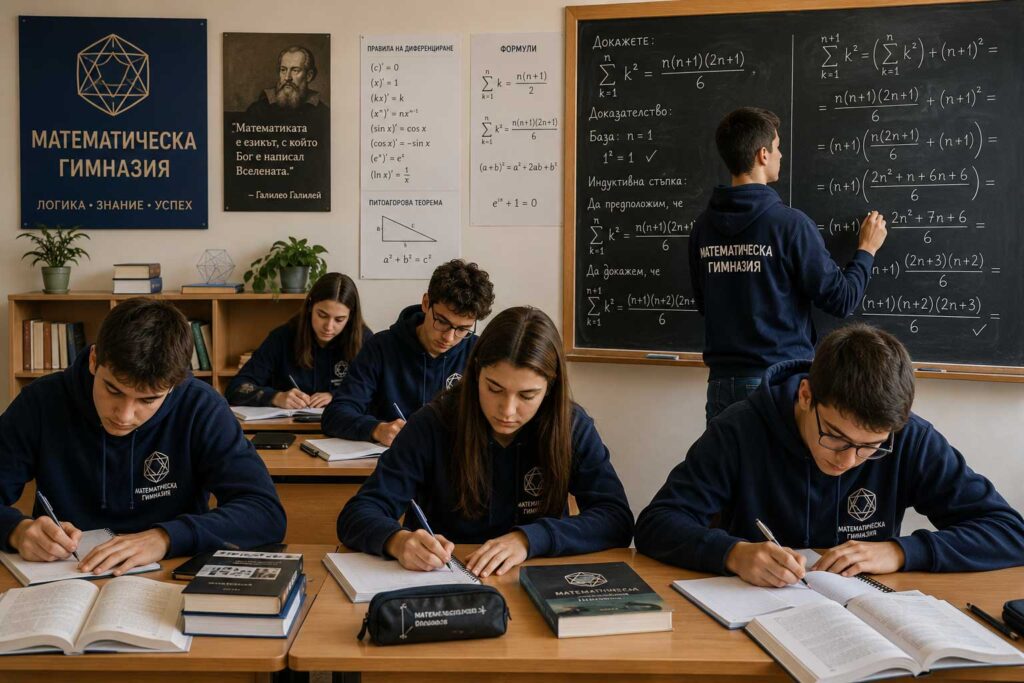
Bulgaria’s historic success at the 2003 International Mathematical Olympiad was not the product of a single exceptional generation. It grew from an educational tradition developed over decades—one that identified mathematically talented students early, challenged them with increasingly difficult problems, and connected them with experienced teachers and coaches.
At the heart of this model is a simple idea: mathematical ability should be recognized, encouraged, and developed from a young age. For generations of Bulgarian students, that journey has begun in primary school classrooms and local competitions before progressing to specialized schools, national Olympiads, training camps, and, for a select few, the international stage.
The historic Bulgaria International Mathematical Olympiad triumph of 2003 showed what this educational tradition could produce when exceptional talent, experienced teachers, and years of preparation came together.
Early Talent Identification
One of the strengths of Bulgaria’s mathematics education system is the early identification of students with exceptional problem-solving abilities.
Many children begin participating in mathematics competitions while still in primary school. These contests allow students to encounter problems that go beyond the standard curriculum and give teachers an opportunity to recognize those who demonstrate unusual creativity, logical reasoning, or persistence.
For some students, an early competition becomes the beginning of a journey that lasts for years. As they progress, they face increasingly challenging problems and gain experience in mathematical reasoning long before reaching secondary school.
Specialized Mathematics Schools
Bulgaria’s network of specialized mathematics schools has played a central role in developing generations of Olympiad competitors, scientists, engineers, and technology professionals.
Schools in Sofia, Varna, Plovdiv, Burgas, Ruse, Shumen, Pleven, and other cities provide academically talented students with opportunities to study mathematics and related subjects at a more advanced level. The curriculum is complemented by extracurricular competitions, mathematics circles, specialized seminars, and preparation with experienced educators.
These schools do more than teach advanced formulas or techniques. At their best, they create an environment where solving a difficult problem is valued, intellectual curiosity is encouraged, and talented students can learn alongside peers who share their enthusiasm for mathematics.
A Competitive Environment
Competition is another important part of the Bulgarian model.
Throughout their school years, talented students may participate in local contests, regional competitions, national Olympiads, the Balkan Mathematical Olympiad, and other international events. Each new level introduces more difficult challenges and requires greater creativity, discipline, and mathematical maturity.
This competitive structure gives students regular opportunities to test their abilities, learn from mistakes, and measure their progress against other talented young mathematicians.
By the time a student reaches the final stages of selection for Bulgaria’s International Mathematical Olympiad team, years of demanding competitions may already lie behind them.
A Strong Network of Teachers and Coaches
Exceptional students need exceptional mentors.
Bulgaria’s mathematical tradition has been sustained by generations of teachers, university professors, researchers, and Olympiad coaches who have devoted considerable time to identifying and developing young talent.
Their role extends beyond classroom teaching. They select challenging problems, organize training sessions, review proofs, identify weaknesses, and help students develop more creative and rigorous approaches to problem-solving.
The knowledge accumulated by one generation is often passed to the next. Former competitors may later become teachers, researchers, or coaches themselves, helping preserve and strengthen Bulgaria’s Olympiad tradition.
An Olympiad Culture Built Over Generations
In Bulgaria, mathematics competitions have long held a special place within the country’s educational culture.
For talented students, success in an Olympiad can be a significant source of pride for their school, teachers, family, and community. National and international medalists demonstrate that intellectual achievement deserves recognition alongside accomplishments in sports, arts, and other fields.
This tradition creates something difficult to measure but extremely important: continuity. Young students can look to previous generations of Bulgarian champions and see that reaching the highest international level is possible.
The six gold medalists of 2003 became part of that tradition, just as earlier Bulgarian Olympians helped create the foundation on which their success was built.
Years of Continuous Preparation
An International Mathematical Olympiad champion is not created in a few months.
Many elite competitors spend years solving increasingly difficult problems, attending specialized seminars, participating in training camps, and learning from experienced mentors. Along the way, they develop not only mathematical knowledge but also patience, resilience, precision, and the ability to remain focused when a solution does not come easily.
This long preparation matters because IMO problems rarely reward memorization. Students must often experiment with several approaches, recognize hidden patterns, and construct rigorous proofs under strict time limits.
By the time Bulgaria’s six competitors arrived in Tokyo in 2003, their performance represented the culmination of years of individual effort supported by teachers, schools, competitions, and a broader mathematical community.
A System That Helped Produce a World-Champion Team
The Bulgarian mathematics school model does not have a single secret formula. Its strength comes from the interaction of several elements: early opportunities for talented children, specialized education, regular competition, dedicated mentors, and a long-established respect for mathematical achievement.
The historic performance in Tokyo showed what this system could produce at its very best. Six students arrived representing a country of fewer than eight million people. All six returned as gold medalists, and together they placed Bulgaria at the top of the world standings.
Their victory belonged to the students who solved the problems, but it also reflected the work of generations of educators who had helped build Bulgaria’s mathematical tradition.
That is perhaps the most enduring lesson of the 2003 team: extraordinary talent matters, but talent reaches its highest potential when a country creates the schools, competitions, mentorship, and culture needed to help it grow.
Bulgaria’s Place in IMO History
Since making its debut at the International Mathematical Olympiad (IMO), Bulgaria has established itself as one of the world’s most successful and respected mathematical nations. Despite its relatively small population, the country has consistently competed with global educational powerhouses, earning an impressive record of medals and championship performances over more than six decades.
Throughout its history at the IMO, Bulgaria has produced:
- More than two hundred International Mathematical Olympiad medalists
- Dozens of gold medal winners
- Numerous contestants who later became internationally recognized mathematicians, scientists, professors, and researchers
- Generations of students who continued their studies at some of the world’s leading universities
These achievements are the result of a long-standing tradition of excellence in mathematics education, supported by specialized schools, dedicated teachers, and a national culture that values academic success.
The Bulgaria International Mathematical Olympiad story is defined by decades of remarkable results, but the 2003 victory stands apart as the country’s most successful team performance at the competition.
A Consistent International Contender
Unlike countries that occasionally produce exceptional teams, Bulgaria has remained competitive across multiple generations.
Bulgarian students have regularly earned medals at the International Mathematical Olympiad while also excelling in the Balkan Mathematical Olympiad, the European Girls’ Mathematical Olympiad, and other prestigious international competitions. This sustained success has earned Bulgaria a reputation as one of Europe’s leading centers for mathematical talent.
Over the decades, Bulgarian teams have repeatedly finished among the world’s top-performing nations, often outperforming countries with significantly larger populations and educational budgets.
The Pinnacle of Bulgarian Olympiad Success
Among all of Bulgaria’s achievements at the International Mathematical Olympiad, none has matched the historic performance of the 2003 team in Tokyo.
Winning the overall team championship would have been an extraordinary accomplishment on its own. What elevated the achievement into Olympiad history was the fact that every member of the Bulgarian delegation won a gold medal, producing one of the finest team performances ever recorded.
The combination of six gold medals, first place in the team standings, and exceptional consistency across all six contestants has made the 2003 team the benchmark against which all subsequent Bulgarian Olympiad teams are measured.
A Lasting Legacy
More than twenty years later, Bulgaria’s victory in 2003 remains one of the defining moments in the country’s educational history.
The success of that team continues to inspire young mathematicians, teachers, and Olympiad coaches throughout Bulgaria. It also serves as a powerful reminder that a nation does not need a large population to achieve world-class results. Through dedication, outstanding education, and a culture that celebrates knowledge, Bulgaria earned a permanent place among the greatest nations in the history of the International Mathematical Olympiad.
Today, the legacy of the 2003 champions lives on in every new generation of Bulgarian students who dream of representing their country on the world’s biggest mathematical stage.
Where Are They Today?
More than two decades have passed since Bulgaria’s historic victory at the 2003 International Mathematical Olympiad. The six champions have largely remained outside the public spotlight, and detailed information about each team member’s later career is not always readily available.
More broadly, Bulgarian Olympiad medalists have gone on to study and work at leading universities, research institutions, and technology companies around the world. The analytical thinking and problem-solving skills developed through Olympiad training can provide a strong foundation for careers in academia, engineering, finance, computer science, and technology.
Over the years, Bulgarian Olympiad participants and graduates of the country’s specialized mathematics programs have continued their studies at prestigious institutions such as:
- Harvard University
- Massachusetts Institute of Technology (MIT)
- Stanford University
- University of Cambridge
- University of Oxford
- ETH Zurich and other leading European universities
Many have gone on to become:
- University professors
- Scientific researchers
- Software engineers
- Artificial intelligence specialists
- Technology entrepreneurs
- Data scientists
- Financial analysts
- Leaders in the global technology industry
Beyond Mathematics
The value of Olympiad training extends far beyond solving difficult mathematical problems.
Preparing for competitions like the International Mathematical Olympiad teaches students skills that remain valuable throughout their professional and personal lives, including:
- Advanced problem-solving
- Analytical and critical thinking
- Logical reasoning
- Creativity and innovation
- Persistence when facing difficult challenges
- Attention to detail
- Clear communication through rigorous proofs
- The ability to solve unfamiliar problems under pressure
These abilities are highly sought after in fields ranging from scientific research and engineering to finance, cybersecurity, artificial intelligence, and entrepreneurship.
An Inspiration for Future Generations
The legacy of Bulgaria’s 2003 team is measured not only by the six gold medals they won but also by the inspiration they continue to provide for young mathematicians across the country.
Every year, new generations of Bulgarian students enter mathematics competitions hoping to follow in the footsteps of the champions who stood atop the world in Tokyo. Their story demonstrates that with exceptional teachers, dedicated preparation, and a passion for learning, students from a small nation can compete with—and defeat—the very best in the world.
More than twenty years later, the 2003 Bulgarian team remains a symbol of intellectual excellence and one of the greatest success stories in the history of Bulgarian education.
The Global Impact of Bulgarian Mathematical Talent
Bulgaria’s success at the International Mathematical Olympiad is more than a collection of medals—it reflects the country’s lasting contribution to science, technology, and innovation around the world. For decades, Bulgarian mathematicians and former Olympiad competitors have applied their talents to fields that shape modern society, from academic research and engineering to artificial intelligence and software development.
Bulgaria’s scientific tradition extends far beyond competitive mathematics. Generations of Bulgarian scientists have contributed to research and innovation, while notable Bulgarian inventions have influenced fields ranging from technology and computing to medicine and engineering. The country’s broader scientific legacy also includes internationally recognized achievements connected to Lactobacillus bulgaricus and microbiology.
Many of Bulgaria’s brightest mathematics students have continued their education at leading universities across Europe and North America before building careers in internationally recognized research institutions, technology companies, and innovative startups. Their expertise has contributed to advances in areas such as computer science, cryptography, machine learning, data science, finance, telecommunications, and theoretical mathematics.
The skills developed through Olympiad mathematics—logical reasoning, creativity, persistence, and the ability to solve complex problems—are highly valued far beyond the classroom. As a result, former Bulgarian Olympians are frequently found working as university professors, scientific researchers, software engineers, artificial intelligence specialists, quantitative analysts, and technology entrepreneurs.
Mathematics as a Foundation for Innovation

The rigorous training required for competitions such as the International Mathematical Olympiad prepares students for some of the world’s most demanding careers. Many employers in the technology and scientific sectors actively seek individuals with strong mathematical backgrounds because of their ability to analyze difficult problems and develop innovative solutions.
Bulgarian graduates have gone on to make important contributions in:
- Artificial intelligence and machine learning
- Computer science and software engineering
- Cybersecurity and cryptography
- Data science and big data analytics
- Financial mathematics and quantitative analysis
- Scientific research and higher education
- Engineering and advanced technologies
This tradition of excellence has helped establish Bulgaria as a country that consistently produces highly skilled scientists, engineers, and innovators.
Strengthening Bulgaria’s International Reputation
The historic victory of the 2003 Bulgarian International Mathematical Olympiad team reinforced Bulgaria’s reputation as a nation capable of competing with the world’s leading educational systems.
While the country is often recognized internationally for its rich history, cultural heritage, and sporting achievements, its accomplishments in mathematics and science have earned equal respect within academic circles. The success of Bulgarian Olympiad teams has demonstrated that a relatively small nation can produce world-class talent through outstanding education, dedicated teachers, and a culture that values knowledge.
Today, Bulgaria continues to build on that legacy as new generations of students win medals in mathematics, informatics, physics, astronomy, chemistry, and other international Olympiads. Together, these achievements have helped establish the country as one of Europe’s enduring centers of academic excellence and scientific potential.
Lessons from the 2003 Champions
The remarkable success of Bulgaria’s team at the 2003 International Mathematical Olympiad extends far beyond medals and rankings. Their historic victory offers valuable lessons about education, perseverance, and the power of investing in young talent. More than twenty years later, these lessons remain just as relevant for students, educators, and policymakers around the world.
Excellence Can Come from Small Nations
One of the most powerful messages of Bulgaria’s victory is that greatness is not determined by a country’s size.
With a population of fewer than eight million people at the time, Bulgaria defeated nations with vastly larger populations and educational budgets. The achievement proved that exceptional talent, combined with effective education and dedicated preparation, can overcome differences in size and resources.
The 2003 team demonstrated that small countries can compete with—and even surpass—the world’s largest academic powers.
Education Is a Long-Term Investment
Bulgaria’s triumph did not happen overnight.
It was the result of decades of investment in specialized mathematics schools, national Olympiads, experienced teachers, and programs designed to identify and nurture gifted students from an early age. The success of the 2003 team illustrates how sustained support for education can produce achievements that inspire an entire nation.
Investing in talented young people benefits not only the individuals themselves but also society as a whole, creating future scientists, engineers, researchers, and innovators.
Dedicated Teachers Make the Difference
Behind every Olympiad champion stands a teacher who believed in their potential.
The Bulgarian coaches and mathematics educators who trained the 2003 team devoted countless hours to designing challenging problems, reviewing proofs, organizing training camps, and encouraging students to push beyond their limits.
Their commitment reminds us that exceptional teachers are often the foundation of extraordinary achievements.
A Culture That Values Knowledge Creates Success
Bulgaria has long celebrated academic excellence, particularly in mathematics and science.
Students who succeed in national and international Olympiads are respected by their schools, families, and communities. This culture of recognizing intellectual achievement motivates young people to pursue excellence and inspires future generations to follow in the footsteps of those who came before them.
The 2003 champions became role models not only because they won gold medals but because they demonstrated what dedication, curiosity, and hard work can accomplish.
Teamwork Matters Even in Individual Competitions
Although each contestant solved the Olympiad problems independently, Bulgaria’s victory was ultimately a team achievement.
Every member of the delegation contributed to the nation’s championship, proving that collective excellence often depends on mutual support, shared preparation, and a common commitment to success. The team’s unity and consistency were just as important as the brilliance of its individual members.
The Power of Perseverance
Success at the International Mathematical Olympiad requires years of disciplined preparation.
The students who stood on the podium in Tokyo had spent countless hours solving difficult problems, learning from mistakes, and continually improving their skills. Their journey demonstrates that extraordinary accomplishments are built through persistence, patience, and a willingness to embrace difficult challenges.
A Legacy That Continues to Inspire
The story of Bulgaria’s 2003 International Mathematical Olympiad champions is about far more than winning a competition. It is a testament to what can be achieved when talented students are supported by outstanding teachers, encouraged by a culture that values education, and given the opportunity to reach their full potential.
Their achievement continues to inspire young mathematicians in Bulgaria and around the world, reminding us that knowledge, determination, and a passion for learning can leave a lasting mark on history.
Legacy of the Perfect Team
More than two decades after their unforgettable victory in Tokyo, the six members of Bulgaria’s 2003 International Mathematical Olympiad team remain enduring symbols of academic excellence and national pride. Their achievement continues to be celebrated as one of the greatest moments in the history of Bulgarian education, demonstrating that determination, knowledge, and perseverance can elevate a small nation to the top of the world.
The impact of their success extends far beyond the medals they won. Their historic performance has inspired countless:
- Students pursuing mathematics and science
- Teachers dedicated to developing young talent
- Parents encouraging academic achievement
- Researchers and university professors
- Future Olympiad competitors
- Educators seeking to strengthen gifted education
Bulgaria is celebrated around the world for its ancient history, natural beauty, and vibrant Bulgarian festivals and traditions, but its remarkable achievements in mathematics and science deserve equal recognition.
For many young Bulgarians, the story of the 2003 champions serves as proof that extraordinary accomplishments are possible regardless of a country’s size. Their journey encourages new generations to embrace curiosity, work hard, and strive for excellence in mathematics, science, and other academic disciplines.
The legacy of the Bulgaria International Mathematical Olympiad team of 2003 continues to inspire young students who dream of representing their country on the international stage.
Bulgaria has celebrated extraordinary champions in many fields, from the legendary Bulgarian Olympic Gold Medalists who reached the pinnacle of world sport to the six young mathematicians who conquered the world’s most prestigious mathematics competition.
A Source of National Pride
Bulgaria is widely known for its rich history, ancient civilizations, cultural traditions, and breathtaking landscapes. Yet the nation’s achievements in education and science are equally deserving of recognition.
The victory at the 2003 International Mathematical Olympiad showcased Bulgaria’s intellectual strength on one of the world’s most prestigious academic stages. At a time when global attention often focuses on sporting events, the six Bulgarian students demonstrated that victories earned through knowledge, creativity, and rigorous problem-solving can be just as meaningful as those won on the playing field.
Although Bulgarian culture is often associated with ancient traditions, folklore, music, and historic heritage, the nation’s achievements in education and science are equally important parts of its modern identity.
Their success reminded the world that Bulgaria’s greatest ambassadors are not only athletes, artists, and cultural figures, but also its scientists, mathematicians, engineers, and innovators.
While Bulgaria’s history is filled with courageous Bulgarian national heroes, the country’s modern champions also include students, scientists, athletes, and innovators who have brought international recognition to their homeland.
Inspiring Future Generations
The legacy of the 2003 team continues every time a Bulgarian student participates in a mathematics competition, solves a challenging problem, or dreams of representing the country at an international Olympiad.
Many of today’s young competitors grew up hearing about the remarkable team that won six gold medals and became world champions. Their story has become part of Bulgaria’s mathematical tradition, inspiring students to believe that they too can compete with the very best in the world.
As new generations continue to earn medals at international mathematics, informatics, physics, chemistry, and astronomy Olympiads, they build upon the foundation established by those who came before them.
One of Bulgaria’s Greatest Educational Achievements
The triumph of the 2003 Bulgarian team stands as a lasting example of what can be achieved through exceptional talent, dedicated teachers, disciplined preparation, and a strong mathematical tradition. Six students traveled to Tokyo to represent their country, and all six returned as gold medalists after helping Bulgaria finish first in the world standings.
More than two decades later, their performance remains one of Bulgaria’s proudest educational accomplishments. The six champions did more than win a competition—they created a legacy that continues to inspire young mathematicians and remind new generations of what Bulgarian students can achieve on the international stage.
Readers inspired to learn more about the country can explore our complete Bulgaria travel guide, covering its historic cities, natural wonders, cultural landmarks, and hidden treasures.
FAQs About Bulgaria International Mathematical Olympiad
Did Bulgaria win the International Mathematical Olympiad in 2003?
Yes. Bulgaria won the 44th International Mathematical Olympiad (IMO) held in Tokyo, Japan, in 2003. The Bulgarian team finished first in the overall team standings with 227 out of 252 possible points, ahead of China and the United States.
How many gold medals did Bulgaria win at the 2003 International Mathematical Olympiad?
Bulgaria won six gold medals—one for each member of its national team. This is one of the rarest and most remarkable achievements in the history of the International Mathematical Olympiad.
Who were the members of Bulgaria’s 2003 International Mathematical Olympiad team?
The six members of the championship team were:
- Kaloyan Slavov
- Rumen Zarev
- Iliya Tsekov
- Rosen Dimitrov Kralev
- Aleksandar Dimitrov Lishkov
- Dobromir Rahnev
Each competitor earned a gold medal during the 2003 competition.
Where was the 2003 International Mathematical Olympiad held?
The 44th International Mathematical Olympiad took place in Tokyo, Japan, from July 7 to July 19, 2003, bringing together 457 students from 82 countries.
Why is Bulgaria’s 2003 IMO team considered historic?
The team is considered historic because Bulgaria won the overall championship while every member of the six-person delegation earned a gold medal. Very few countries have ever achieved such a perfect team performance at the IMO.
What is the International Mathematical Olympiad?
The International Mathematical Olympiad (IMO) is the world’s most prestigious mathematics competition for secondary school students. Established in 1959, it brings together the top young mathematicians from more than 100 countries each year.
How are students selected for the International Mathematical Olympiad?
Students qualify through a series of national mathematics competitions, Olympiads, and intensive training camps. Only the six highest-performing students are selected to represent Bulgaria at the International Mathematical Olympiad.
Why is Bulgaria so successful in mathematics competitions?
Bulgaria’s success is built on decades of investment in specialized mathematics schools, experienced teachers, rigorous national competitions, and a strong culture that values academic excellence. These factors have helped produce generations of internationally recognized mathematicians and Olympiad medalists.
What subjects are tested at the International Mathematical Olympiad?
The competition focuses on four main areas of mathematics:
- Algebra
- Geometry
- Number Theory
- Combinatorics
Contestants must solve six challenging proof-based problems over two examination days.
Why is the 2003 Bulgarian team still remembered today?
More than twenty years later, the 2003 team remains one of the greatest symbols of Bulgarian academic excellence. Their victory demonstrated that a small country with exceptional students, dedicated teachers, and a strong educational tradition could become world champion in one of the world’s toughest academic competitions.
Bulgaria’s Greatest Mathematical Triumph
The story of Bulgaria’s 2003 International Mathematical Olympiad team reaches far beyond the final standings in Tokyo. It is a story of six young people, years of demanding preparation, dedicated teachers, and a mathematical tradition that allowed a small European nation to stand at the top of the world.
When six young Bulgarians traveled to Tokyo in 2003, they carried with them not only years of preparation but also the hopes of a nation with a proud mathematical tradition. By returning home with six gold medals and the team world championship, they accomplished something that remains one of the greatest academic achievements in Bulgarian history.
The Bulgaria International Mathematical Olympiad victory of 2003 remains a defining chapter in the country’s educational history and a powerful symbol of Bulgarian excellence.
Their victory demonstrated that success is not determined by a country’s size or wealth. Instead, it showed that exceptional teachers, specialized schools, disciplined students, and a culture that values knowledge can produce results that inspire the world.
More than two decades later, the legacy of the 2003 champions continues to motivate new generations of Bulgarian students to pursue mathematics, science, and innovation. Their achievement stands as a powerful reminder that Bulgaria’s greatest victories are not only written on athletic fields or battlefields but also in classrooms, laboratories, and international academic competitions.
As Bulgaropedia celebrates the people and events that have shaped Bulgaria’s past and present, the triumph of the 2003 International Mathematical Olympiad team deserves its place among the nation’s finest accomplishments—a moment when six brilliant young minds proved that Bulgarian excellence can stand at the very top of the world.