

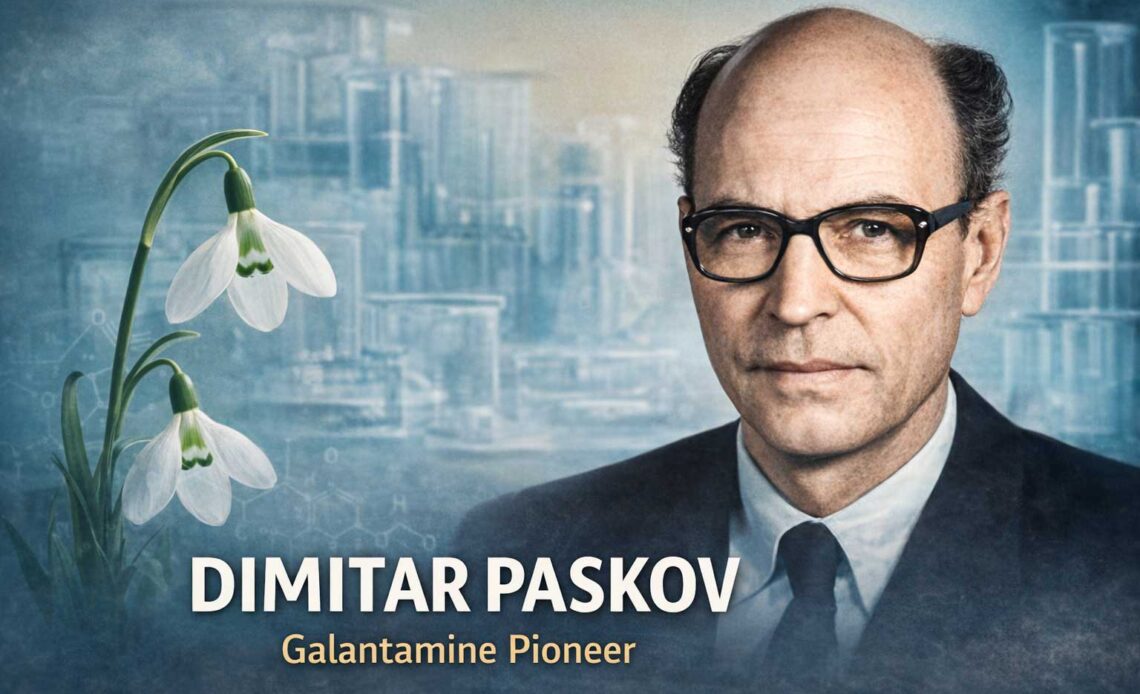

Dimitar Paskov (Bulgarian: Димитър Пасков) is one of the most important figures in Bulgarian scientific history, best known for his role in the development of Galantamine (Nivalin)—a plant-derived pharmaceutical compound that later became a globally recognized treatment for Alzheimer’s disease.
In 1959, Paskov led a research team at Sopharma that successfully extracted and industrialized galantamine from the common snowdrop plant. This breakthrough marked a major milestone not only for Bulgarian pharmacology but for global medicine.
What makes this achievement particularly remarkable is the transformation of a natural compound into a standardized pharmaceutical product. At a time when many countries were still developing their modern healthcare systems, Bulgaria managed to contribute a discovery that would eventually enter international clinical practice.
👉 Explore more → Bulgarian Scientists Who Changed the World.
Quick facts
Name: Dimitar Paskov
Bulgarian: Димитър Пасков
Born: 18 October 1914
Died: 24 April 1986
Field: Chemistry / Pharmacology
Known for: Development of Nivalin (galantamine)
Breakthrough year: 1959
Global impact: Alzheimer’s disease treatment.
Who was Dimitar Paskov?
Dimitar Paskov (1914–1986) was a Bulgarian chemist and pharmacologist whose work focused on extracting and studying biologically active compounds from natural sources.
Unlike many researchers who remained within theoretical science, Paskov operated at the intersection of laboratory research and practical application, helping move discoveries from experimentation to real-world use.
His work represents a broader tradition in Bulgarian science—achieving meaningful breakthroughs despite limited resources. By combining deep chemical knowledge with applied pharmacology, Paskov helped demonstrate that innovation is driven more by insight and persistence than by scale.
👉 Related reading → Bulgarian Contributions to Medicine.
The 1959 Breakthrough: Creation of Nivalin
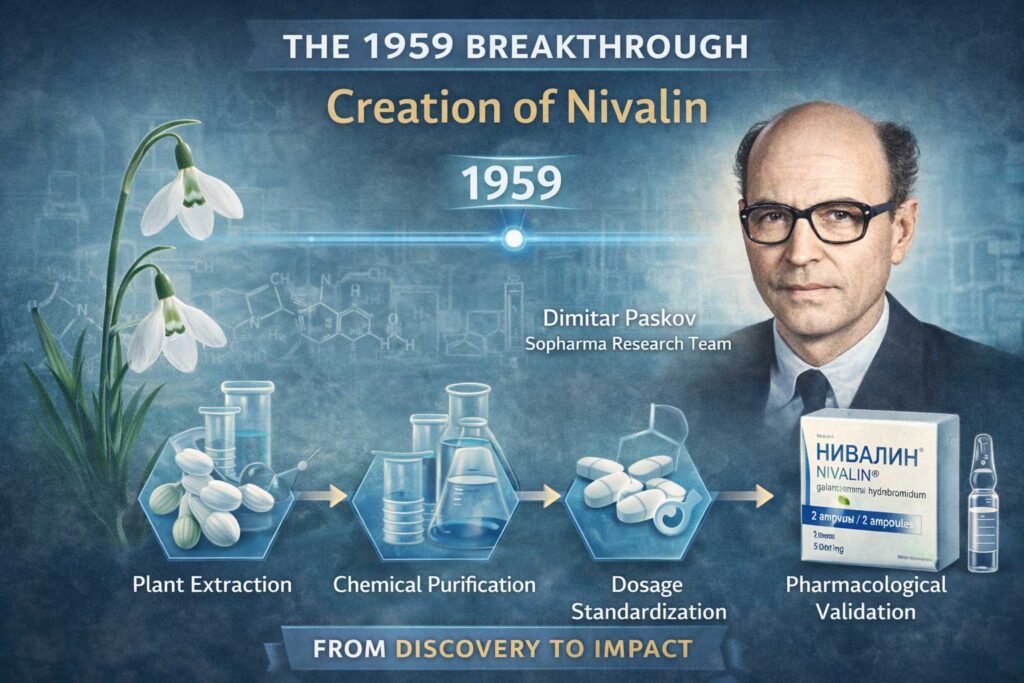
The most important milestone in the historical record is 1959, the year Dimitar Paskov led a research team at Sopharma to successfully extract and industrialize galantamine, later marketed as Nivalin.
This achievement marked the first time the compound was transformed from a naturally occurring alkaloid into a stable, standardized pharmaceutical product suitable for clinical use. It was not simply a laboratory discovery—it was a complete transition from plant chemistry to modern medicine.
The process required multiple advanced steps, including:
- Extraction from plant material
- Chemical purification
- Dosage standardization
- Pharmacological validation
Each stage demanded precision and innovation, especially considering the technological limitations of the time.
More importantly, the shift to industrial-scale production ensured that the drug could be distributed and used in real healthcare settings. This is the defining moment when discovery becomes impact—when a compound moves from the laboratory into patients’ lives.
For Bulgaria, this breakthrough was a landmark achievement. It demonstrated that the country could not only contribute to global scientific knowledge but also develop practical medical solutions with long-term international relevance.
👉 Explore more → History of Bulgarian Science and Technology
The Snowdrop: From Nature to Medicine
The compound galantamine is derived from plants in the Amaryllidaceae family, most notably the snowdrop Galanthus nivalis.
While often seen as a delicate ornamental flower, the snowdrop contains alkaloids with powerful biological activity. This contrast between appearance and function highlights a key principle in pharmacology: natural compounds can possess significant therapeutic potential even when their source appears ordinary.
Paskov’s work transformed this plant from a botanical curiosity into a medically valuable resource. It also reinforced the importance of biodiversity and plant-based research in modern drug discovery.
👉 Learn more → Bulgarian Nature and Medicinal Plants
The snowdrop is therefore not a trivial footnote in the history of medicine—it is central to the story. Without the plant source and the knowledge to explore it scientifically, there would have been no Nivalin.
What is Nivalin?
Nivalin is the pharmaceutical name used in Bulgaria for galantamine hydrobromide, a compound derived from plant alkaloids and developed into a standardized medication.
It has the chemical formula:
C17H21NO3 · HBr
Molecular weight: 386.3
The significance of Nivalin lies not just in its chemical structure, but in its transformation into a controlled pharmaceutical product. Standardization ensures consistent dosage, predictable effects, and safe medical use—essential factors for any modern drug.
Without this step, galantamine would have remained a laboratory compound rather than becoming part of clinical practice.
How Galantamine Works
Galantamine functions as a reversible acetylcholinesterase inhibitor, meaning it slows the breakdown of acetylcholine in the brain.
Acetylcholine is a neurotransmitter responsible for memory, learning, and communication between nerve cells. In neurodegenerative diseases like Alzheimer’s, levels of this chemical decline, leading to impaired cognitive function.
By preserving acetylcholine, the drug helps maintain neural communication for longer periods. While it does not address the underlying cause of the disease, it supports brain function and can improve the quality of life for patients.
Brain Support Supplements for Cognitive Function
| Product | Best For | Why It’s Useful | Rating | Check Price |
|---|---|---|---|---|
| Omega-3 Fish Oil | Brain health | Supports cognitive function | ⭐⭐⭐⭐⭐ | 👉 Check Price on Amazon |
| Ginkgo Biloba | Memory support | Traditional cognitive herb | ⭐⭐⭐⭐☆ | 👉 Check Price on Amazon |
| Phosphatidylserine | Focus | Supports brain cell activity | ⭐⭐⭐⭐☆ | 👉 Check Price on Amazon |
| Bacopa Monnieri | Cognitive boost | Used in herbal medicine | ⭐⭐⭐⭐☆ | 👉 Check Price on Amazon |
👉 Support your brain naturally → Browse trusted cognitive supplements.
⚠️ These supplements are not intended to diagnose, treat, cure, or prevent any disease.
Role in Alzheimer’s Disease

Galantamine is primarily used in the treatment of mild to moderate Alzheimer’s disease, one of the most common forms of dementia worldwide.
Its benefits include:
- Improved memory and recall
- Enhanced cognitive awareness
- Better ability to perform daily activities
However, it is important to note that galantamine is not a cure. It is part of a broader treatment strategy aimed at managing symptoms and slowing cognitive decline.
Despite this limitation, it remains an important tool in modern neurological care.
👉 Read also → Modern Medical Innovations
From Bulgaria to Global Medicine
Although originally developed in Bulgaria, galantamine has achieved global recognition and is now used in healthcare systems around the world.
Its adoption in international medical practice demonstrates the scientific validity and effectiveness of the compound. It also reflects the ability of research from smaller countries to influence global healthcare when supported by strong evidence and application.
Paskov’s work stands as a powerful example of how local discoveries can scale into worldwide medical solutions.
👉 Explore more → Bulgarian Global Contributions.
Scientific Significance
The importance of Dimitar Paskov’s work extends beyond a single drug.
First, it highlights the role of natural product chemistry in drug discovery—a field that continues to produce major medical breakthroughs.
Second, it demonstrates the value of interdisciplinary research, combining chemistry, biology, and pharmacology to achieve practical outcomes.
Finally, it shows that innovation often comes from refining and applying existing knowledge rather than discovering entirely new concepts.
This positions Paskov’s work within the broader evolution of modern pharmaceutical science.
Why Dimitar Paskov Deserves More Recognition

Despite his clear contribution to global medicine, the Bulgarian scientist Paskov remains relatively unknown outside academic circles and regional historical accounts. This lack of recognition stands in contrast to the lasting global impact of his work.
Several factors help explain this. During the mid-twentieth century, scientific achievements from Eastern Europe often received limited international visibility, particularly in English-language publications. In addition, pharmaceutical history tends to emphasize later commercial development and global distribution, rather than the original research and early industrial breakthroughs that made those advancements possible.
As a result, foundational contributors like Paskov can be overlooked, even when their work directly influences modern medical practice. In the case of galantamine, the early Bulgarian development of Nivalin played a critical role in shaping its path toward international recognition.
Restoring visibility to Paskov is therefore more than a matter of historical accuracy—it helps broaden the global narrative of scientific innovation. His story highlights how important discoveries can emerge outside major scientific centers and still achieve lasting worldwide impact.
👉 Explore more → Forgotten Bulgarian Geniuses.
Why Dimitar Paskov matters in Bulgarian history
Dimitar Paskov matters because he represents a form of Bulgarian achievement that is both scientifically rigorous and globally verifiable. His contribution is not based on folklore, national pride, or retrospective interpretation—it is grounded in documented research, pharmaceutical development, and continued medical use.
This distinction is important. Many historical figures are remembered symbolically, but Paskov’s impact can be directly measured through the development and ongoing use of Galantamine in modern medicine. His work connects Bulgaria to a concrete, internationally recognized advancement in pharmacology.
He also plays a key role in reshaping how Bulgaria is perceived in global history. The country is often associated with cultural and historical achievements—folklore, medieval heritage, monasteries, rose oil, yogurt, and archaeology. While these are significant, they represent only part of the national story. Paskov’s legacy highlights Bulgaria’s contribution to scientific innovation, medicinal chemistry, and drug development.
In a time when nations increasingly look to their past for credible scientific role models, Paskov stands out as a figure of lasting relevance. He should be recognized not only within Bulgaria, but as part of the broader history of twentieth-century medical science.
The Link Between Ethnobotany and Pharmacology
One of the most compelling aspects of the galantamine story is its connection to ethnobotany-driven drug discovery—the study of how traditional knowledge of plants can lead to modern medical breakthroughs. Scientific research suggests that the development of Galantamine was influenced, at least in part, by observations of medicinal plants within the Amaryllidaceae family, including the snowdrop Galanthus nivalis.
This places the work of Dimitar Paskov within a broader scientific tradition—one where natural remedies serve as the starting point for pharmacological investigation. Rather than relying solely on synthetic experimentation, researchers examine how plants have been used historically and then apply modern chemistry to isolate and validate active compounds.
The significance of this approach lies in its ability to bridge traditional knowledge and modern science. Ethnobotanical insights can guide researchers toward compounds that might otherwise remain undiscovered, while pharmacology provides the tools to test, refine, and standardize those compounds for clinical use.
In the case of galantamine, this process demonstrates how a naturally occurring alkaloid can move from observational knowledge to a globally recognized pharmaceutical treatment. It is a clear example of how scientific innovation often begins with careful attention to nature—and how that knowledge can be transformed into lasting medical impact.
Galantamine and Alzheimer’s Disease
Today, Galantamine is most widely recognized for its role in the symptomatic treatment of Alzheimer’s disease. Clinical and healthcare sources consistently state that it is prescribed for mild to moderate Alzheimer’s dementia, where it helps support cognitive function rather than providing a cure.
By inhibiting acetylcholinesterase, galantamine increases the availability of acetylcholine in the brain—a neurotransmitter essential for memory and learning. This mechanism can improve thinking ability, memory retention, and overall cognitive performance in some patients. However, it is important to emphasize that the drug does not stop or reverse the progression of the disease.
This stage of the story highlights the lasting impact of Dimitar Paskov’s work. A discovery made in Bulgaria in the mid-twentieth century became part of modern treatment strategies for one of the most complex and challenging neurodegenerative conditions.
While today’s Alzheimer’s treatment landscape includes multiple medications and approaches, galantamine remains an important component of symptomatic care. Its continued use reinforces the medical relevance of Paskov’s contribution and underscores how foundational research can shape patient care decades into the future.
👉 This article may contain affiliate links. If you purchase through these links, we may earn a small commission at no extra cost to you.
Recommended Books on Alzheimer’s & Brain Health
| Product | Best For | Why It’s Useful | Rating | Check Price |
|---|---|---|---|---|
| The End of Alzheimer’s – Dale Bredesen | Beginners | Science-backed prevention strategies | ⭐⭐⭐⭐⭐ | 👉 Check Price on Amazon |
| Keep Sharp – Sanjay Gupta | Everyday readers | Practical brain health tips | ⭐⭐⭐⭐⭐ | 👉 Check Price on Amazon |
| The Alzheimer’s Solution | Lifestyle focus | Diet + prevention strategies | ⭐⭐⭐⭐☆ | 👉 Check Price on Amazon |
| Grain Brain – David Perlmutter | Nutrition | Brain-health diet insights | ⭐⭐⭐⭐☆ | 👉 Check Price on Amazon |
👉 Want to better understand brain health? Explore top-rated Alzheimer’s and neuroscience books.
Dimitar Paskov’s Legacy in Science and Medicine
The legacy of Dimitar Paskov can be understood through several key contributions that extend far beyond his original discovery.
First, he helped establish Bulgaria’s place in the field of pharmaceutical natural products. Historical and scientific reviews of galantamine consistently reference the 1959 industrial development led by Paskov, positioning Bulgaria within the global narrative of plant-based drug discovery. This alone represents a significant national achievement in modern science.
Second, he contributed to the advancement of neurological therapeutics. Although galantamine gained broader international recognition years later, the early development of Nivalin in Bulgaria laid the essential groundwork for its future use in treating Alzheimer’s disease and related conditions.
Third, Paskov’s work demonstrates how botanical resources can be transformed into clinically valuable medicines. His research highlights the importance of combining chemistry and pharmacology to unlock the therapeutic potential of natural compounds—an approach that continues to influence modern drug development.
Fourth, he represents a rare kind of scientific legacy: one directly connected to a medicine still used in contemporary healthcare. This continuity—from discovery to ongoing clinical relevance—is uncommon and underscores the lasting impact of his work.
Taken together, these contributions position Paskov not only as a Bulgarian scientific figure, but as part of a broader global legacy in medicine—one that continues to shape research, treatment, and understanding of neurological disease.
Why His Story Deserves More Visibility
Despite the global importance of galantamine, Dimitar Paskov remains largely unknown outside specialist circles, Bulgarian references, and limited historical mentions. This is surprising, considering his story contains all the elements of a compelling scientific legacy: a Bulgarian researcher, a medicinal plant, a pharmaceutical breakthrough, and a drug that continues to impact modern neurological medicine.
One reason for this gap is that medical histories often emphasize the final global product rather than the earlier scientific development behind it. In many cases, the original researchers and regional breakthroughs receive less recognition than the later commercial or international stages.
Additionally, Eastern European scientific contributions have historically been underrepresented in English-language publications, which has further limited global awareness of figures like Paskov. As a result, significant discoveries can remain partially overlooked despite their lasting impact.
However, this lack of visibility also creates an opportunity. By highlighting Paskov’s work, we not only restore recognition to an important scientist but also broaden the narrative of global innovation—showing that meaningful breakthroughs can emerge from any part of the world.
For Bulgaropedia, Dimitar Paskov represents the ideal subject: a figure who combines scientific achievement, national significance, and global relevance, making his story both educational and essential.
👉 This discovery places Bulgaria among the countries that have directly contributed to modern neurological medicine.
Conclusion
Dimitar Paskov should be remembered as one of Bulgaria’s most important scientific figures of the twentieth century. His role in the extraction and industrial development of Nivalin (galantamine) in 1959 represents far more than a chemical milestone—it marks a defining moment in the intersection of natural compounds and modern pharmacology.
This achievement reflects Bulgaria’s contribution to global science, demonstrating how plant-based research can lead to clinically significant medical treatments. The journey from snowdrop-derived alkaloid to internationally recognized neurological drug stands as a powerful example of innovation rooted in both nature and scientific precision.
His legacy continues to matter because galantamine remains an active part of modern medicine. Used worldwide in the treatment of mild to moderate Alzheimer’s disease, it continues to support patients and healthcare systems decades after its initial development.
Dimitar Paskov is therefore not simply a historical figure. He represents a living scientific legacy—one that continues to shape medical practice and highlight Bulgaria’s role in advancing global healthcare.
Tools to Support Memory and Brain Function
| Product | Best For | Why It’s Useful | Rating | Check Price |
|---|---|---|---|---|
| Brain Training Apps (Lumosity) | Mental fitness | Improves memory & focus | ⭐⭐⭐⭐☆ | 👉 Check Price |
| Puzzle & Activity Books | Cognitive stimulation | Keeps brain active | ⭐⭐⭐⭐☆ | 👉 Check Price |
| Blue Light Blocking Glasses | Sleep quality | Better sleep = better cognition | ⭐⭐⭐⭐☆ | 👉 Check Price |
| Guided Journals | Memory retention | Enhances mental clarity | ⭐⭐⭐⭐☆ | 👉 Check Price |
👉 Train your brain daily → Explore tools that improve memory and focus.
Frequently Asked Questions (FAQ) About Dimitar Paskov
Who was Dimitar Paskov?
Dimitar Paskov was a Bulgarian chemist and pharmacologist best known for leading the team that developed Nivalin (galantamine) in 1959, a breakthrough in plant-based pharmaceutical medicine.
What is Nivalin?
Nivalin is the Bulgarian pharmaceutical preparation of galantamine hydrobromide, originally developed for medical use as a neurological treatment.
What is Galantamine used for?
Galantamine is used to treat symptoms of mild to moderate Alzheimer’s disease by improving memory and cognitive function.
Where does galantamine come from?
The drug is derived from plants in the Amaryllidaceae family, especially the snowdrop Galanthus nivalis.
What type of drug is galantamine?
It is an acetylcholinesterase inhibitor, a class of drugs that enhances communication between nerve cells in the brain.
Does galantamine cure Alzheimer’s disease?
No, galantamine does not cure Alzheimer’s disease. It helps manage symptoms and may temporarily improve cognitive function.
Why is the snowdrop plant important?
The snowdrop contains natural alkaloids, including galantamine, which can be extracted and used in medicine.
When was Nivalin discovered?
Nivalin was developed in 1959 by a research team led by Dimitar Paskov.
What company developed Nivalin?
Nivalin was developed by Sopharma, one of Bulgaria’s leading pharmaceutical companies.
Is galantamine still used today?
Yes, the drug is still widely used worldwide as part of Alzheimer’s treatment plans.
What does acetylcholine do in the brain?
Acetylcholine is a neurotransmitter that plays a key role in memory, learning, and communication between nerve cells.
Why is Dimitar Paskov important?
He helped transform a natural plant compound into a standardized pharmaceutical drug with global medical use.
Is galantamine a natural or synthetic drug?
The drug is naturally derived but is often synthesized today for large-scale pharmaceutical production.
What field did Paskov specialize in?
Dimitar Paskov worked in chemistry and pharmacology, focusing on medicinal compounds derived from plants.
How has Bulgaria contributed to medicine?
Bulgaria has contributed through discoveries like galantamine and the work of scientists such as Stamen Grigorov, known for probiotic research.
Is galantamine used outside of Bulgaria?
Yes, this medicine is used internationally, including in the United States and across Europe.
What diseases does galantamine treat?
It is primarily used to treat symptoms of Alzheimer’s disease and other forms of dementia.
Why isn’t Dimitar Paskov widely known?
His work was developed during a time when Eastern European scientific contributions received less global attention.
What is the chemical formula of galantamine?
The chemical formula of galantamine hydrobromide is C17H21NO3 · HBr.
What is Dimitar Paskov’s legacy?
His legacy is the development of a globally used neurological drug that continues to help patients with cognitive disorders.
References
- Dimitar Paskov – Biography and scientific contribution
https://en.wikipedia.org/wiki/Dimitar_Paskov - Heinrich, M., & Teoh, H. L. (2004). Galanthamine from snowdrop to Alzheimer’s therapy. Journal of Ethnopharmacology
https://www.sciencedirect.com/science/article/abs/pii/S037887410400073X - Galantamine – Chemical data and structure
https://pubchem.ncbi.nlm.nih.gov/compound/Galantamine - U.S. Food and Drug Administration. Galantamine Prescribing Information
https://www.accessdata.fda.gov/drugsatfda_docs/label/2017/021169Orig1s032lbl.pdf - National Health Service (UK). Alzheimer’s Disease Treatment
https://www.nhs.uk/conditions/alzheimers-disease/treatment/ - Royal College of Physicians. Medicinal History of Snowdrop
https://history.rcp.ac.uk/blog/white-here-white-now-medicinal-power-dainty-snowdrop - World Health Organization. Dementia Fact Sheet
https://www.who.int/news-room/fact-sheets/detail/dementia - European Medicines Agency. Galantamine Assessment Report
https://www.ema.europa.eu/en/medicines/human/referrals/galantamine-stada - Mayo Clinic. Galantamine Drug Information
https://www.mayoclinic.org/drugs-supplements/galantamine - Chruściel, M., & Varagić, V. (1966). Effect of Galantamine on Blood Pressure. British Journal of Pharmacology
https://doi.org/10.1111/j.1476-5381.1966.tb01908.x