


Bulgarian symbols and their meaning are deeply embedded in the country’s identity, functioning as powerful carriers of history, culture, and national consciousness. Unlike many modern nations where symbols are primarily institutional, in Bulgaria they exist simultaneously in official state imagery, folklore traditions, religious life, and everyday customs.
This layered symbolism reflects Bulgaria’s complex past—spanning ancient Thracian civilizations, medieval empires, centuries of Ottoman rule, and eventual national revival. Each period contributed new symbols or reshaped existing ones, creating a rich tapestry of meaning that continues to influence modern Bulgarian life.
What makes Bulgarian symbols unique is their continuity. The same lion that appeared in medieval heraldry still represents the nation today. The same Martenitsa tradition practiced centuries ago is still exchanged every March. The same alphabet created in the early medieval period continues to be used by millions.
👉 To understand how these symbols connect to everyday life, explore → Bulgarian Traditions and Customs Explained.
Symbols in Bulgaria are not passive—they are lived, worn, celebrated, and remembered.
Why Bulgarian Symbols Are Unique in Europe
What makes Bulgarian symbols particularly unique is their continuous use across multiple historical periods without losing meaning.
Unlike many European nations where symbols were replaced or redefined, Bulgaria preserved its core symbolic system through:
- Medieval empires
- Ottoman rule
- National revival
- Modern statehood
This continuity creates a rare phenomenon:
👉 A living symbolic system that connects over 1,000 years of history into a single cultural identity.
What Are the Main Bulgarian Symbols?
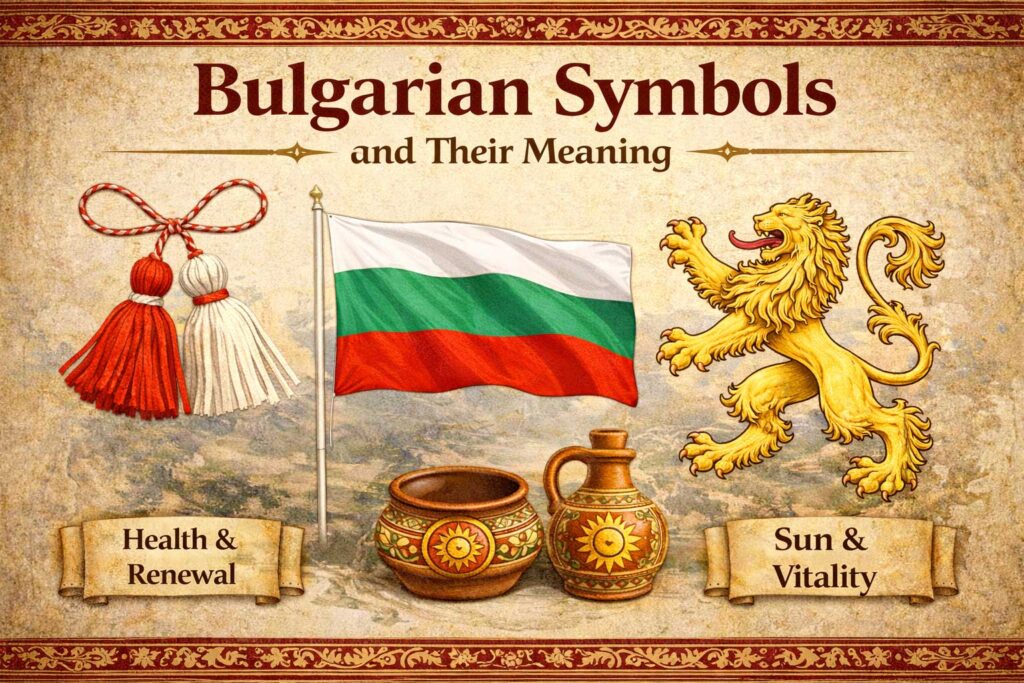
To fully understand Bulgarian symbols and their meaning, it is helpful to organize them into distinct categories.
Official National Symbols
These represent the state and are legally recognized:
- National flag
- Coat of arms
- National anthem
Cultural Symbols
These emerge from tradition and daily life:
- The lion
- The rose
- The Martenitsa
- The Cyrillic alphabet
Folk and Artistic Symbols
These appear in crafts and traditional expression:
- Embroidery motifs
- Carpets and pottery
- Ritual bread designs
Religious Symbols
Rooted in Orthodox Christianity:
- Crosses
- Icons
- Monasteries
Each group plays a role in shaping Bulgarian identity from a different angle—political, cultural, spiritual, and artistic.
👉 For a broader cultural overview, see → Why Bulgaria’s Culture Is So Unique.
The Bulgarian Lion: Symbol of Strength, Courage, and Statehood
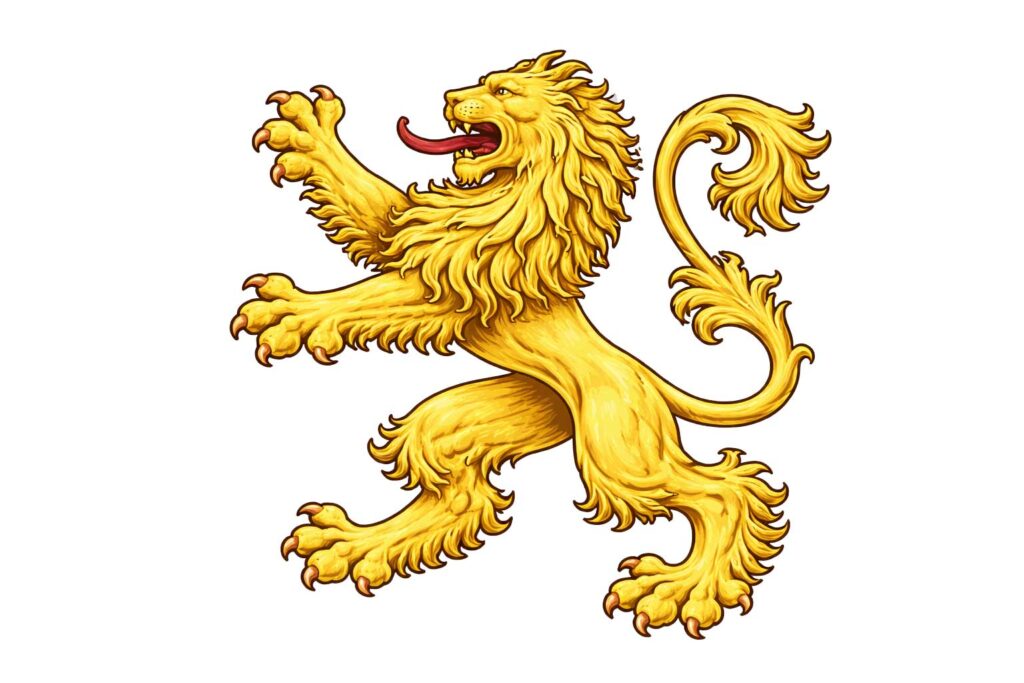
The lion is arguably the most important symbol in Bulgaria.
Historical Origins of the Lion Symbol
The lion appeared in Bulgarian heraldry as early as the 13th–14th centuries during the Second Bulgarian Empire. Medieval rulers used the lion to represent royal authority, sovereignty, and divine legitimacy.
Over time, the lion became synonymous with Bulgarian statehood itself.
The Lion During Ottoman Rule
During the Ottoman period (14th–19th century), Bulgaria lost its political independence—but not its symbolic identity.
The lion evolved into a symbol of resistance:
- Used in revolutionary flags
- Featured in nationalist literature
- Represented the dream of liberation
This transformation is crucial: the lion was no longer just a royal symbol—it became a national one.
The Lion in Modern Bulgaria
Today, the lion appears in:
- The coat of arms
- Government institutions
- Military insignia
- Public monuments
It represents:
- Strength
- Courage
- Independence
- National unity
The lion is not just a symbol—it is the emotional core of Bulgarian identity.
This is one of the clearest examples of Bulgarian symbols and their meaning, where a single image represents centuries of statehood, resistance, and national identity.
👉 See how traditions shaped everyday Bulgarian life → Bulgarian Traditions and Customs Explained.
The Bulgarian Flag: Meaning of the White, Green, and Red Colors
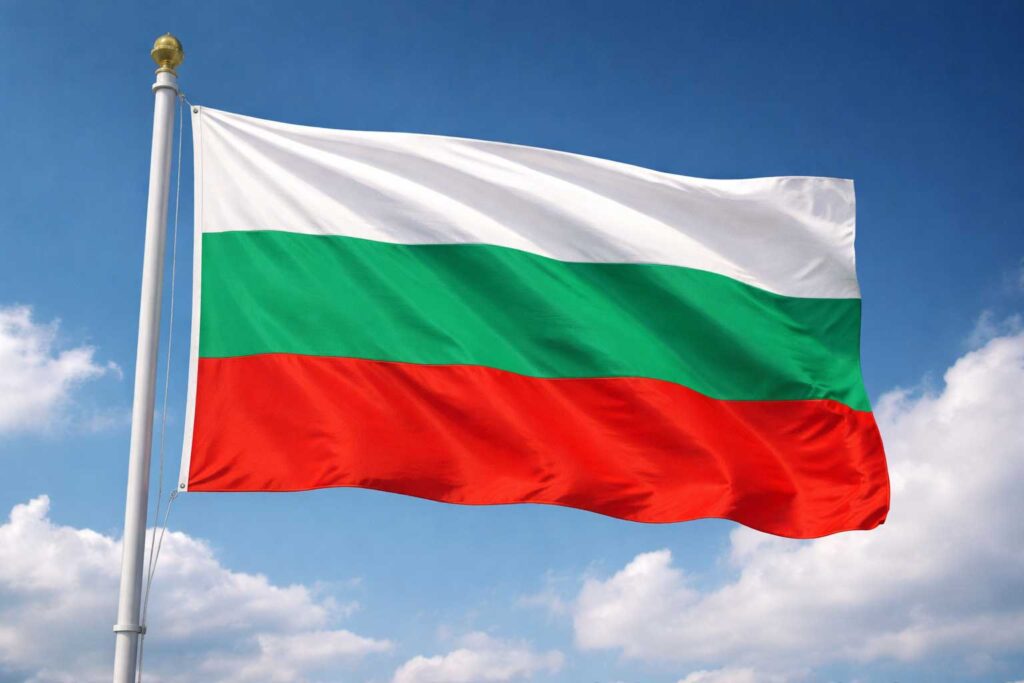
The Bulgarian flag may appear simple at first glance, but its meaning is deeply rooted in the country’s history, struggles, and national identity. Every element of the flag reflects a story—one shaped by centuries of resilience, cultural continuity, and the pursuit of independence.
Unlike more complex national emblems, the power of the Bulgarian flag lies in its clarity. Its three horizontal stripes—white, green, and red—communicate a complete narrative about the Bulgarian people, their land, and their sacrifices.
The Three Colors Explained
White – Peace, Freedom, and Spiritual Ideals
The top stripe, white, represents peace and freedom—two values that have defined Bulgaria’s historical journey. It also carries a deeper spiritual meaning, symbolizing purity, hope, and the moral aspirations of the nation.
For centuries, Bulgarians lived under foreign rule, making the idea of freedom not just symbolic, but existential. White reflects that long-standing desire for liberation and self-determination.
Green – Fertility, Nature, and the Land
The middle stripe, green, represents Bulgaria’s rich natural landscape and agricultural heritage. From the fertile plains of the Danube to the valleys and mountains, the land has always been central to Bulgarian life.
Green symbolizes:
- Fertility and abundance
- Connection to nature
- The importance of agriculture in sustaining the population
It reflects a nation deeply tied to its environment—one where the land is not just territory, but identity.
Red – Courage, Sacrifice, and National Struggle
The bottom stripe, red, represents courage and the sacrifices made for independence. It is a reminder of the blood shed during uprisings, wars, and revolutionary movements.
Red stands for:
- Heroism
- Resistance
- The cost of freedom
It honors those who fought to preserve Bulgarian identity through centuries of hardship.
👉 See how these traditions reflect Bulgarian identity today → Bulgarian Traditions and Customs Explained.
Historical Development of the Bulgarian Flag
The modern Bulgarian flag was officially adopted after the country’s liberation from Ottoman rule in 1878. However, its roots go deeper.
The tricolor design was influenced by Pan-Slavic colors, but Bulgaria adapted them to reflect its own national identity. Over time, the flag became more than a political symbol—it became a representation of unity and cultural survival.
During the Bulgarian National Revival, similar color combinations appeared in revolutionary flags and banners, reinforcing their association with independence and national awakening.
Symbolic Unity: A Nation Told Through Color
When viewed together, the three colors form a powerful narrative:
- A people striving for freedom (white)
- Sustained by their land and traditions (green)
- Willing to sacrifice for their future (red)
This layered meaning transforms the flag from a simple design into a complete story of Bulgaria.
Why the Bulgarian Flag Still Matters Today
The symbolism of the Bulgarian flag is not confined to history books—it remains highly relevant in modern life.
Today, the flag is present in:
- National celebrations and holidays
- Schools and public institutions
- International representation (sports, diplomacy)
- Cultural and tourism branding
For Bulgarians, the flag is not just a national marker—it is a reminder of identity, resilience, and continuity.
The flag remains one of the most recognizable examples of Bulgarian symbols and their meaning, expressing the nation’s values through simple yet powerful colors.
The Coat of Arms of Bulgaria: Unity Makes Strength
The coat of arms of Bulgaria is the most formal and powerful visual representation of the Bulgarian state. While the national flag tells a story through color, the coat of arms expresses authority, continuity, and sovereignty through heraldic symbolism.
It is not just a decorative emblem—it is a declaration of statehood, rooted in medieval traditions and carried into the modern republic.
Key Elements of the Bulgarian Coat of Arms
Each element of the coat of arms has a specific meaning, carefully constructed to represent the nation as a whole:
- A golden lion on a red shield
The central lion symbolizes power, courage, and sovereignty. It is the core emblem of Bulgarian identity and has been used since medieval times to represent ruling authority. - Two supporting crowned lions
Positioned on either side, these lions represent unity, protection, and the strength of the Bulgarian state. Together with the central lion, they form a balanced symbol of stability and national cohesion. - A crown symbolizing sovereignty
The crown reflects Bulgaria’s historical monarchic traditions and its enduring concept of independent statehood, even through periods when independence was lost. - The motto: “Unity Makes Strength”
This phrase is one of the most important symbolic messages in Bulgarian national identity.
Meaning: Why “Unity Makes Strength” Defines Bulgaria
The motto “Unity Makes Strength” is not just a slogan—it reflects Bulgaria’s historical reality.
Throughout its history, Bulgaria has experienced:
- Periods of powerful empires
- Times of division and foreign rule
- Moments of national revival and reunification
This motto emerged as a guiding principle: that only through unity—cultural, political, and social—can the nation remain strong and independent.
Few symbols demonstrate Bulgarian symbols and their meaning as clearly as the coat of arms, where history, power, and unity are combined into a single visual identity.
👉 See how these historical cycles shaped Bulgaria → History of Bulgaria.
Bring Bulgarian Symbols Into Your Home
If you want to connect more deeply with Bulgarian identity, these symbolic items inspired by the coat of arms and national emblems are a great place to start.
| Product | Best For | Why It’s Valuable | Rating | Action |
|---|---|---|---|---|
| Bulgarian Coat of Arms Wall Plaque | Home decor | Authentic symbol of statehood and pride | ⭐⭐⭐⭐⭐ | 👉 Check Price on Amazon |
| Bulgarian Flag (Indoor/Outdoor) | Patriotic display | High-quality tricolor for home or events | ⭐⭐⭐⭐⭐ | 👉 Check Price on Amazon |
| Bulgarian Emblem Necklace (Lion Crest) | Personal wear | Subtle way to carry national identity | ⭐⭐⭐⭐☆ | 👉 Check Price on Amazon |
| Bulgarian Lion Shield Poster | Office / studio decor | Strong visual of strength and heritage | ⭐⭐⭐⭐⭐ | 👉 Check Price on Amazon |
| Traditional Bulgarian Embroidery Tablecloth | Cultural interior design | Features symbolic patterns and motifs | ⭐⭐⭐⭐⭐ | 👉 Check Price on Amazon |
Historical Evolution of the Coat of Arms
The Bulgarian coat of arms has evolved across centuries of political change, yet one element has remained constant—the lion. This continuity is not accidental. It reflects the enduring nature of Bulgarian identity, which has survived empires, occupations, and transformations while preserving its core symbols.
Rather than being reinvented, the coat of arms has been adapted and reaffirmed in each historical era, making it one of the strongest examples of symbolic continuity in Europe.
Medieval Period: The Birth of the Lion Symbol
During the height of the Bulgarian medieval states—particularly the Second Bulgarian Empire (12th–14th centuries)—the lion emerged as a symbol of royal authority and sovereignty.
It appeared in:
- Royal seals
- Heraldic shields
- Military banners
The lion represented:
- Strength and rulership
- Divine legitimacy
- The power of the Bulgarian цар (tsar)
This early adoption established the lion as the central emblem of Bulgarian statehood—a role it has never lost.
Ottoman Period: Symbol of Resistance and Memory
Following the Ottoman conquest in the late 14th century, Bulgaria lost its political independence for nearly five centuries. However, its symbols did not disappear.
Instead, the lion transformed into a symbol of resistance and cultural survival.
It appeared in:
- Revolutionary flags and banners
- National revival literature
- Secret societies and liberation movements
During this time, the lion no longer represented a ruling monarchy—it represented a future vision of freedom.
👉 Explore how culture preserved identity through centuries → Why Bulgaria’s Culture Is So Unique.
Post-Liberation (1878): Rebirth of a National Symbol
After the Liberation of Bulgaria in 1878, the newly established state sought to reconnect with its historical roots.
The lion was officially reintroduced as a national emblem, symbolizing:
- Restoration of independence
- Continuity with medieval Bulgaria
- National unity
This was a crucial moment: the lion transitioned from a symbol of resistance back into a symbol of state authority.
Modern Era: Standardization and National Identity
In the modern period, the Bulgarian coat of arms was formally standardized, preserving its historical elements while adapting to contemporary state structures.
The current version includes:
- A central crowned lion on a shield
- Two supporting lions
- The national motto “Unity Makes Strength”
This modern form balances tradition and statehood, ensuring that the symbol remains both historically grounded and politically relevant.
Why This Evolution Matters
The evolution of the Bulgarian coat of arms tells a larger story—one of survival, adaptation, and continuity.
Across centuries:
- The political system changed
- Borders shifted
- External powers ruled the land
But the core symbol—the lion—remained unchanged.
This continuity reinforces a powerful idea:
👉 Bulgarian identity is not defined by temporary political conditions, but by enduring cultural and historical foundations.
Where You See the Coat of Arms Today
The Bulgarian coat of arms is not confined to history books or ceremonial use—it is an active and visible symbol woven into the fabric of modern Bulgarian life. Its presence across institutions reinforces not only state authority, but also continuity between Bulgaria’s past and present.
Today, the coat of arms appears in a wide range of official and public spaces:
- Government buildings – prominently displayed on ministries, parliament, and administrative institutions as a mark of state authority
- Official documents and passports – serving as a guarantee of legitimacy and national identity
- Courtrooms and legal institutions – symbolizing justice, law, and the sovereignty of the Bulgarian state
- Military insignia and uniforms – representing strength, protection, and national defense
- Educational and state organizations – reinforcing civic identity and shared national heritage
Its consistent use across these domains sends a clear message: the Bulgarian state is not a recent creation, but a continuation of a much older historical tradition.
From medieval царства (kingdoms) to the modern republic, the coat of arms acts as a visual bridge connecting different eras of Bulgarian history.
Symbolism Beyond Government
While the coat of arms is officially tied to the state, its meaning extends far beyond institutions and formal authority.
For many Bulgarians, it represents something deeper and more personal:
- National unity – the idea that strength comes from collective identity
- Historical continuity – a reminder that Bulgaria has endured through centuries of change
- Collective strength – the belief that resilience is built through shared experience
This broader symbolism allows the coat of arms to function not only as a political emblem, but also as a cultural and emotional one.
It appears in:
- Cultural events and national celebrations
- Souvenirs and symbolic merchandise
- Educational materials and history books
- Artistic interpretations in modern design
In this way, the coat of arms moves beyond government—it becomes part of everyday cultural expression.
Why the Coat of Arms Still Matters Today
In many countries, traditional symbols lose relevance over time. In Bulgaria, the opposite is true—the coat of arms remains a powerful and meaningful symbol in the modern era.
This continued relevance comes from its ability to connect past and present.
Today, it serves as:
- A unifying national symbol – bringing together people across regions and generations
- A reminder of historical resilience – reflecting centuries of survival and renewal
- A visual expression of sovereignty – reinforcing Bulgaria’s independence in a globalized world
Perhaps most importantly, the message behind the coat of arms—“Unity Makes Strength”—remains timeless.
It resonates:
- Politically, as a principle of governance
- Socially, as a foundation for community
- Culturally, as a shared national value
A Living Symbol, Not Just a Historical One
The Bulgarian coat of arms is not a relic of the past—it is a living symbol that continues to evolve while preserving its core meaning.
It reminds Bulgarians that identity is not defined by borders alone, but by:
- Shared history
- Cultural memory
- Common values
And in a rapidly changing world, that reminder is more important than ever.
The message behind it—that unity creates strength—continues to resonate not only politically, but culturally and socially.
The Bulgarian Rose: Beauty, Identity, and Global Recognition
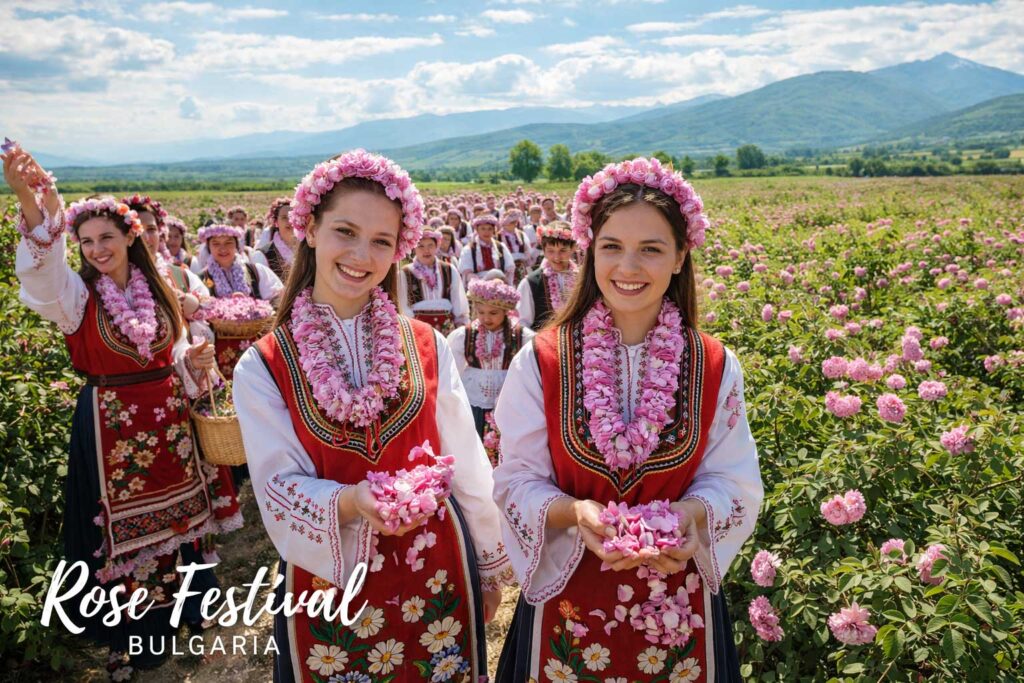
The Bulgarian rose is one of the country’s most internationally recognized symbols, combining natural beauty, centuries-old craftsmanship, and global economic importance. Unlike many national symbols that exist primarily in history or politics, the rose is a living symbol—grown, harvested, and celebrated every year.
It represents not only Bulgaria’s natural richness, but also its ability to transform tradition into global influence.
Why the Rose Matters
Bulgaria is one of the world’s leading producers of rose oil, often referred to as “liquid gold” due to its value and rarity. The heart of this production lies in the Rose Valley, a unique geographical region where climate, soil, and tradition combine to create ideal conditions for rose cultivation.
The primary species grown here is Rosa damascena, known for its intense fragrance and high oil content.
This rose is used in:
- Luxury perfumes (including some of the world’s most prestigious brands)
- High-end cosmetics and skincare products
- Pure essential oils for aromatherapy and wellness
What makes Bulgarian rose oil special is not just the plant itself, but the traditional harvesting process, which is often done by hand in the early morning hours to preserve the delicate aroma.
Cultural Meaning of the Bulgarian Rose
Beyond its economic value, the rose carries deep symbolic meaning in Bulgarian culture.
It represents:
- Beauty – reflecting both nature and aesthetic tradition
- Craftsmanship – highlighting the skill required to cultivate and process roses
- Tradition – connecting modern Bulgaria to centuries-old practices
- Economic identity – showcasing Bulgaria’s role in global perfumery
The rose is also associated with femininity, grace, and celebration, often appearing in folklore, poetry, and national imagery.
The Rose Festival: Celebrating a National Treasure
Every year, the Rose Festival Kazanlak celebrates this iconic symbol with a vibrant mix of tradition, culture, and tourism.
The festival includes:
- Traditional rose-picking rituals at sunrise
- Folklore music and dance performances
- A ceremonial Rose Queen selection
- Parades featuring traditional costumes and floral decorations
This event attracts visitors from around the world, turning a local agricultural tradition into an international cultural experience.
From Local Tradition to Global Symbol
The journey of the Bulgarian rose—from fields in the Rose Valley to luxury products worldwide—illustrates how a local tradition can achieve global significance.
It is a perfect example of how Bulgarian symbols function:
- Rooted in history
- Sustained by tradition
- Recognized worldwide
Why the Bulgarian Rose Still Matters Today
In modern Bulgaria, the rose continues to play a vital role both culturally and economically.
It serves as:
- A national symbol of beauty and identity
- A key export product with global demand
- A tourism driver attracting visitors to the Rose Valley
- A bridge between tradition and modern industry
Unlike static symbols, the rose is dynamic—it grows, evolves, and continues to shape Bulgaria’s global image.
👉 Cultural connection → Bulgarian Festivals and Traditions.
The Martenitsa: Red and White Threads of Life and Renewal
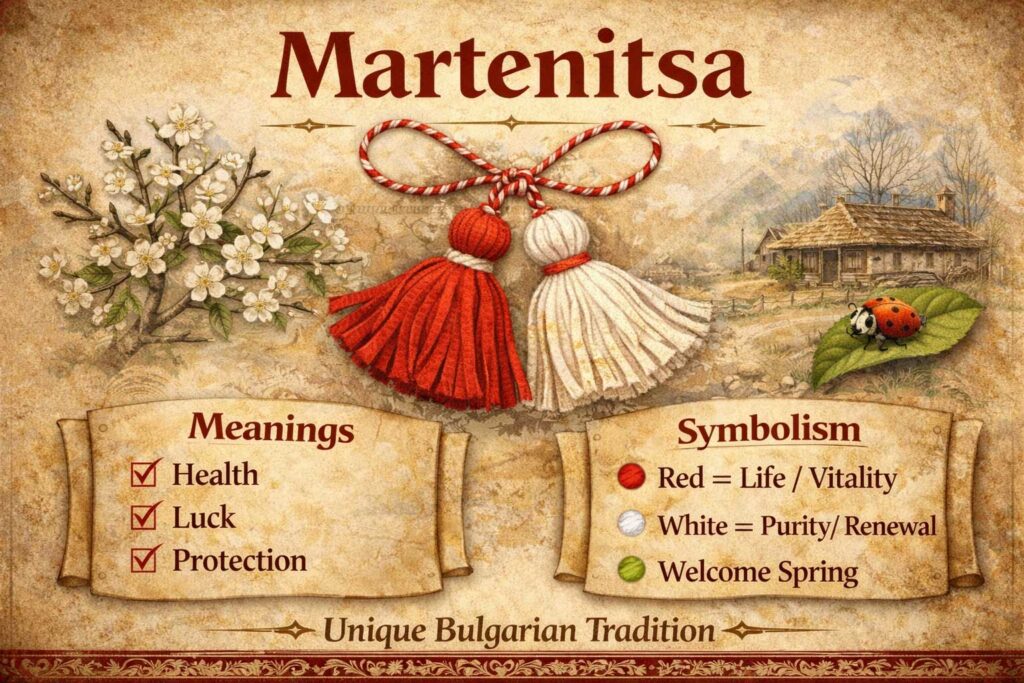
The Martenitsa is one of the most beloved symbols in Bulgarian culture, deeply connected to seasonal traditions and folklore explored in Bulgarian Festivals and Traditions. Unlike official state symbols, it is personal, emotional, and actively practiced—making it one of the strongest living traditions in Bulgarian culture.
Every year on March 1st, Bulgarians exchange Martenitsi as a symbolic gesture of health, renewal, and good fortune. This simple red-and-white ornament connects people not only to each other, but also to nature and the changing seasons.
What Is a Martenitsa?
A Martenitsa is a small ornament made of intertwined red and white threads. It is typically worn as:
- A bracelet on the wrist
- A pin attached to clothing
- A decorative figure (such as the traditional dolls Pizho and Penda)
People begin wearing Martenitsi on March 1st, a day associated with the folklore figure Baba Marta (Grandmother March), who symbolizes the arrival of spring.
The Martenitsa is worn until one of the first signs of spring appears, such as:
- Seeing a stork
- Spotting a blooming tree
- Experiencing consistently warm weather
At that moment, the Martenitsa is removed and traditionally tied to a tree branch—symbolizing the transfer of health and luck into nature.
Meaning of the Colors
The power of the Martenitsa lies in its simplicity—just two colors, yet deeply symbolic.
Red – Life, Health, and Protection
Red represents vitality, strength, and the life force. In Bulgarian folklore, it is also believed to protect against illness and negative energy.
White – Purity, Renewal, and New Beginnings
White symbolizes cleanliness, innocence, and the renewal that comes with spring. It reflects the transition from winter to a new cycle of life.
Together, red and white create a balance between life and purity, energy and renewal, making the Martenitsa a powerful symbol of harmony.
Cultural Role: A Tradition That Connects People
The Martenitsa is more than a decorative object—it is a social ritual that strengthens relationships and community bonds.
It is traditionally:
- Given as a gift between family, friends, and colleagues
- Worn collectively, creating a shared cultural experience
- Associated with well-wishes, especially for health and happiness
This exchange reinforces a key aspect of Bulgarian culture: connection through tradition.
👉 Explore more customs like this → Bulgarian Traditions and Customs Explained.
Folklore and the Legend of Baba Marta
The Martenitsa tradition is closely tied to the folklore figure Baba Marta, a symbolic character representing the unpredictable nature of early spring.
According to tradition:
- Baba Marta is temperamental—her mood changes bring shifting weather
- When she is happy, the sun shines
- When she is angry, winter briefly returns
Wearing a Martenitsa is believed to please Baba Marta and encourage warmer weather, linking human behavior with natural cycles.
Recognition by UNESCO
The cultural importance of the Martenitsa extends beyond Bulgaria. The tradition has been recognized by UNESCO as part of the Intangible Cultural Heritage of Humanity.
This recognition highlights:
- Its deep historical roots
- Its continued relevance in modern society
- Its role in preserving cultural identity
Few traditions in Europe have remained so widely practiced across generations.
A Living Symbol in Modern Bulgaria
Today, the Martenitsa continues to thrive in both traditional and modern forms.
You can find it:
- Handmade in villages using traditional methods
- Sold in markets and shops across Bulgaria
- Adapted into modern jewelry and fashion accessories
Despite these variations, the meaning remains unchanged—a wish for health, happiness, and renewal.
Why the Martenitsa Still Matters Today
In a fast-paced, globalized world, the Martenitsa stands out as a rare example of a tradition that has not lost its meaning.
It remains important because it:
- Connects people to nature’s cycles
- Reinforces social bonds
- Preserves cultural identity
- Bridges past and present
More than just threads, the Martenitsa represents a worldview—one where health, nature, and human relationships are deeply interconnected. This is a key example of Bulgarian symbols and their meaning in everyday life.
The Martenitsa remains one of the most personal expressions of Bulgarian symbols and their meaning, connecting people directly to tradition and seasonal change.
The Cyrillic Alphabet: Bulgaria’s Contribution to Civilization
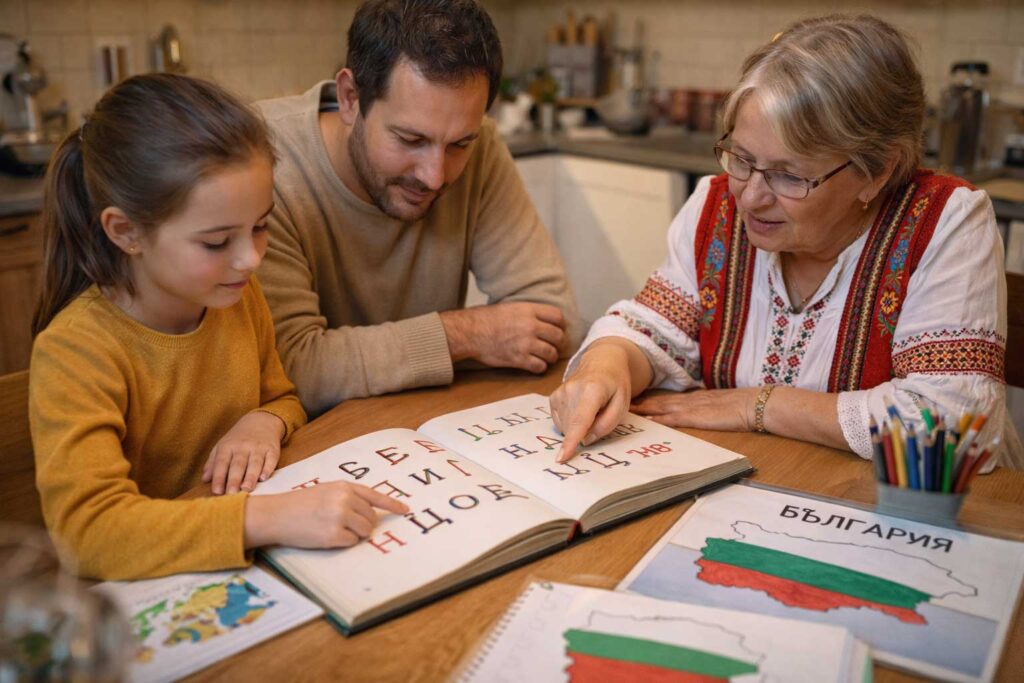
The Cyrillic alphabet is one of Bulgaria’s most profound and lasting contributions to global civilization. Unlike many national symbols that remain within a country’s borders, the Cyrillic script extends far beyond Bulgaria—used today by hundreds of millions of people across Europe and Asia.
It is not just a writing system. It is a symbol of cultural identity, intellectual achievement, and historical influence.
Origins: From Missionary Work to Cultural Revolution
The origins of the Cyrillic alphabet are closely tied to Saint Cyril and Methodius, two Byzantine brothers who played a key role in spreading Christianity among the Slavic peoples in the 9th century.
While they originally created the Glagolitic alphabet, their disciples later developed the Cyrillic script in the First Bulgarian Empire, particularly in the literary centers of Preslav and Ohrid.
This development was revolutionary.
For the first time:
- Slavic languages could be written systematically
- Religious texts were translated into a language people could understand
- Literacy began to spread beyond elite circles
Bulgaria became the cultural and intellectual hub of the Slavic world during this period.
👉 See how this fits into Bulgaria’s broader historical development → History of Bulgaria
Why the Cyrillic Alphabet Matters
The impact of the Cyrillic alphabet goes far beyond linguistics—it reshaped entire civilizations.
It Enabled the Spread of Literacy
Before the development of Slavic alphabets, written communication was largely limited to Greek or Latin. Cyrillic allowed millions of people to access written language in their native tongue.
It Shaped Religious and Cultural Identity
By translating religious texts into Slavic languages, the alphabet strengthened both spiritual life and cultural independence.
It Became a Global Writing System
Today, Cyrillic is used by over 250 million people, including in countries such as Russia, Bulgaria, Serbia, and others.
This makes it one of the most influential writing systems in the world.
Bulgaria as a Cultural Power Center
During the medieval period, Bulgaria was not just a political state—it was a cultural superpower.
The literary schools of Preslav and Ohrid:
- Produced manuscripts and translations
- Trained scholars and clergy
- Spread literacy across Eastern Europe
This period is often referred to as a Golden Age of Bulgarian culture, where language, religion, and identity were unified through the Cyrillic script.
Modern Significance: Language as a National Symbol
In modern Bulgaria, the Cyrillic alphabet is more than a practical tool—it is a core element of national identity.
Every year on May 24, Bulgaria celebrates the Day of the Alphabet, Education, and Culture, honoring the legacy of the script and its creators.
This celebration highlights a powerful idea:
👉 Language itself can be a national symbol—just as important as a flag or coat of arms.
Cyrillic in the Modern World
Today, the Cyrillic alphabet continues to evolve and adapt.
It is used in:
- Education systems
- Government and official communication
- Media and digital platforms
- International organizations
It is also one of the official scripts of the European Union, reinforcing Bulgaria’s cultural contribution on a global scale.
Why the Cyrillic Alphabet Still Matters Today
In a world dominated by global languages and digital communication, the Cyrillic alphabet remains a strong marker of identity.
It represents:
- Intellectual independence
- Cultural continuity
- Historical influence
For Bulgaria, it is proof that a nation’s greatest legacy is not always territorial or political—it can be cultural and civilizational.
A Symbol Beyond Borders
Unlike many national symbols, the Cyrillic alphabet does not belong only to Bulgaria—it belongs to a wider cultural sphere influenced by Bulgarian history.
This makes it unique:
- A bridge between past and present
- A national symbol with global reach
- A historical achievement still in daily use
The Cyrillic alphabet is one of the strongest examples of Bulgarian symbols and their meaning, extending beyond national borders into global cultural influence.
👉 Related → Bulgarian Contributions to Modern Technology.
Traditional Folk Symbols in Bulgarian Embroidery and Art
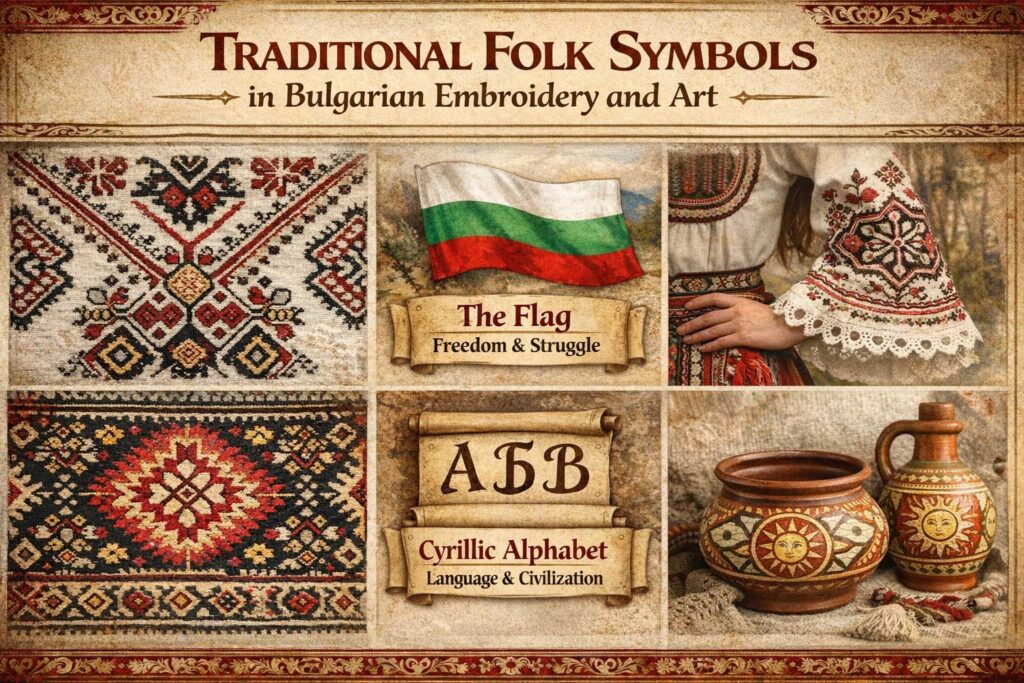
Bulgarian folk art is one of the most visually striking and symbolically rich aspects of the country’s cultural heritage. Far from being purely decorative, traditional embroidery, weaving, pottery, and woodcarving were historically infused with meaning, intention, and even spiritual purpose.
In traditional Bulgarian society, symbols were believed to carry protective power. They were carefully placed on clothing, household items, and ritual objects to guard against misfortune, ensure fertility, and promote health and prosperity.
This makes Bulgarian folk symbolism not just artistic—but deeply functional.
Common Motifs and Their Meanings
Across regions of Bulgaria, certain symbols appear repeatedly in embroidery and decorative arts. While styles vary, their meanings remain remarkably consistent.
Sun Symbols – Life, Energy, and Protection
The sun is one of the oldest and most universal symbols in Bulgarian folklore. It represents:
- Life and vitality
- Warmth and growth
- Protection from darkness and evil forces
Often depicted as circular or radiating geometric patterns, sun motifs were commonly embroidered on garments to “bring light” into the wearer’s life.
Tree of Life – Growth, Family, and Continuity
The Tree of Life is a powerful symbol representing:
- The connection between generations
- Family roots and lineage
- The cycle of life and renewal
This motif often appears in vertical, branching patterns, symbolizing both stability and growth. It reflects the importance of family and continuity in Bulgarian culture.
Geometric Patterns – Protection and Balance
Geometric symbols—such as diamonds, crosses, and zigzags—were believed to protect against evil spirits and negative energy.
These patterns served as:
- Protective barriers
- Symbols of harmony and order
- Visual expressions of cosmic balance
They were especially common on:
- Sleeves and collars
- Aprons and belts
- Household textiles
The placement of these symbols was intentional, often covering areas considered vulnerable.
Colors and Their Symbolic Meaning
Color plays a central role in Bulgarian folk symbolism, with each shade carrying a specific message.
Red – Protection, Vitality, and Life Force
Red is the most dominant color in Bulgarian embroidery. It symbolizes strength, health, and protection against evil influences.
Black – Earth, Stability, and Grounding
Black represents the earth and the foundation of life. It provides contrast and balance, grounding the brighter elements of a design.
White – Purity, Light, and Renewal
White symbolizes cleanliness, spiritual purity, and new beginnings. It often serves as the background, allowing other colors to stand out.
Together, these colors create a visual language that communicates both aesthetic beauty and symbolic depth.
Symbol Placement: Protection Through Design
One of the most fascinating aspects of Bulgarian embroidery is the intentional placement of symbols.
Patterns were often positioned on:
- Necklines and cuffs – to protect entry points of the body
- Waistbands – to preserve vitality and strength
- Aprons and chest areas – to symbolize fertility and life
This reflects a belief that clothing could act as a form of spiritual armor, shielding the wearer from unseen forces.
Beyond Clothing: Symbols in Everyday Life
Folk symbols were not limited to garments—they appeared across all aspects of daily life.
They can be found in:
- Carpets (kilimi) with repeating geometric motifs
- Pottery decorated with symbolic patterns
- Wood carvings in homes and churches
- Ritual bread used in celebrations and holidays
👉 Explore how these traditions connect to daily life → Bulgarian Traditions and Customs Explained
This widespread use shows how deeply symbolism was integrated into Bulgarian culture.
A Living Tradition in Modern Bulgaria
Today, traditional symbols continue to inspire modern design and fashion.
They appear in:
- Contemporary clothing collections
- Home decor and textiles
- сувенири (souvenirs) and cultural products
- Digital and graphic design
While the context has changed, the meaning often remains intact—preserving a connection between past and present. This is a key example of Bulgarian symbols and their meaning in everyday life.
Why These Symbols Still Matter Today
Bulgarian folk symbols are more than historical artifacts—they are a living expression of identity.
They matter because they:
- Preserve ancient beliefs and traditions
- Connect modern Bulgarians to their roots
- Represent a unique visual language of culture
- Continue to influence art and design
These traditional motifs further illustrate Bulgarian symbols and their meaning, where art, protection, and belief are combined into everyday objects.
Most importantly, they remind us that in traditional Bulgarian culture, art was never just decoration—it was protection, meaning, and identity woven into everyday life.
Bring Bulgarian Folk Symbols Into Your Home
If you love the meaning behind Bulgarian embroidery and traditional symbols, these authentic-inspired products let you bring that heritage into your everyday life.
| Product | Best For | Why It’s Valuable | Rating | Action |
|---|---|---|---|---|
| Bulgarian Embroidery Tablecloth | Dining / decor | Features traditional protective motifs | ⭐⭐⭐⭐⭐ | 👉 Check Price on Amazon |
| Handmade Kilim Rug (Bulgarian Style) | Home interior | Rich geometric symbolism + warmth | ⭐⭐⭐⭐⭐ | 👉 Check Price on Etsy |
| Folk Pattern Throw Pillow Covers | Living room decor | Easy way to add cultural design | ⭐⭐⭐⭐☆ | 👉 Check Price on Etsy |
| Traditional Embroidered Apron | Cultural wear | Authentic design inspired by folk costumes | ⭐⭐⭐⭐⭐ | 👉 Check Price on Etsy |
| Bulgarian Folk Art Wall Hanging | Wall decor | Showcases symbolic motifs beautifully | ⭐⭐⭐⭐⭐ | 👉 Check Price on Amazon |
Religious Symbols in Bulgarian Identity
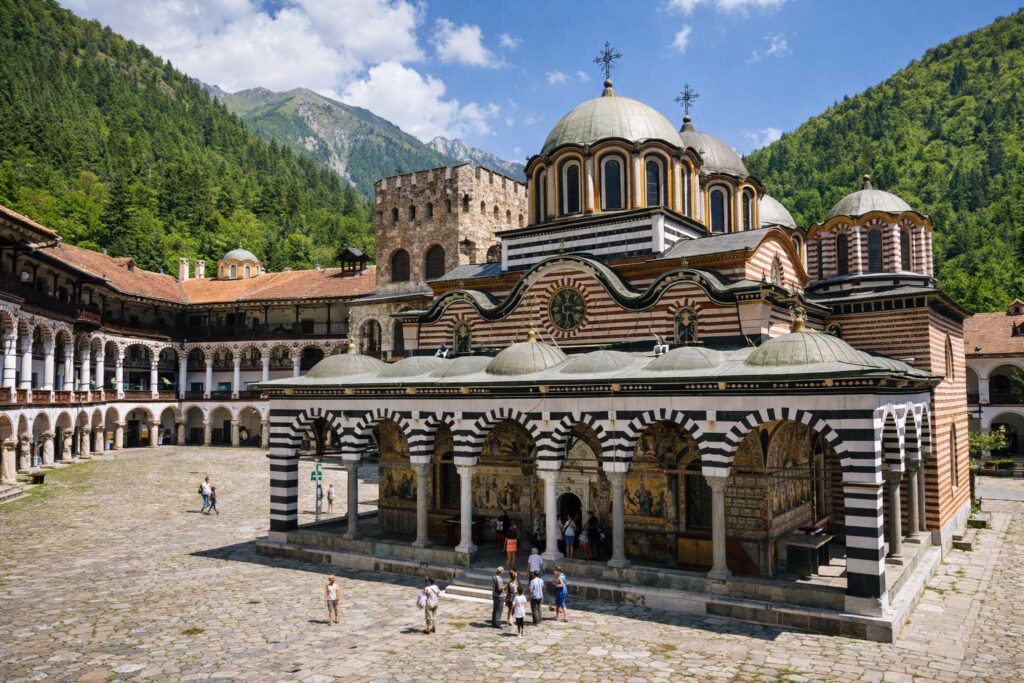
Religion has played a central role in shaping Bulgarian symbolic identity, especially through centuries of political change and foreign rule. In Bulgaria, religious symbols are not only expressions of faith—they are also powerful markers of cultural survival, national continuity, and spiritual resilience.
During periods when the Bulgarian state did not exist politically, religion became one of the strongest forces preserving identity. Churches, monasteries, and religious imagery acted as guardians of language, tradition, and collective memory.
Key Religious Symbols
The Orthodox Cross
The Orthodox cross is one of the most recognizable symbols in Bulgaria. It represents:
- Faith and spiritual devotion
- Protection and divine presence
- Connection to Eastern Orthodox Christianity
It is commonly found in churches, homes, jewelry, and public spaces, serving both religious and cultural purposes.
Icons of Saints
Icons hold a special place in Bulgarian Orthodox tradition. These sacred images are not viewed merely as art, but as spiritual windows connecting believers to the divine.
Common features include:
- Depictions of saints and biblical figures
- Rich colors and symbolic composition
- Use in prayer, rituals, and home altars
Icons are often passed down through generations, becoming both religious and family heirlooms.
Monasteries as Symbols of Survival
Monasteries are among the most powerful religious symbols in Bulgaria—not only as places of worship, but as centers of cultural preservation.
The Rila Monastery is the most famous example.
It represents:
- Spiritual strength
- Cultural endurance
- Preservation of Bulgarian language and literature
During the Ottoman period, monasteries like Rila became safe havens for education, manuscript preservation, and national consciousness.
👉 Explore more cultural landmarks like this → Why Bulgaria’s Culture Is So Unique.
Religion as a Cultural Foundation
In Bulgaria, religion is deeply intertwined with culture. Many traditions, holidays, and customs are rooted in Orthodox Christianity.
Religious symbols appear in:
- празднични ритуали (holiday rituals)
- Traditional celebrations
- Family customs and life events
👉 Explore more traditions → Bulgarian Festivals and Traditions.
This integration of faith and daily life strengthens the role of religious symbols beyond purely spiritual contexts.
Beyond Faith: A Symbol of National Identity
While Bulgaria today is a modern, secular country, religious symbols continue to hold cultural significance even for those who are not actively religious.
They represent:
- Historical continuity
- Shared values
- Cultural heritage
For many Bulgarians, the church and its symbols are not just about belief—they are about belonging. Religious imagery provides another important layer of Bulgarian symbols and their meaning, preserving identity through faith and cultural continuity.
Bring Bulgarian Spiritual Symbols Into Your Home
If you appreciate the meaning behind Bulgaria’s religious symbols, these items allow you to connect with that heritage in a meaningful and personal way.
| Product | Best For | Why It’s Valuable | Rating | Action |
|---|---|---|---|---|
| Bulgarian Orthodox Icon Set | Home altar / decor | Traditional saint icons with deep spiritual meaning | ⭐⭐⭐⭐⭐ | 👉 Check Price on Amazon |
| Orthodox Cross Necklace | Personal wear | Symbol of faith and protection | ⭐⭐⭐⭐⭐ | 👉 Check Price on Amazon |
| Handcrafted Wooden Cross Wall Decor | Home decor | Rustic, monastery-style aesthetic | ⭐⭐⭐⭐☆ | 👉 Check Price on Amazon |
| Religious Icon Wall Frame (Gold Style) | Interior design | Classic Orthodox visual centerpiece | ⭐⭐⭐⭐⭐ | 👉 Check Price on Amazon |
| Monastery Incense & Burner Set | Spiritual practice | Authentic Orthodox ritual experience | ⭐⭐⭐⭐☆ | 👉 Check Price on Amazon |
Why Religious Symbols Still Matter Today
In a rapidly changing world, religious symbols provide a sense of stability and continuity.
They serve as:
- Anchors of tradition
- Reminders of resilience
- Connections between generations
Most importantly, they tell a story:
👉 That Bulgarian identity has been preserved not only through political power, but through faith, culture, and collective memory.
A Legacy Preserved Through Faith
Places like Rila Monastery are not just religious centers—they are national symbols of survival and endurance.
They stand as proof that even in the absence of a state, a nation can survive through its culture, language, and spiritual traditions.
Bring Bulgarian Symbolism Into Your Home
Affiliate Disclosure: This article may contain affiliate links. If you purchase through these links, we may earn a commission at no additional cost to you.
| Product | Best For | Why It’s Useful | Rating | Price |
|---|---|---|---|---|
| Bulgarian Martenitsa Bracelets | Cultural gifts | Authentic tradition you can wear | ⭐⭐⭐⭐⭐ | 👉 Check Price |
| Rose Oil from Bulgaria | Aromatherapy | Real product from Rose Valley | ⭐⭐⭐⭐⭐ | 👉 Check Price |
| Cyrillic Alphabet Wall Art | Home decor | Cultural + educational | ⭐⭐⭐⭐☆ | 👉 Check Price |
| Bulgarian Embroidery Tablecloth | Interior design | Traditional patterns | ⭐⭐⭐⭐⭐ | 👉 Check Price |
👉 Explore more authentic Bulgarian items →
How Bulgarian Symbols Connect History, Culture, and Identity
Bulgarian symbols are not isolated elements—they form an interconnected system that reflects the country’s entire historical and cultural journey. Each symbol represents a different dimension of identity, but together they create a unified narrative that defines Bulgaria across centuries.
Rather than existing independently, these symbols reinforce one another:
- The lion connects to statehood, power, and sovereignty
- The flag connects to national struggle, sacrifice, and unity
- The rose connects to economic identity, craftsmanship, and global recognition
- The Martenitsa connects to seasonal life, nature, and human relationships
- The Cyrillic alphabet connects to civilization, knowledge, and cultural influence
Each symbol tells part of the story—but only together do they reveal the full picture.
👉 Explore how these traditions shape everyday life → Bulgarian Traditions and Customs Explained
This interconnected system is what makes Bulgarian symbolism so powerful. It is not fragmented—it is layered, consistent, and deeply rooted in both history and lived experience.
This is a key example of Bulgarian symbols and their meaning in everyday life.
A Complete Cultural System, Not Just Individual Symbols
When viewed collectively, Bulgarian symbols represent three core pillars:
1. Historical Identity
Symbols like the lion and coat of arms preserve the memory of statehood, independence, and political continuity.
2. Cultural and Social Life
Traditions like the Martenitsa and folk embroidery connect people to each other and to seasonal cycles.
3. Intellectual and Civilizational Contribution
The Cyrillic alphabet demonstrates Bulgaria’s role in shaping not just its own identity, but that of entire regions.
👉 See how Bulgaria’s cultural identity stands out globally → Why Bulgaria’s Culture Is So Unique.
Together, these pillars form a complete system—one that explains not just what Bulgaria is, but how it has endured.
To fully understand Bulgarian symbols and their meaning, it is important to see how they continue to evolve while preserving their original cultural significance.
Bulgarian Symbols and Their Meaning in Modern Life
Today, Bulgarian symbols continue to evolve while maintaining their original meaning. They are not relics of the past—they are actively used, reinterpreted, and integrated into modern life.
You can see them in:
- Tourism branding – promoting Bulgaria’s heritage to the world
- Fashion and design – incorporating traditional motifs into modern aesthetics
- Souvenirs and cultural products – connecting visitors to Bulgarian identity
- Education and national curriculum – teaching history through symbolic meaning
- National celebrations and holidays – reinforcing unity and shared memory
👉 Explore how these traditions are celebrated today → Bulgarian Festivals and Traditions.
This continued presence ensures that symbols remain relevant, not just remembered.
Tradition Meets Modern Identity
One of the most remarkable aspects of Bulgarian symbolism is its adaptability.
Traditional elements like:
- Embroidery patterns
- The Martenitsa
- Religious icons
are now being reinterpreted in:
- Contemporary fashion
- Graphic design
- Digital branding
This fusion of old and new allows Bulgarian identity to remain dynamic while staying authentic.
Why Bulgarian Symbols Still Matter Today
In a globalized world where cultures can easily blend and lose distinction, symbols play a critical role in preserving identity.
For Bulgaria, they serve as:
- Cultural anchors – grounding people in tradition
- Historical memory – preserving stories of resilience and survival
- Expressions of national pride – reinforcing a shared sense of belonging
These symbols remind people not only where they come from—but also what values define them.
More Than Symbols: A Living Identity
Bulgarian symbols are not static representations—they are living elements of culture.
They:
- Connect past, present, and future
- Link individuals to a collective identity
- Preserve meaning across generations
In this way, they function not just as symbols, but as a cultural language—one that continues to evolve while maintaining its roots.
Final Thought: A Nation Defined Through Meaning
Bulgaria’s symbols—whether worn, displayed, or celebrated—tell a story of endurance, creativity, and unity.
They show that identity is not built only through borders or politics, but through:
- Shared traditions
- Cultural memory
- Collective values
And in that sense, Bulgarian symbols are not just representations of the nation— They are the nation.
Few countries in Europe maintain such a continuous and living symbolic system as Bulgaria.
⭐ Top Bulgarian Symbol Products (Editor’s Picks)
👉 Don’t want to read everything? These are the top picks most readers choose:
If you want the most meaningful and authentic Bulgarian-inspired items, start here:
| Category | Product | Why It Stands Out | Best For | Action |
|---|---|---|---|---|
| Best Overall | Bulgarian Rose Oil | Authentic, globally recognized Bulgarian product | Wellness / gifts | 👉 Check Price |
| Most Cultural | Martenitsa Bracelet Set | Deep tradition, symbolic meaning | Cultural connection | 👉 Check Price |
| Best Decor | Bulgarian Embroidery Tablecloth | Traditional patterns with protective symbolism | Home decor | 👉 Check Price |
| Spiritual Pick | Orthodox Icon Set | Strong religious and cultural significance | Spiritual / decor | 👉 Check Price |
FAQs About Bulgarian Symbols and Their Meaning
What are the main Bulgarian symbols and their meaning?
The main symbols include the lion, flag, coat of arms, rose, Martenitsa, and Cyrillic alphabet. Their meaning represents the country’s history, traditions, and identity.
What does the Bulgarian flag represent?
It represents peace (white), nature (green), and sacrifice (red).
Why is the lion important in Bulgaria?
It symbolizes strength, independence, and historical statehood.
What is a Martenitsa?
A traditional red-and-white ornament worn for health and good luck in spring.
Why is the rose a symbol of Bulgaria?
Because of the country’s global leadership in rose oil production.
Is the Cyrillic alphabet Bulgarian?
It was developed in the First Bulgarian Empire and is a major cultural contribution.
Why are Bulgarian symbols important?
Bulgarian symbols are important because they preserve cultural identity, connect generations, and represent the country’s history, traditions, and values.
What is the most important Bulgarian symbol?
The lion is considered the most important symbol, representing strength, independence, and statehood throughout Bulgarian history.
Conclusion
Bulgarian symbols and their meaning reveal a nation deeply connected to its past, yet actively shaping its future. From ancient empires to modern Europe, these symbols continue to define Bulgaria’s identity in powerful and meaningful ways.
Understanding Bulgarian symbols and their meaning helps reveal how a nation preserves its identity through culture, tradition, and shared values. These symbols are not random—they form a system that reflects Bulgaria’s past, present, and future.
They are not just symbols—they are stories, values, and living traditions that continue to unite generations.
👉 “Few countries in Europe maintain such a continuous and living symbolic system as Bulgaria.”
References
- Encyclopaedia Britannica. Flag of Bulgaria. https://www.britannica.com/topic/flag-of-Bulgaria
- Encyclopaedia Britannica. Bulgaria – Cultural Life. https://www.britannica.com/place/Bulgaria/Cultural-life
- National Assembly of the Republic of Bulgaria. National Symbols of Bulgaria. https://www.parliament.bg/en/21
- National Assembly of the Republic of Bulgaria. Coat of Arms of the Republic of Bulgaria. https://www.parliament.bg/en/20
- UNESCO. Cultural Practices Associated to the 1st of March (Martenitsa). https://ich.unesco.org/en/RL/cultural-practices-associated-to-the-1st-of-march-01287
- UNESCO World Heritage Centre. Rila Monastery. https://whc.unesco.org/en/list/216
- Ministry of Foreign Affairs of the Republic of Bulgaria. May 24 – Day of the Bulgarian Alphabet, Education and Culture. https://www.mfa.bg/en/news/37810
- Bulgarian Academy of Sciences. Official Website. https://www.bas.bg
- Visit Bulgaria Official Tourism Portal. The Rose Valley. https://bulgariatravel.org/rose-valley/
- Visit Plovdiv. The Rose Valley and Rose Festival. https://www.visitplovdiv.com/en/node/544
- World Intellectual Property Organization (WIPO). Official Website. https://www.wipo.int
- European Union. European Union Languages and Scripts. https://european-union.europa.eu
- Oxford University Press. The Oxford Dictionary of Byzantium. https://global.oup.com
- Cambridge University Press. The Early Medieval Balkans. https://www.cambridge.org
- Curta, Florin. Southeastern Europe in the Middle Ages, 500–1250. Cambridge University Press.
- Dimitrov, Bozhidar. History of Bulgaria. Sofia Press.
- Fine, John V. A. The Late Medieval Balkans. University of Michigan Press.
- Roudometof, Victor. Nationalism, Globalization, and Orthodoxy. Greenwood Publishing.
- Todorova, Maria. Imagining the Balkans. Oxford University Press.
- National Ethnographic Museum at the Bulgarian Academy of Sciences. Official Website. https://naim.bg/en/home/
- Bulgarian Orthodox Church. Official Website. https://bg-patriarshia.bg
- National Statistical Institute of Bulgaria. Official Website. https://www.nsi.bg
- European Travel Commission. Official Website. https://etc-corporate.org
- UNESCO. Intangible Cultural Heritage. https://ich.unesco.org
- UN Tourism. Official Website. https://www.unwto.org