

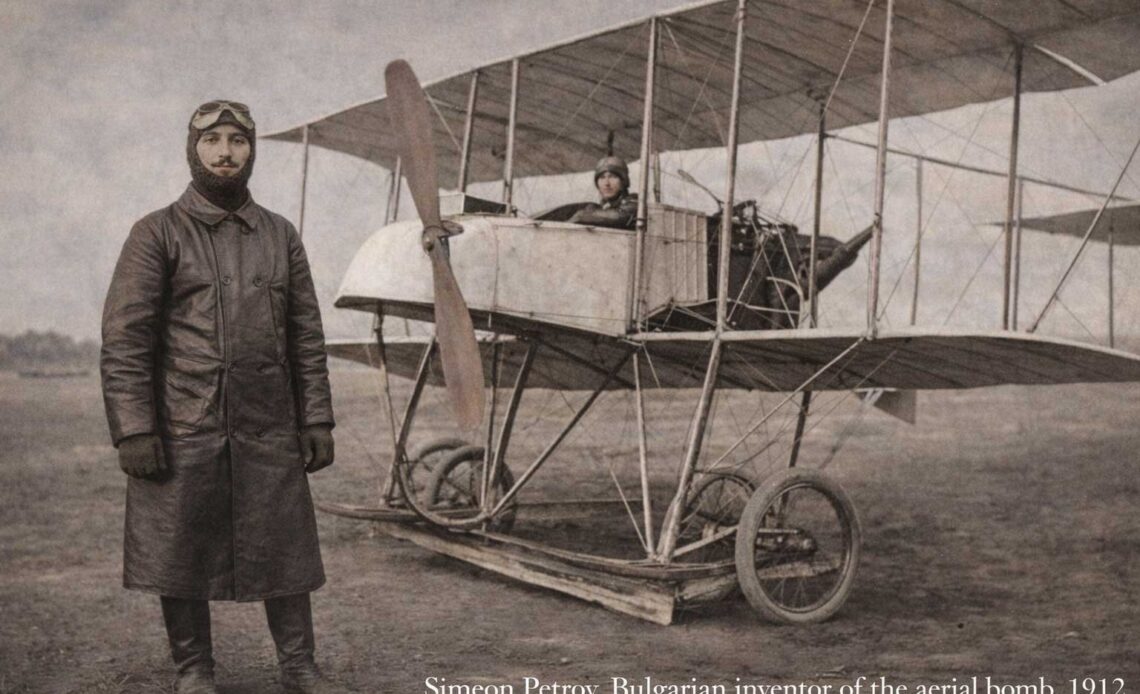

Captain Simeon Petrov stands as one of the most influential yet often overlooked figures in the history of military aviation. A Bulgarian Air Force officer and innovator, Petrov is credited with inventing the world’s first purpose-built air-to-surface bomb in 1912—a breakthrough that fundamentally transformed warfare and laid the foundation for modern aerial combat.
At a time when aircraft were barely capable of sustained flight, one Bulgarian officer changed warfare forever.
His invention introduced key design elements still used today, including aerodynamic stabilization, fin-guided trajectory, and an impact detonator. These innovations were revolutionary at a time when aviation itself was still in its infancy.
Who Invented the First Aerial Bomb?
Simeon Petrov, a Bulgarian Air Force captain, invented the first purpose-built aerial bomb in 1912. His design introduced stabilizing fins, aerodynamic structure, and an impact detonator—features still used in modern bombs today.
The Dawn of Aviation Warfare
At the beginning of the 20th century, aircraft were primarily used for reconnaissance and observation. The idea of using planes offensively was still experimental and largely untested.
During the First Balkan War, Bulgaria found itself in a coalition alongside Greece, Serbia, and Montenegro against the Ottoman Empire. This conflict became a testing ground for new military technologies—including aviation.
It was in this environment that Petrov’s innovation emerged.
The Birth of Air Warfare
At the beginning of the 20th century, aviation was still in its infancy. Early airplanes were fragile, slow, and primarily used for reconnaissance missions, giving military commanders a new way to observe enemy positions from above. The idea of using aircraft as offensive weapons had not yet been fully developed, and most military strategists still viewed aviation as a support tool rather than a decisive force.
Everything changed during the First Balkan War, when Bulgaria and its allies fought against the Ottoman Empire. This conflict became one of the first major wars where aircraft were actively deployed—not just for observation, but for experimentation with new combat roles.
The war created the perfect environment for innovation. Faced with entrenched enemy positions and evolving battlefield conditions, Bulgarian military leaders began exploring unconventional strategies. Among these was the bold idea of using aircraft to deliver explosives directly onto enemy targets.
👉 This marked the true beginning of air warfare, where the sky became an extension of the battlefield.
As a result, the First Balkan War is now widely recognized as the first real testing ground for military aviation, laying the foundation for the aerial strategies that would dominate World War I and beyond.
💡 The Problem: Why Early Bombing Failed
Before the innovations of Simeon Petrov, early attempts at aerial bombing were crude and highly ineffective.
Pilots would simply drop hand grenades or improvised explosives from open cockpits, hoping they would land somewhere near the target. However, this method lacked any form of control or precision.
This approach created serious limitations:
- ❌ No control over trajectory, leading to unpredictable results
- ❌ Wind drift, causing bombs to miss targets entirely
- ❌ No reliable detonation mechanism, reducing impact effectiveness
- ❌ Low accuracy and inconsistent damage
In many cases, bombs failed to detonate or landed far from their intended targets, making early aerial attacks more symbolic than strategically useful.
Additionally, pilots had no tools to calculate factors such as altitude, speed, or wind direction, which are critical for accurate targeting. This made aerial bombing unreliable and difficult to scale as a military tactic.
👉 It quickly became clear that simply dropping explosives was not enough—a scientific and engineering-based solution was needed.
Early military leaders initially underestimated the importance of precision in aerial attacks. Many believed that simply dropping explosives from above would be sufficient to disrupt enemy positions. However, repeated failures quickly demonstrated that without control, aerial bombing could not be relied upon as an effective strategy.
This realization created urgency for innovation and pushed engineers like Petrov to rethink the entire concept of aerial weapons.
The Breakthrough: First Purpose-Built Aerial Bomb
Captain Simeon Petrov solved these critical problems by designing the world’s first purpose-built aerial bomb, transforming aerial attacks from random attempts into a structured and effective system.
Unlike earlier improvised explosives, Petrov’s bomb was carefully engineered to behave predictably when released from an aircraft. His design incorporated aerodynamics, stabilization, and controlled detonation, making it far more effective than anything used before.
Key Innovations
1. X-Shaped Tail Fins
- Stabilized the bomb during descent
- Prevented spinning and tumbling in the air
- Allowed a consistent and predictable trajectory
👉 This was one of the most important breakthroughs, as it ensured the bomb would fall nose-first toward the target, increasing both accuracy and effectiveness.
2. Aerodynamic Body
- Reduced air resistance during descent
- Improved speed and directional stability
- Enabled controlled ballistic movement
By shaping the bomb to move efficiently through the air, Petrov ensured it could travel further and strike with greater force.
3. Impact Detonator (Contact Fuze)
- Triggered explosion upon impact
- Increased reliability compared to timed explosives
- Maximized destructive effectiveness
This innovation eliminated one of the biggest problems of early bombing—failure to detonate.
Together, these features transformed aerial bombing into a precise, reliable, and repeatable military tactic.
For the first time in history, aircraft could be used not just to observe—but to strike targets with calculated accuracy.
👉 This breakthrough marked the transition from experimental aviation to modern aerial warfare, influencing every major conflict that followed.
Evolution of Aerial Bomb Design After Petrov
Following the invention by Simeon Petrov, aerial bomb technology evolved rapidly, especially during World War I. Military engineers across Europe began refining his original design, increasing payload capacity, improving detonation systems, and enhancing aerodynamic stability.
Early bombs became:
- Larger and more destructive
- More stable in flight
- More reliable in detonation
By the time of World War I, aerial bombs had become a standard weapon of war, used in large-scale bombing campaigns.
👉 Despite these advancements, the core principles remained unchanged, proving how far ahead of his time Petrov truly was.
The First Aerial Bombing Mission (1912)
On October 16, 1912, during the First Balkan War, Bulgarian aviation achieved a historic breakthrough that would change warfare forever.
Bulgarian pilot Prodan Tarakchiev carried out what is widely recognized as the first combat aerial bombing mission in history.
Flying a two-seater Albatros aircraft, Tarakchiev dropped two purpose-built bombs designed by Simeon Petrov over the Ottoman-controlled railway station at Karagaç (near Edirne).
This moment marked a dramatic shift in how wars could be fought. Until then, battles were confined to land and sea, with aircraft serving only as observation tools. With this mission, Bulgaria demonstrated that aircraft could directly influence the outcome of combat operations.
Even more importantly, the bombing was not random—it was calculated. The use of Petrov’s engineered bombs introduced precision, planning, and repeatability, elements that would later define modern air warfare strategies across the world.
Why This Moment Matters
This single event fundamentally reshaped military history:
- ✅ First tactical use of aerial bombing in combat
- ✅ First real-world test of engineered air-to-surface bombs
- ✅ Proof that aircraft could be used as offensive weapons
- ✅ Foundation of modern airstrike doctrine
👉 From this moment forward, air power became a decisive factor in warfare, eventually evolving into one of the most dominant military forces of the 20th and 21st centuries.
The psychological impact of this mission was just as important as its military significance. For the first time, enemy forces experienced attacks from above—an entirely new dimension of warfare that was both unexpected and difficult to defend against.
👉 This marked the beginning of psychological air warfare, a tactic still used today.
The First Night Bombing in History
Just weeks later, on November 7, 1912, Bulgarian aviators achieved another world-first: the first recorded night bombing mission.
Due to limited technology, pilots relied on:
- Hand-thrown grenades
- Improvised explosive devices
Although primitive, these early attempts demonstrated incredible courage and innovation. Flying at night in fragile aircraft without modern navigation tools was extremely dangerous, yet Bulgarian pilots successfully executed the mission.
This event proved a crucial strategic advantage—air operations were no longer limited to daylight hours. This concept would later evolve into modern night raids, stealth missions, and continuous aerial surveillance.
👉 In essence, Bulgaria helped introduce the idea of round-the-clock air warfare, a principle still used by modern air forces worldwide.
The Science Behind Petrov’s Design
What made Simeon Petrov truly revolutionary was not just the invention—but the scientific thinking behind it.
Before his work, aerial attacks were chaotic and ineffective. Bombs dropped without stabilization would tumble unpredictably, often missing their targets. Petrov solved this by applying engineering principles to weapon design, something rarely done at the time.
His innovations allowed bombs to follow a more predictable path, significantly increasing accuracy. This was a turning point where warfare began to rely not only on strength and numbers, but also on mathematics, physics, and engineering precision.
👉 This transformation laid the foundation for everything from World War I bombing campaigns to modern smart weapons systems.
Before vs After Simeon Petrov’s Invention
| Feature | Before Petrov | After Petrov |
|---|---|---|
| Accuracy | Very low | Significantly improved |
| Stability | Unstable, tumbling | Controlled descent |
| Detonation | Unreliable | Impact-based |
| Military Use | Experimental | Tactical weapon |
👉 This comparison clearly shows how Petrov transformed aerial bombing from ineffective experimentation into a reliable combat strategy.
Collaboration and Development
The initial idea of using aircraft offensively was proposed by
👉 Christo Toprakchiev
However, it was Petrov who turned theory into reality through experimentation and engineering.
He conducted a series of tests to understand how bombs behaved when dropped from different altitudes and speeds. Through trial and error, he refined the shape, weight, and stability of the bombs to achieve optimal performance.
This process of continuous improvement and field testing was critical. It ensured that the final design was not just innovative, but also practical and effective in real combat conditions.
👉 Petrov’s work represents one of the earliest examples of modern military R&D (research and development).
Global Impact and Adoption
Petrov’s invention quickly attracted attention beyond Bulgaria. His bomb designs were later shared with German engineers, contributing to the rapid advancement of aerial warfare technologies in Europe.
Within a short period, nations began to recognize the strategic value of air power. This led to the development of aircraft specifically designed for bombing missions rather than reconnaissance.
Among the first were:
- Caproni Ca.30 (Italy, 1913)
- Bristol T.B.8 (United Kingdom, 1913)
These aircraft marked the beginning of a new era where aircraft design and weapon development evolved together.
👉 Petrov’s innovation became a catalyst for the global arms race in aviation technology.
As more countries adopted aerial bombing, aviation quickly shifted from experimental curiosity to a core military asset. Investments in aircraft design, pilot training, and weapons development increased dramatically, leading to the rapid militarization of the skies.
👉 Within just a few years, air forces became a permanent and essential branch of modern militaries.
Long-Term Legacy of Simeon Petrov
More than a century later, the principles introduced by Petrov remain at the core of aerial weapon design.
Modern bombs, despite their advanced technology, still rely on:
- Stabilizing fins
- Aerodynamic structure
- Controlled detonation mechanisms
Even the most advanced precision-guided munitions build upon these same concepts, enhanced with electronics, GPS, and laser guidance.
👉 This makes Petrov not just an inventor, but a foundational figure in modern military engineering.
His work bridges the gap between early experimental aviation and today’s highly sophisticated air combat systems.
Bulgaria’s Role in Aviation History
The achievements of Simeon Petrov highlight Bulgaria’s important—but often overlooked—role in the history of aviation.
Despite limited resources, Bulgaria demonstrated remarkable innovation during the early days of flight. Its contributions helped shape the development of military aviation at a global level.
Alongside other pioneers, Bulgaria helped:
- Introduce aerial bombing as a combat strategy
- Advance military aviation tactics and strategy
- Influence global technological development
This legacy places Bulgaria among the early leaders in aviation innovation, proving that even smaller nations can have a lasting impact on world history.
👉 Today, these achievements continue to be recognized as a key chapter in the evolution of modern warfare.
Why Simeon Petrov Still Matters Today
Even in the age of drones, smart bombs, and satellite-guided weapons, the core principles introduced by Simeon Petrov remain essential.
Modern weapons systems still rely on:
- Aerodynamic stability
- Controlled trajectory
- Reliable detonation
👉 The difference today is not the concept—but the technology layered on top of it.
This makes Petrov one of the true founding figures of modern military engineering.
Captain Simeon Petrov, Bulgarian Air Force, invented the world’s first purpose-built air-to-surface bomb in 1912. The innovations included an aerodynamically stabilized x-tail and an impact detonator. The majority of aircraft bombs to date follow Petrov’s design. The Bulgarian Air Force deployed the original prototype, thus becoming the first military force in the world to conduct tactical airplane bombing in a full-scale war in 1912.
The first recorded night bombing was during the Balkan War of 1912. On November 7th, 1912, the Bulgarian Air Force bombed the Turkish positions by throwing handheld grenades out of the plane. This Bulgarian invention set the stage for the modern aerial bomb, with its distinctive elongated shape, stabilizing fins, and nose-fitted detonator. Aerial bombs typically use a contact fuze to detonate the bomb upon impact, or a delayed-action fuze initiated by impact.
In the Balkan War of 1912, Bulgaria, Greece, Serbia, and Montenegro were fighting against Turkey.
Christo Toprakchiev had suggested the use of aircraft for the bombing. Captain Simeon Petrov used this idea and created prototypes of different grenades that were of different types and payload sizes. On October 16, 1912, Prodan Tarakchiev dropped 2 of Simeon’s bombs on the Turkish railroad station of Karagaac from a two-seater Albatros. This was deemed as the first use of an aircraft for the bombing. It became obvious to that just dropping the bomb wasn’t enough.
They needed to consider the altitude, wind, the trajectory of the bomb, how fast the plane was going, etc. After a series of tests, Simeon Petrov created his final prototype that had improved aerodynamics, an X-shaped tail, and an impact detonator. The plans were later sold to the Germans. The first-ever planes made specifically for bombing were the Italian Caproni Ca 30 and the British Bristol T.B.8. Both of these planes were made-produced in 1913.
This article may contain affiliate links, which means we may earn a small commission at no extra cost to you if you make a purchase through these links.
Recommended Books & History Gear (Affiliate Section)
Aviation & Military History Books
| Product | Why It’s Useful | Rating | Price | Check Price |
|---|---|---|---|---|
| The First Air War | Early aviation warfare insights | ⭐⭐⭐⭐⭐ | $$ | Check Price |
| Bombers 1914–1919 | WWI bomber evolution | ⭐⭐⭐⭐☆ | $$ | Check Price |
| Military Aviation History Guide | Beginner-friendly overview | ⭐⭐⭐⭐⭐ | $ | Check Price |
Educational Models & Collectibles
| Product | Use | Rating | Price | Check Price |
|---|---|---|---|---|
| WWI Aircraft Model Kits | Visual learning | ⭐⭐⭐⭐☆ | $$ | Check Price |
| Aviation Posters Set | Home/office decor | ⭐⭐⭐⭐⭐ | $ | Check Price |
| Historic War Maps Collection | Educational reference | ⭐⭐⭐⭐☆ | $$ | Check Price |
Challenges and Limitations of Early Aerial Bombing
Despite the groundbreaking success of Simeon Petrov, early aerial bombing still faced significant challenges.
Aircraft in 1912 were:
- Slow and unstable
- Limited in payload capacity
- Highly vulnerable to weather conditions
Pilots also lacked proper targeting systems, meaning even with improved bombs, accuracy depended heavily on skill and environmental factors.
Additionally, early missions required pilots to operate in extremely dangerous conditions—often flying low and exposed, without armor or protection.
👉 These limitations highlight just how revolutionary Petrov’s innovation was, as it succeeded despite the technological constraints of the time.
Frequently Asked Questions About Simeon Petrov (First Aerial Bomb Inventor)
Who was Simeon Petrov?
Simeon Petrov was a Bulgarian Air Force captain and innovator who invented the world’s first purpose-built aerial bomb in 1912, transforming early aviation into an offensive military force.
What did Simeon Petrov invent?
He developed the first engineered air-to-surface bomb, introducing key innovations such as aerodynamic shaping, stabilizing tail fins, and an impact detonator—features still used in modern aerial bombs.
When was the first aerial bombing?
The first recorded combat aerial bombing took place on October 16, 1912, during the First Balkan War, when Bulgarian forces used aircraft to attack enemy positions.
Who carried out the first bombing mission?
The mission was carried out by Bulgarian pilot Prodan Tarakchiev, who dropped two bombs designed by Simeon Petrov from a two-seater aircraft.
Why is Simeon Petrov important?
Simeon Petrov is important because he transformed aerial warfare by making bombing accurate, effective, and scientifically engineered, laying the foundation for modern military aviation.
The Beginning of Modern Air Power
The success of Bulgaria’s early bombing missions marked the beginning of a new military doctrine: control of the skies equals control of the battlefield.
In the years that followed, major world powers began investing heavily in:
- Dedicated air forces
- Advanced bomber aircraft
- Strategic bombing campaigns
By World War I, aerial bombing had evolved from experimentation into a core component of military strategy.
👉 Today, air superiority remains one of the most decisive factors in modern warfare—an idea that traces directly back to the innovations of Simeon Petrov.
Final Thoughts
Captain Simeon Petrov didn’t just invent a weapon—he reshaped the future of warfare by turning early aviation into a force capable of precision and impact.
From the crude practice of dropping handheld grenades to the development of advanced, precision-guided munitions, his original design principles continue to define aerial combat even today.
👉 A true pioneer.
👉 A forgotten innovator.
👉 A cornerstone of modern aviation history.
References
- Encyclopaedia Britannica. “Siege of Adrianople (1912–1913).” Accessed April 13, 2026.
- Wikipedia. “Aerial bomb.” Accessed April 13, 2026.
- Wikipedia. “First Balkan War.” Accessed April 13, 2026.
- Wikipedia. “Bombing of Adrianople (1912).” Accessed April 13, 2026.
- War History Online. “The Third Battle of Edirne.” Accessed April 13, 2026.
- Fakti.bg. “October 16, 1912: The Bombing of Edirne.” Accessed April 13, 2026.
- Bulgarian Military History. “The First Combat Use of an Airplane in Bulgaria.” Accessed April 13, 2026.
- European Aeronautical Archives. Early Military Aviation and Bomb Development (1900–1915). Brussels: EAA Publications.
- Gunston, Bill. The Development of Air Warfare. London: Salamander Books, 1983.
- Gray, Peter, ed. The Cambridge History of the First World War, Volume I: Global War. Cambridge: Cambridge University Press, 2014.
- Morrow, John H. The Great War in the Air: Military Aviation from 1909 to 1921. Washington, D.C.: Smithsonian Institution Press, 1993.
- Bulgarian State Military Archives. Early Aviation Records of the Bulgarian Air Force (1912–1915).
- National Museum of Military History (Bulgaria). Exhibition Archives: Early Aviation and the Balkan Wars.