

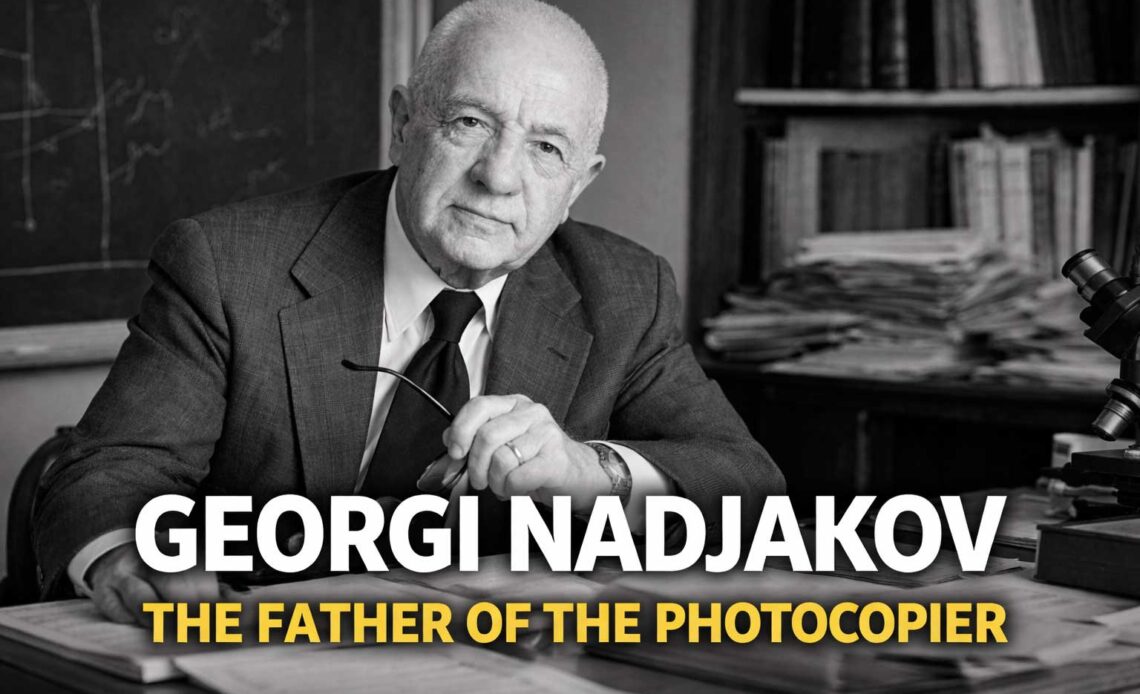

Georgi Nadjakov is one of the most important yet underrecognized scientific figures in modern history. His groundbreaking discovery of the photoelectret state of matter in 1937 laid the scientific foundation for one of the most widely used technologies of the 20th century—the photocopier.
While millions of people use printers and copiers daily, very few know that the physics behind these devices traces back to a Bulgarian scientist working in modest laboratory conditions. Nadjakov’s work bridged fundamental physics and real-world application, ultimately influencing innovations like Xerography, later developed by Chester Carlson.
Georgi Nadjakov is part of a remarkable legacy of innovators featured in our guide to 👉 Bulgarian Scientists Who Changed the World, where Bulgarian discoveries have shaped global science and technology.
This is not just a biography—it is the story of how Bulgarian science helped shape the modern technological world.
Early Life and Background
Georgi Nadjakov was born on December 26, 1896, in the town of Dupnitsa. At the time, Bulgaria was still developing its academic and scientific institutions, making his later achievements even more remarkable.
Growing up during a period of political and social transformation, Nadjakov showed early interest in science, particularly physics and mathematics. However, like many young men of his generation, his education was interrupted by World War I, where he served before returning to continue his studies.
Nadjakov’s achievements must also be understood within the broader context of 👉 History of Bulgarian Science and Technology, a period marked by rapid development and international collaboration.
He later enrolled at Sofia University, the country’s leading academic institution, where he studied physics and mathematics. It was here that his scientific journey truly began, laying the foundation for his future breakthroughs in solid-state physics.
Training in Paris: Learning from Legends
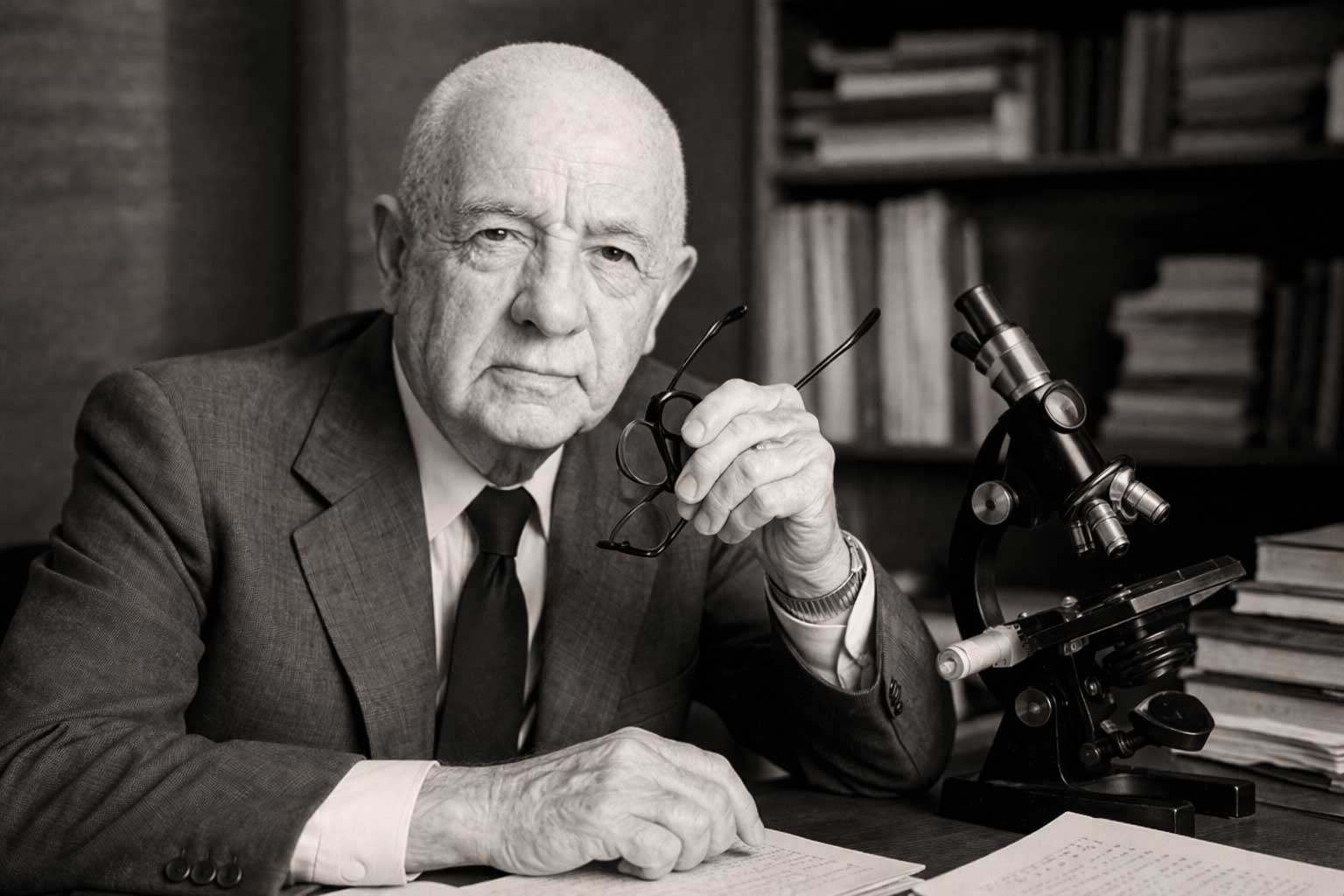
A turning point in Nadjakov’s career came when he was sent to Paris to specialize in advanced physics research—one of the world’s leading centers for scientific innovation at the time.
There, he worked under two of the greatest scientific minds in history:
This experience exposed him to cutting-edge research in photoelectricity, radiation physics, and atomic science, placing him at the forefront of early 20th-century scientific discovery.
Working in the intellectual environment shaped by pioneers like Curie and Langevin gave Nadjakov direct access to experimental methods and theoretical frameworks that were far ahead of what was available in Bulgaria at the time.
At a time when very few Bulgarian scientists had access to Western European research institutions, Nadjakov’s Paris training placed him among an elite group of internationally educated physicists—an advantage that would later enable his groundbreaking discovery of the photoelectret state of matter.
Academic Career and Scientific Leadership

After returning to Bulgaria, Georgi Nadjakov began teaching at Sofia University in 1927 and quickly rose through the academic ranks, establishing himself as one of the country’s leading physicists.
He is widely recognized among the leading figures in Famous Bulgarian Physicists, contributing significantly to the advancement of solid-state physics and experimental research in Bulgaria.
Over the course of his career, Nadjakov held several prestigious positions:
- Professor of Physics
- Rector of Sofia University (1947–1952)
- Member of the Bulgarian Academy of Sciences
- Corresponding member of the Göttingen Academy of Sciences
- Member of the Russian Academy of Sciences
These appointments reflect his growing international reputation and the global recognition of his scientific contributions.
His influence extended far beyond teaching and research. In 1946, Nadjakov founded what would later become the:
👉 Georgi Nadjakov Institute of Solid State Physics
This institution remains one of the leading research centers in Bulgaria today, continuing his legacy in condensed matter physics, materials science, and advanced experimental research.
What Did Georgi Nadjakov Discover? The Photoelectret Explained
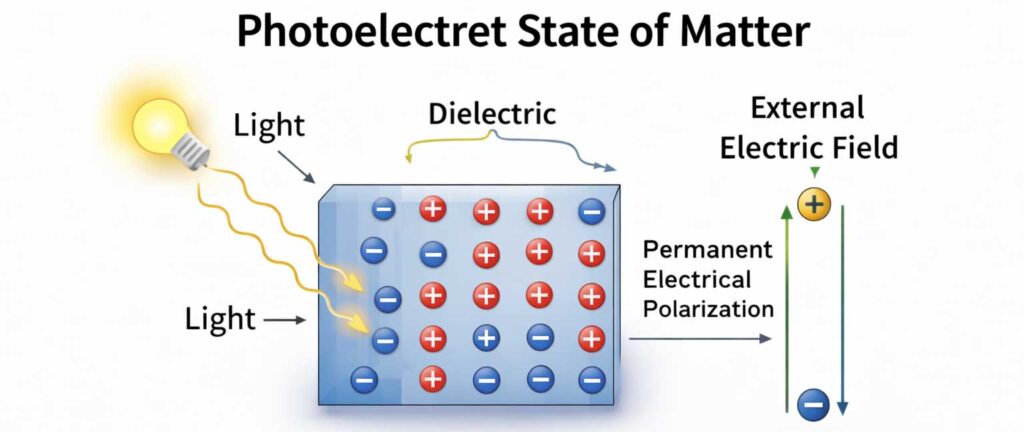
In 1937, Georgi Nadjakov made a groundbreaking discovery that transformed the understanding of materials in physics:
👉 The photoelectret state of matter
This discovery revealed that certain insulating materials—called dielectrics—can develop a permanent electrical polarization when exposed simultaneously to:
- Light (photons)
- An external electric field
Unlike previously known effects, this polarization remains even after the light source and electric field are removed.
What Is a Photoelectret? (Simple Definition)
A photoelectret is:
A dielectric material that acquires and retains a long-lasting electrical polarization after exposure to light and an electric field.
👉 In simple terms: Light + electricity → creates a permanent “charge memory” inside a material
This property makes photoelectrets fundamental to technologies that rely on electrostatic charge storage and light interaction.
How the Photoelectret Effect Works (Step-by-Step)
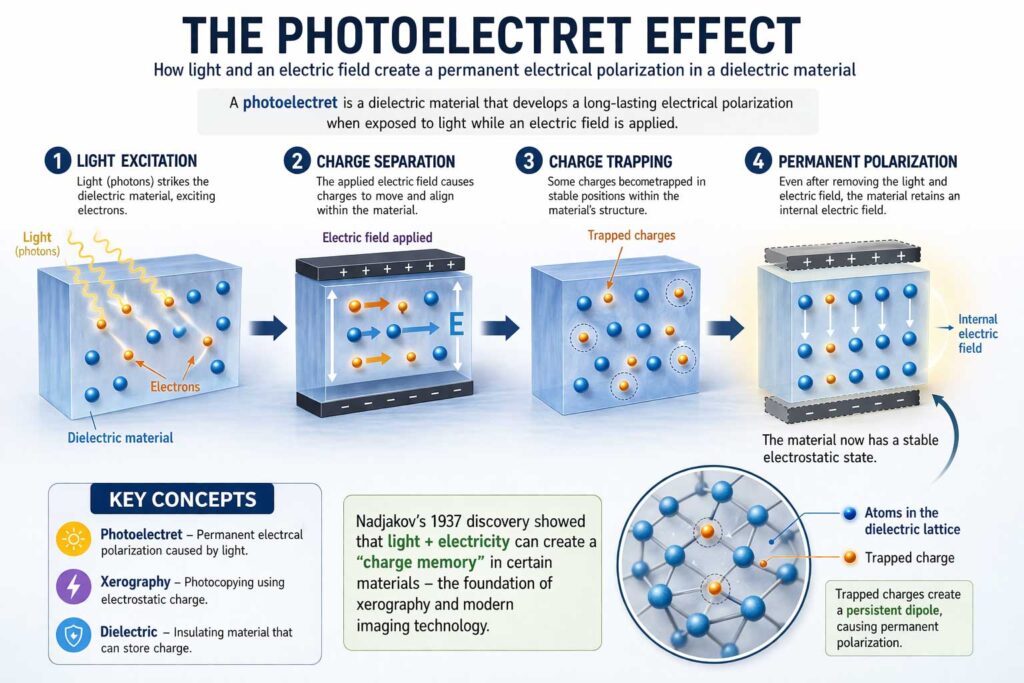
Nadjakov’s experiments—primarily using materials like sulfur—demonstrated a repeatable physical process:
1. Light Excitation
When light strikes the material, it energizes electrons inside the dielectric.
2. Charge Separation
The applied electric field causes these charges to move and align within the material.
3. Charge Trapping
Some charges become trapped in stable positions within the material’s structure.
4. Permanent Polarization
Even after removing the light and electric field, the material retains an internal electric field.
👉 This creates a stable electrostatic state, similar to how a magnet retains magnetization.
Why Nadjakov’s Discovery Was Revolutionary
Before the work of Georgi Nadjakov, the scientific consensus in physics was clear:
- Electrical polarization in insulating materials was temporary
- Charges would quickly dissipate once the external field was removed
- Continuous energy input was required to maintain any ordered charge state
In other words, materials could not “remember” an electrical condition without constant influence.
The Paradigm Shift
Nadjakov overturned this assumption with a single, powerful insight:
👉 Light can create a stable, long-lasting electrical state in matter
He demonstrated that under the right conditions, dielectric materials could:
- Store electrical charge internally
- Maintain polarization over time
- Exhibit a form of electrical memory
This was not just a new observation—it was a fundamental shift in how scientists understood matter itself.
Photoelectret vs Thermoelectret
To understand the significance, compare Nadjakov’s discovery with earlier work:
| Type | Scientist | Method | Key Feature |
|---|---|---|---|
| Thermoelectret | Mototaro Eguchi | Heat + electric field | Thermal polarization |
| Photoelectret | Georgi Nadjakov | Light + electric field | Light-induced polarization |
👉 Nadjakov introduced a completely new mechanism: optical control of electrical properties
What Changed in Physics
Nadjakov’s discovery reshaped multiple scientific fields:
1. Understanding of Charge Behavior in Insulators
Previously considered passive, insulating materials were now seen as capable of storing and stabilizing electrical charge, opening new possibilities for energy and signal retention.
2. Solid-State Physics
The discovery contributed to the early development of solid-state physics, a field that would later drive the invention of semiconductors, transistors, and modern electronics.
3. Materials Science
Nadjakov introduced the concept that materials could be engineered to exhibit light-controlled electrical properties, laying groundwork for advanced functional materials.
From Temporary Effects to “Electrical Memory”
One of the most revolutionary aspects of the photoelectret effect is its ability to create a persistent internal state.
👉 This transformed the concept of materials from passive conductors/insulators into active systems capable of storing information
This idea is foundational in modern technologies such as:
- Data storage systems
- Imaging technologies
- Electrostatic printing
Why This Was Ahead of Its Time
In the 1930s, the scientific world had not yet fully developed:
- Semiconductor theory
- Modern electronics
- Information storage concepts
Yet Nadjakov’s work anticipated all of these.
👉 He effectively discovered a mechanism for storing electrical information using light, decades before the digital age.
Connection to the Photocopier
This is where the story of Georgi Nadjakov becomes truly powerful—his discovery did not remain confined to theoretical physics, but directly influenced one of the most important technologies of the modern world.
Georgi Nadjakov’s discovery of the photoelectret state of matter helped make photocopying possible by proving that light can create and preserve electrical charge in materials, a principle later used in xerography.
His research laid the scientific foundation for: Xerography
What Is Xerography?
Xerography is a dry copying process invented by Chester Carlson in the late 1930s and commercialized in the 1940s.
It is the core technology behind:
- Photocopiers
- Laser printers
- Digital imaging systems
How Xerography Works (Simplified)
Xerography operates through a sequence of electrostatic processes:
- Charging – A surface (usually a drum) is given a uniform electrical charge
- Exposure – Light reflects from the original image onto the charged surface
- Charge Pattern Formation – Light alters the charge distribution
- Development – Toner particles attach to the charged pattern
- Transfer & Fixing – The image is transferred to paper and fused with heat
How Nadjakov’s Discovery Connects
Xerography depends on three fundamental physical principles:
- Light exposure
- Electrostatic charge behavior
- Charge retention in materials
👉 These are exactly the phenomena Nadjakov discovered and studied
His work on photoelectrets proved that:
- Light can influence electrical charge
- Materials can retain that charge over time
- Stable electrostatic patterns can exist
| Concept | Meaning |
|---|---|
| Photoelectret | Permanent electrical polarization caused by light |
| Xerography | Photocopying using electrostatic charge |
| Dielectric | Insulating material that can store electrical charge |
The Critical Link
Without Nadjakov’s discovery, scientists would not have fully understood:
- How to control charge using light
- How to store electrostatic patterns
- How to create repeatable imaging systems
👉 Without this knowledge, xerography—and modern photocopying—would not exist
From Laboratory Physics to Everyday Technology
What began as a laboratory experiment with dielectric materials evolved into:
- Office copiers used worldwide
- Home and industrial printers
- High-speed document reproduction systems
This transformation highlights a powerful truth:
👉 Fundamental science drives real-world innovation
Real-World Impact
The true significance of Georgi Nadjakov’s discovery becomes clear when we follow its impact beyond the laboratory and into everyday life.
Because of this scientific chain—from the photoelectret effect to the development of Xerography—modern society gained the ability to:
- Accelerate communication and information sharing on a global scale
- Instantly duplicate documents in offices worldwide
- Make printing technology widely accessible to businesses and individuals
Georgi Nadjakov’s discovery had a real-world impact by enabling technologies like photocopiers and laser printers, which transformed how information is duplicated, shared, and distributed worldwide.
Before these advancements, copying documents was slow, manual, and inefficient. The introduction of electrostatic printing technologies revolutionized:
- Business operations
- Education systems
- Government administration
- Publishing and media industries
👉 What began as a physics experiment ultimately reshaped how knowledge moves across the world.
Nadjakov’s discovery is a powerful example of how fundamental scientific research can lead to transformative global technologies, often decades after the original breakthrough.
Other Scientific Contributions
Although best known for discovering the photoelectret state of matter, Georgi Nadjakov was far from a one-discovery scientist.
His research extended across multiple areas of physics, including:
- Semiconductor physics – studying how materials conduct electricity under different conditions
- Magnetism – exploring magnetic properties and field interactions
- Nuclear physics – contributing to early research in atomic science
- X-ray spectroscopy – investigating the structure of matter using radiation
A Broad Scientific Legacy
Throughout his career, Nadjakov published over 60 scientific papers, contributing to the development of solid-state physics and experimental techniques.
He also demonstrated strong innovation in scientific instrumentation, developing devices such as:
- Electrometers for measuring electrical charge
- Experimental setups for studying dielectric behavior
Collaboration and Continued Innovation
In collaboration with his son, he worked on advanced X-ray spectrograph technology, further expanding his contributions to applied physics.
This work highlights an important aspect of Nadjakov’s legacy:
👉 He remained scientifically active and innovative throughout his life, continuously pushing the boundaries of research.
International Recognition and Influence
Georgi Nadjakov was not only a leading figure in Bulgarian science but also a respected presence in the international scientific community.
Georgi Nadjakov gained international recognition through his leadership in scientific institutions and contributions to global research, becoming a key figure in both Bulgarian and international physics.
Throughout his career, he held influential roles, including:
- Vice-President of the Bulgarian Academy of Sciences
- Representative at the Joint Institute for Nuclear Research
- Member of multiple international scientific organizations
These positions reflect not only his scientific expertise but also the global relevance of his research in solid-state physics and material science.
Beyond Science
Nadjakov’s influence extended beyond the laboratory. He was also involved in international initiatives such as the World Peace Council, demonstrating his commitment to global cooperation and intellectual exchange during a complex geopolitical era.
👉 This broader engagement highlights his role as both a scientist and a public intellectual.
Honors and Legacy

The legacy of Georgi Nadjakov continues through numerous honors that recognize his lasting impact on science.
Georgi Nadjakov’s legacy is honored through institutions, geographic landmarks, and international recognition, reflecting his lasting contribution to physics and modern technology.
Among the most notable recognitions:
- Nadjakov Glacier located in Graham Land
- The Georgi Nadjakov Institute of Solid State Physics, named in his honor
- Recognition by the European Physical Society
A Lasting Scientific Legacy
These honors are more than symbolic—they represent Nadjakov’s enduring influence on:
- Solid-state physics
- Material science
- Modern imaging technologies
His work continues to inspire researchers and institutions worldwide.
From Antarctica to leading scientific institutions, Nadjakov’s name remains embedded in the global scientific landscape—proof that his contributions extend far beyond his lifetime.
Why Georgi Nadjakov Matters Today

In today’s fast-moving digital world, we often take everyday technologies for granted—rarely stopping to consider the scientific discoveries that made them possible.
The work of Georgi Nadjakov is a powerful reminder that behind every modern convenience lies decades of fundamental research.
Georgi Nadjakov matters today because his discovery of the photoelectret laid the foundation for technologies like photocopiers and laser printers, proving how fundamental science can shape modern life.
This article may contain Amazon affiliate links. As an Amazon Associate, I earn from qualifying purchases at no extra cost to you.
The Hidden Science Behind Everyday Technology
Nadjakov’s research on the photoelectret effect directly contributed to technologies we use daily, including:
- Photocopiers might not exist in their current form
- Laser printers would be significantly different
- Modern imaging systems could have been delayed
His work stands alongside other breakthroughs highlighted in 👉 Bulgarian Inventions That Impacted Everyday Life, demonstrating how Bulgarian science has influenced technologies used worldwide.
He represents:
- Bulgarian scientific excellence
- The power of fundamental research
- The global impact of local innovation
👉 His work helped enable the rapid duplication and distribution of information, a cornerstone of modern society.
FAQS About Georgi Nadjakov
Who was Georgi Nadjakov?
Georgi Nadjakov was a Bulgarian physicist and academic leader known for discovering the photoelectret state of matter in 1937. He was a professor and rector at Sofia University and a member of the Bulgarian Academy of Sciences. His work in solid-state physics helped lay the foundation for technologies such as photocopiers and modern imaging systems.
What is a photoelectret?
A photoelectret is a material that develops and retains permanent electrical polarization after being exposed to light and an electric field. This means the material can “store” an electrical charge even after the external energy source is removed. This property is fundamental in technologies that rely on electrostatic charge and light interaction, including printing and imaging systems.
How did Nadjakov influence photocopying?
Nadjakov’s discovery of the photoelectret provided the scientific basis for Xerography, the technology used in photocopiers and laser printers. Xerography depends on how light affects electrical charges in materials—exactly the phenomenon Nadjakov studied. His research made it possible to develop systems that transfer images using electrostatic charge.
Did Georgi Nadjakov invent the photocopier?
No, the photocopier was invented by Chester Carlson in the late 1930s and 1940s. However, Carlson’s invention relied on the scientific principles discovered by Nadjakov. In this sense, Nadjakov’s work was a foundational breakthrough, while Carlson’s was the practical application.
Why is Georgi Nadjakov important?
Georgi Nadjakov is important because he made a key discovery in physics that influenced modern technology used worldwide. He also helped develop scientific research in Bulgaria, founded major institutions, and contributed to international science. His work demonstrates how fundamental research can lead to transformative global innovations.
Where was Georgi Nadjakov born?
Georgi Nadjakov was born in Dupnitsa on December 26, 1896. He later studied and worked in Sofia, becoming one of the most prominent scientists in Bulgarian history.
What fields did Georgi Nadjakov work in?
Nadjakov worked in several areas of physics, including:
- Solid-state physics
- Dielectrics and semiconductors
- Photoconductivity
- Magnetism
- Nuclear physics
His research contributed to both theoretical understanding and practical applications in modern science.
What honors did Georgi Nadjakov receive?
Nadjakov received numerous honors, including:
- Membership in the Bulgarian Academy of Sciences
- Membership in the Göttingen Academy of Sciences
- Membership in the Russian Academy of Sciences
- The naming of the Georgi Nadjakov Institute of Solid State Physics
- A glacier named after him in Antarctica
These recognitions reflect his lasting impact on global science.
Conclusion
Georgi Nadjakov stands as one of Bulgaria’s greatest scientific minds.
Today, his legacy continues as part of the broader story of 👉 Bulgarian Contributions to Modern Technology, proving that foundational scientific discoveries can shape the modern world.
His discovery of the photoelectret did not just advance physics—it helped enable one of the most important technologies of modern life.
From a small town in Bulgaria to influencing global innovation, his story proves that:
👉 Great discoveries can come from anywhere—and change everything.
👉 The story of Georgi Nadjakov proves that even the most abstract scientific discoveries can reshape the way the world communicates, works, and shares knowledge.
References
- Wikipedia. Georgi Nadjakov. https://en.wikipedia.org/wiki/Georgi_Nadjakov
- Bulgarian Academy of Sciences. Georgi Nadjakov Institute of Solid State Physics – History. https://issp.bas.bg/en/pages-7-istoriia
- Joint Institute for Nuclear Research. Remembering Founding Fathers: Georgi Nadjakov. https://www.jinr.ru/posts/remembering-founding-fathers-georgi-nadjakov/
- Nadjakov, G. (1937). Sur une nouvelle espèce de polarisation permanente des diélectriques. Comptes Rendus de l’Académie des Sciences, 204, 1865–1866.
- Nadjakov, G. (1938). Über eine neue Art von Elektreten: Photoelektreten. Physikalische Zeitschrift, 39(6), 226–227.
- Dielectric Phenomena in Solids. Academic Press. ISBN: 978-0123965615.
- European Physical Society. Historic Sites of Physics – Georgi Nadjakov.
- Institute of Solid State Physics Museum. Georgi Nadjakov Biography.