


The photoelectret state is a remarkable physical phenomenon in which a material—typically a photoconductor—retains a permanent electric polarization after being exposed to light while under the influence of an electric field. What may seem like a highly specialized concept in physics is, in reality, a breakthrough that transformed modern technology.
First discovered by Georgi Nadjakov, this effect revealed that light could be used to “write” and store electrical charge patterns inside materials. This insight became a foundational principle behind xerography, the process that powers photocopiers and laser printers.
👉 In other words, the photoelectret state is not just a scientific curiosity—it is one of the key discoveries that made fast, reliable document reproduction possible, shaping the way businesses, governments, and individuals handle information today.
What Is the Photoelectret State?
The photoelectret state is a physical condition in which a material—typically a photoconductor—acquires and retains a permanent electric polarization after being exposed to light in the presence of an external electric field.
This phenomenon occurs through a simple but powerful sequence:
- A photoconductive material is exposed to light
- At the same time, it is subjected to an external electric field
- The light source is then removed
👉 After this process, the material remains electrically polarized, even though both the light and the electric field are no longer present.
In practical terms, the material has effectively “stored” an electrostatic pattern within its structure. This ability to preserve charge distributions is what makes the photoelectret state so important—it forms the scientific basis for technologies that rely on capturing and reproducing images, including modern photocopying and laser printing systems.
The Physics Behind the Phenomenon
At its core, the photoelectret effect combines three major physical processes:
1. Photoconductivity
When light hits a material, it excites electrons, making the material temporarily conductive.
2. Charge Migration
The applied electric field causes these excited charges to move in a specific direction.
3. Charge Trapping
Once the light is removed, the charges become trapped in localized regions—creating a stable electrostatic pattern.
👉 This “frozen” charge distribution is what makes the material an electret.
Photoelectret vs Thermoelectret
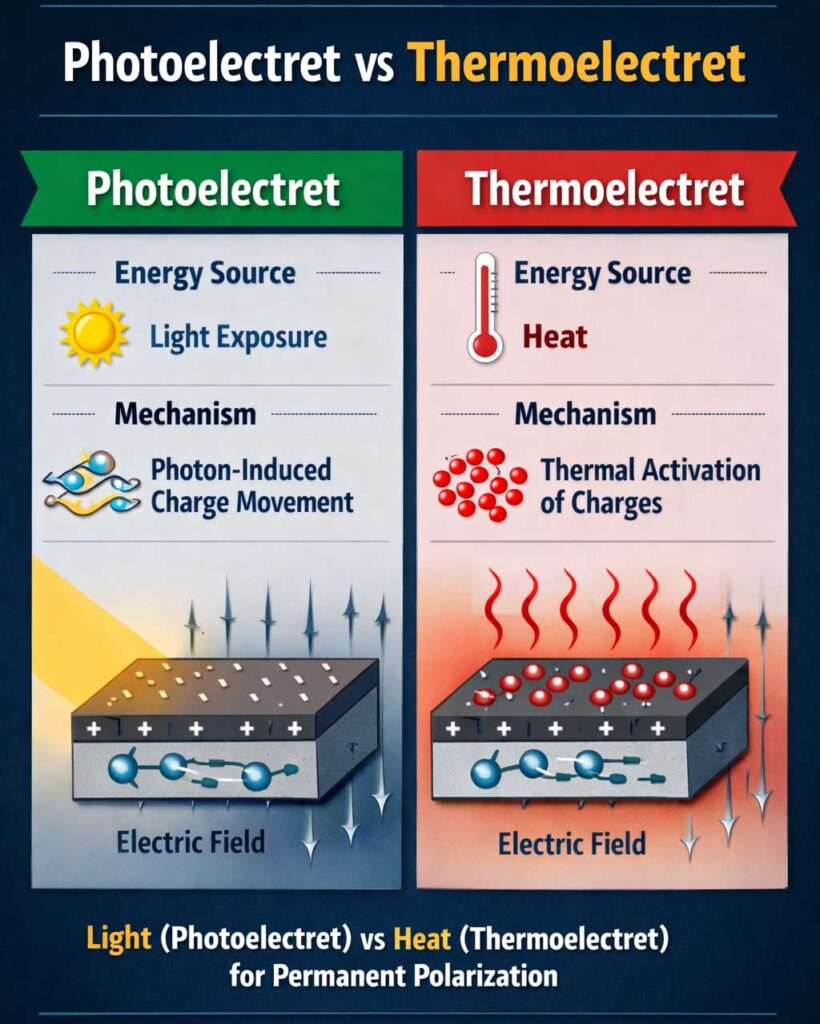
Before Nadjakov’s discovery, scientists were familiar with thermoelectrets.
Key Differences:
| Type | Energy Source | Mechanism |
|---|---|---|
| Thermoelectret | Heat | Thermal activation of charges |
| Photoelectret | Light | Photon-induced charge movement |
👉 Nadjakov introduced a completely new way of creating permanent polarization using light instead of heat.
The Discovery by Georgi Nadjakov
The photoelectret state was discovered in the late 1930s by Bulgarian physicist Georgi Nadjakov, whose pioneering experiments revealed a completely new way in which materials could store electrical charge.
Working with photoconductive substances exposed to both light and an electric field, Nadjakov observed that these materials retained a permanent electric polarization even after the external conditions were removed. This unexpected result led to the identification of a new class of electrets.
His Key Contributions:
- Demonstrated that light combined with an electric field can create a new type of electret
- Coined the term photoelectret to describe this phenomenon
- Clearly distinguished it from:
- Thermoelectrets → produced using heat and an electric field
- Proved that light can “write” and store electrical information within materials
Explore more Bulgarian contributions to science.
👉 This insight was groundbreaking. It introduced the idea that electrostatic charge patterns could be created and preserved using light, forming the scientific foundation for electrostatic imaging and modern photocopying technologies.
How It Works
To understand the photoelectret state, it helps to break the process down into a few intuitive steps:
- Light excites electrons inside the material, temporarily increasing its electrical conductivity
- The external electric field guides the movement of these charges in a specific direction
- When the light is removed, the electrons lose energy and become trapped in stable positions
- The material now retains a latent electrostatic image, representing the original charge pattern
👉 In essence, the material has “recorded” an invisible electrical imprint.
This is the same fundamental principle used in photocopying: a surface first captures an electrostatic image of a document, which is then developed and transferred onto paper. The photoelectret effect makes it possible for that image to be formed, stored, and reproduced with precision.
Why It Matters: The Birth of Photocopying
The discovery of the photoelectret state played a direct and crucial role in the development of xerography—the technology that powers modern photocopiers and laser printers. By proving that light can create and preserve electrical charge patterns, it made electrostatic image reproduction possible.
Connection to Photocopying:
The photocopying process follows a sequence based on the same principles:
- A photoconductive surface is uniformly charged with electricity
- Light, reflected from a document, is projected onto the surface
- Exposed (bright) areas lose their charge, while darker areas retain it
- This contrast forms a latent electrostatic image
- Fine toner particles adhere to the charged regions, revealing the image
- The image is then transferred onto paper and permanently fixed with heat
👉 Without the concept of the photoelectret state, this entire process would not be possible. It provided the scientific foundation that allows machines to capture, store, and reproduce images using electricity and light—a breakthrough that transformed offices, education, and communication worldwide.
Affiliate Disclosure: Some of the links on this page may be affiliate links, which means we may earn a small commission at no additional cost to you if you make a purchase through them. These commissions help support the maintenance and growth of this website. These recommendations are carefully selected to support deeper learning on this topic.
The following books are highly recommended for deeper understanding and are widely used in physics and engineering.
Best Books on Xerography and Photocopying Technology
These books provide the broader scientific foundation, helping readers understand the physics behind electrets, semiconductors, and imaging systems.
| Book | Best For | Why It Matters | Check Price |
|---|---|---|---|
| Electrophotography and Development Physics | Advanced | Explains the full xerography process used in photocopiers and printers | Check Price |
| Xerography and Related Processes – Dessauer & Clark | Historical + Technical | Connects Nadjakov’s discovery to Xerox technology | Check Price |
| Handbook of Imaging Materials | Professional | Covers materials used in imaging, printing, and electrostatic systems | Check Price |
Recommended Books on Electrostatics and Electret Physics
These books help explain the core physics behind the photoelectret state, including charge behavior, dielectric materials, and photoconductivity.
| Book | Best For | Why It Matters | Check Price |
|---|---|---|---|
| Dielectric Phenomena in Solids – Kwan-Chi Kao | Advanced | Deep explanation of electrets and dielectric behavior directly tied to photoelectret theory | Check Price |
| Electrets – Gerhard M. Sessler | Specialist | One of the most focused books on electret materials and polarization physics | Check Price |
| Physics of Semiconductor Devices – S.M. Sze | Intermediate | Connects photoconductivity with real-world electronics and imaging systems | Check Price |
Photocopying in Historical Context

Photocopying encompasses a wide range of technologies developed to duplicate documents quickly and accurately, playing a vital role in everyday operations across:
- Businesses
- Government offices
- Legal systems
- Educational institutions
Before the invention of modern photocopiers, reproducing documents was a time-consuming and often unreliable process.
Before Modern Copiers
Earlier duplication methods included:
- Manual copying → labor-intensive and prone to human error
- Carbon paper duplication → limited copies with declining quality
- Mechanical duplicators → required setup and were inefficient for small tasks
- Chemical photographic methods → costly and complex to operate
Each of these approaches suffered from significant limitations in speed, accuracy, and scalability, making them unsuitable for the growing demands of modern administration and communication.
👉 As the need for fast, reliable document reproduction increased, innovation became inevitable—and the discovery of the photoelectret state by Georgi Nadjakov emerged as a critical breakthrough that helped make modern photocopying possible.
Scientific Importance
The photoelectret effect is not limited to a single discovery—it has broad significance across multiple scientific and technological fields. By demonstrating how light and electric fields can interact to create stable charge patterns, it opened new directions in both theoretical and applied research.
Key Fields Influenced:
- Solid-state physics → advanced understanding of how charges behave in insulating and semiconducting materials
- Materials science → development of new photoconductive and dielectric materials with controlled electrical properties
- Electronics → contributed to technologies that rely on charge storage and manipulation
- Imaging technologies → formed the basis for electrostatic image formation used in photocopying and printing
Beyond its practical applications, the discovery also deepened scientific understanding of several fundamental concepts:
- Charge trapping → how electrons become localized and remain stable over time
- Dielectric polarization → how insulating materials respond to electric fields
- Photoconductivity → how light alters the electrical properties of materials
👉 Together, these insights helped bridge the gap between pure physics and real-world technology, making the photoelectret effect a cornerstone in the evolution of modern electronic and imaging systems.
Essential Solid-State Physics Books for Deeper Understanding
These books help explain the core physics behind the photoelectret state, including charge behavior, dielectric materials, and photoconductivity.
| Book | Best For | Why It Matters | Check Price |
|---|---|---|---|
| Introduction to Solid State Physics – Charles Kittel | Core Foundation | The most widely used textbook for understanding materials and charge behavior | Check Price |
| Solid State Electronic Devices – Streetman & Banerjee | Engineering | Connects physics concepts to real devices like printers and sensors | Check Price |
| Fundamentals of Physics – Halliday, Resnick & Walker | Beginner | Great starting point for understanding core physics concepts | Check Price |
Related Scientific Concepts
The photoelectret state is closely connected to several important physical phenomena that are widely studied in modern science:
- Electrostatics → the study of stationary electric charges
- Semiconductor physics → behavior of materials used in electronics
- Surface charge dynamics → how charge distributes and stabilizes on materials
👉 Understanding these related concepts helps explain why the photoelectret effect became so influential in both scientific research and real-world applications.
From Discovery to Photocopying (Xerography)
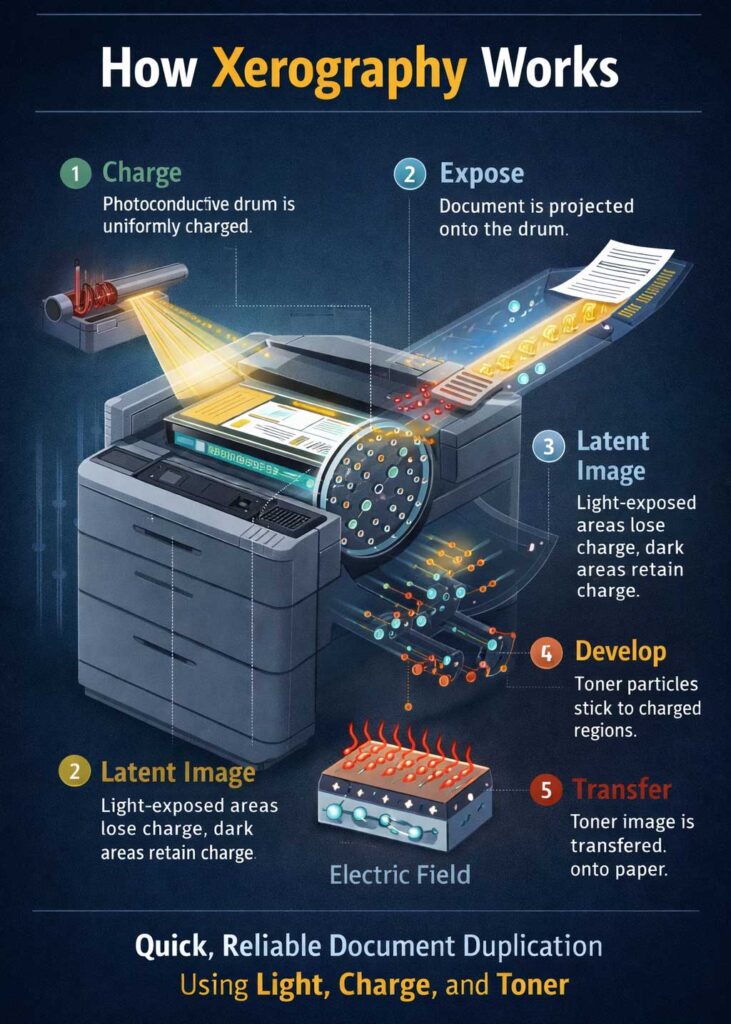
The most important application of the photoelectret effect is xerography, the basis of modern photocopying.
How Xerography Works:
- A photoconductive drum is electrically charged
- Light reflects from a document onto the drum
- Exposed areas lose charge, while dark areas retain it
- This creates a latent electrostatic image
- Toner particles stick to charged regions
- The image is transferred to paper and fused with heat
👉 This process is directly rooted in the principles discovered by Nadjakov.
Legacy and Impact
Although his name is not always widely recognized outside scientific circles, the work of Georgi Nadjakov remains foundational to technologies used daily around the world. His discovery of the photoelectret state introduced a new way to capture and preserve electrical information—an idea that continues to power modern imaging systems.
His Impact Lives On In:
- Photocopiers → enabling fast, reliable document duplication
- Laser printers → using electrostatic imaging for precise printing
- Imaging sensors → capturing and processing visual information
- Electrostatic recording systems → storing and reproducing data through charge patterns
👉 Today, every time a document is copied, scanned, or printed using electrostatic methods, the underlying principle traces back to Nadjakov’s discovery. His work stands as a powerful example of how fundamental scientific research can shape everyday technology on a global scale.
Modern Relevance and Ongoing Impact

The importance of the photoelectret state extends far beyond its original discovery—it continues to play a vital role in modern technology and innovation. As digital systems evolve, the ability to control, store, and manipulate electrical charge using light remains a fundamental principle in many advanced applications.
Today, the concepts introduced by Georgi Nadjakov are still actively used in:
- Modern laser printing systems → delivering high-speed, high-resolution output
- Digital imaging and scanning technologies → enabling accurate reproduction of documents and images
- Semiconductor and memory research → influencing how data can be stored and processed
- Advanced materials science → guiding the development of new photoconductive materials
👉 As the world moves toward faster, more efficient information processing, the principles behind the photoelectret effect remain essential. This discovery is not just part of history—it is still shaping the future of electronics, imaging, and data technology today.
Frequently Asked Questions (FAQ) About Photoelectret state
What is a photoelectret?
A material that retains electric polarization after exposure to light and an electric field.
Who discovered the photoelectret state?
Georgi Nadjakov.
When was it discovered?
In 1937–1938.
What is it used for?
Primarily in photocopying and laser printing technologies.
What is xerography?
A document copying process based on electrostatic imaging.
How does light affect the material?
It excites electrons, allowing charge movement.
What happens after light is removed?
Charges become trapped, forming a stable pattern.
Is it still used today?
Yes, in modern printers and imaging systems.
What is a photoconductor?
A material that becomes conductive when exposed to light.
What is an electret?
A material with permanent electric polarization.
What is the difference from thermoelectret?
Thermoelectrets use heat; photoelectrets use light.
Why is it important?
It enables electrostatic image reproduction.
Does it store images?
Yes, in the form of electrostatic charge patterns.
Is it related to photography?
Indirectly, but it is based on electrostatics, not chemistry.
What industries use it?
Office tech, printing, electronics, research.
Can it be used in memory storage?
Yes, similar principles apply.
Is it part of semiconductor physics?
Yes, closely related.
What materials are used?
Photoconductive dielectrics.
Did it directly create photocopiers?
It provided the key scientific principle.
Why is Nadjakov not widely known?
His work was foundational but not commercially branded like later technologies.
Conclusion
The photoelectret state is a cornerstone of modern imaging technology. What began as a laboratory observation by Georgi Nadjakov evolved into a discovery that transformed how the world handles information.
Without the discovery of the photoelectret state by Georgi Nadjakov, modern photocopying and electrostatic imaging would not exist in their current form. What began as a laboratory experiment evolved into a technology that powers communication, business, and information sharing across the world.
It stands as a powerful reminder that fundamental science can change everyday life in ways we rarely notice—but constantly depend on.
More from Discoveries
Recommended
More From Inventors
You May Be Interested To Read About
Bulgarian Science and Technology History
Boicho Kokinov
Bulgarian Achievements You’ll Be Proud Of
Bulgarian Products You Should Know
References
The following sources include primary research papers, academic publications, and authoritative references supporting the discovery and applications of the photoelectret state.
- Georgi Nadjakov (1937). Sur une nouvelle espèce de polarisation permanente des diélectriques. Comptes Rendus de l’Académie des Sciences de Paris, 204, 1865–1866. https://gallica.bnf.fr/
- Georgi Nadjakov (1938). Über eine neue Art von Elektreten: Photoelektreten. Physikalische Zeitschrift, 39(6), 226–227. https://onlinelibrary.wiley.com/
- Kwan-Chi Kao (2004). Dielectric Phenomena in Solids. Academic Press. https://www.sciencedirect.com/
- Gerhard M. Sessler (1987). Electrets. Springer-Verlag. https://link.springer.com/
- Charles Kittel (2005). Introduction to Solid State Physics. Wiley. https://www.wiley.com/
- S. M. Sze & Kwok K. Ng (2006). Physics of Semiconductor Devices. Wiley-Interscience. https://www.wiley.com/
- Arthur S. Diamond (1991). Handbook of Imaging Materials. Marcel Dekker. https://www.taylorandfrancis.com/
- Xerox Corporation. Xerography Technology Overview. https://www.xerox.com/
- Bulgarian Academy of Sciences. Photoelectret State of Matter.
- IEEE. Research on Photoconductivity and Electret Materials.
- Encyclopaedia Britannica. Electret and Photoconductivity. https://www.britannica.com/
- Photoelectret. Wikipedia. https://en.wikipedia.org/wiki/Photoelectret
- Electret. Encyclopedia of Physics and Technology. https://www.sciencedirect.com/topics/