


In the early 2000s, the field of astronomy experienced a revolutionary breakthrough. Scientists began discovering planets beyond our solar system—worlds orbiting distant stars, known as exoplanets. Among these groundbreaking discoveries was OGLE-TR-56b, a planet located thousands of light-years away from Earth.
This discovery was closely connected to the work of Dimitar Sasselov, a Bulgarian astrophysicist who played a key role in advancing exoplanet research and detection methods.
Learn more about other groundbreaking discoveries in Bulgarian science in our guide to Bulgarian Scientists and Inventions.
.
OGLE-TR-56b is not just another distant world—it represents a major milestone in the history of astronomy and the search for planets beyond our solar system.
Beyond its scientific importance, OGLE-TR-56b represents a powerful example of how global collaboration and Bulgarian expertise intersect in modern astronomy. At a time when exoplanet research was still in its infancy, discoveries like this helped shift the perception of our universe—from a place with a few known planets to a vast cosmic landscape filled with billions of potential worlds.
What Is OGLE-TR-56b?
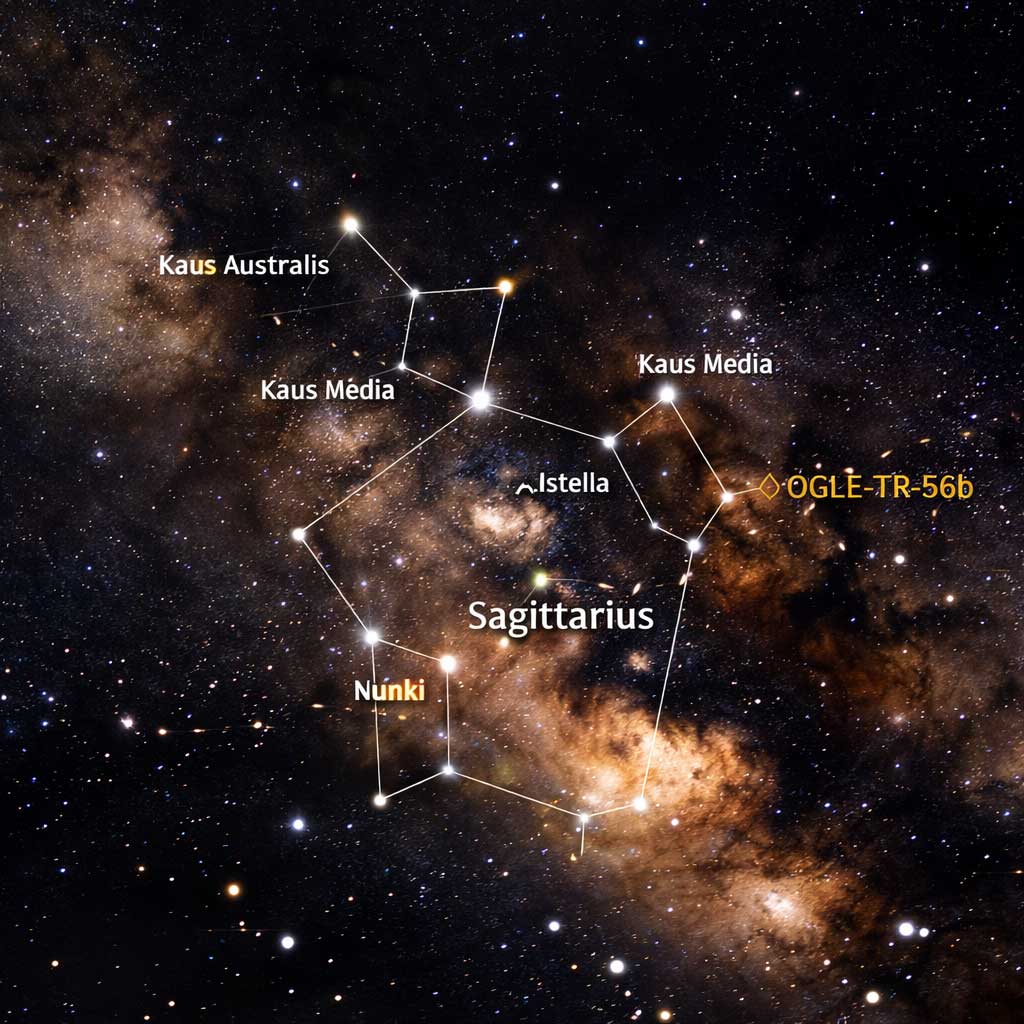
OGLE-TR-56b is an extrasolar planet located approximately 1500 parsecs (about 4,900 light-years) away from Earth in the constellation of Sagittarius.
It orbits a distant star known as OGLE-TR-56 and belongs to a class of planets called hot Jupiters—gas giants that orbit extremely close to their parent stars.
To understand how Bulgaria contributes to global knowledge, explore Famous Bulgarian Contributions to the World.
.
Key Characteristics
- Distance: ~1500 parsecs (≈4,900 light-years)
- Type: Hot Jupiter
- Orbit: Extremely close to its star
- Orbital Period: ~1.2 days
- Temperature: Extremely high (thousands of degrees)
This planet completes a full orbit in just over a day, making it one of the fastest-orbiting planets ever discovered at the time.
Because of its extreme proximity to its host star, OGLE-TR-56b is tidally locked, meaning one side of the planet constantly faces the star while the other remains in darkness. This creates dramatic temperature differences across the planet, resulting in violent atmospheric winds that redistribute heat. These extreme conditions provide scientists with valuable data about atmospheric physics under intense radiation.
The planet is theorized to have iron rain.[5]
More from Discoveries
Recommended
The Breakthrough Discovery
OGLE-TR-56b was first detected in 2002 by the Optical Gravitational Lensing Experiment (OGLE), a large-scale astronomical survey designed to detect dark matter, gravitational lensing events, and planetary transits.
Why This Discovery Was Revolutionary
This planet was:
- One of the first planets discovered using the transit method
- Among the most distant planets known at the time
- Later confirmed using the Doppler (radial velocity) technique
The combination of detection methods made OGLE-TR-56b one of the earliest fully validated exoplanets, setting a new standard for future discoveries.
At the time of its discovery, detecting a planet so far away was considered extremely challenging. The success of the OGLE project demonstrated that even distant and faint stars could be monitored for planetary signals. This achievement paved the way for future large-scale surveys and space missions dedicated entirely to finding exoplanets.
The Transit Method Explained
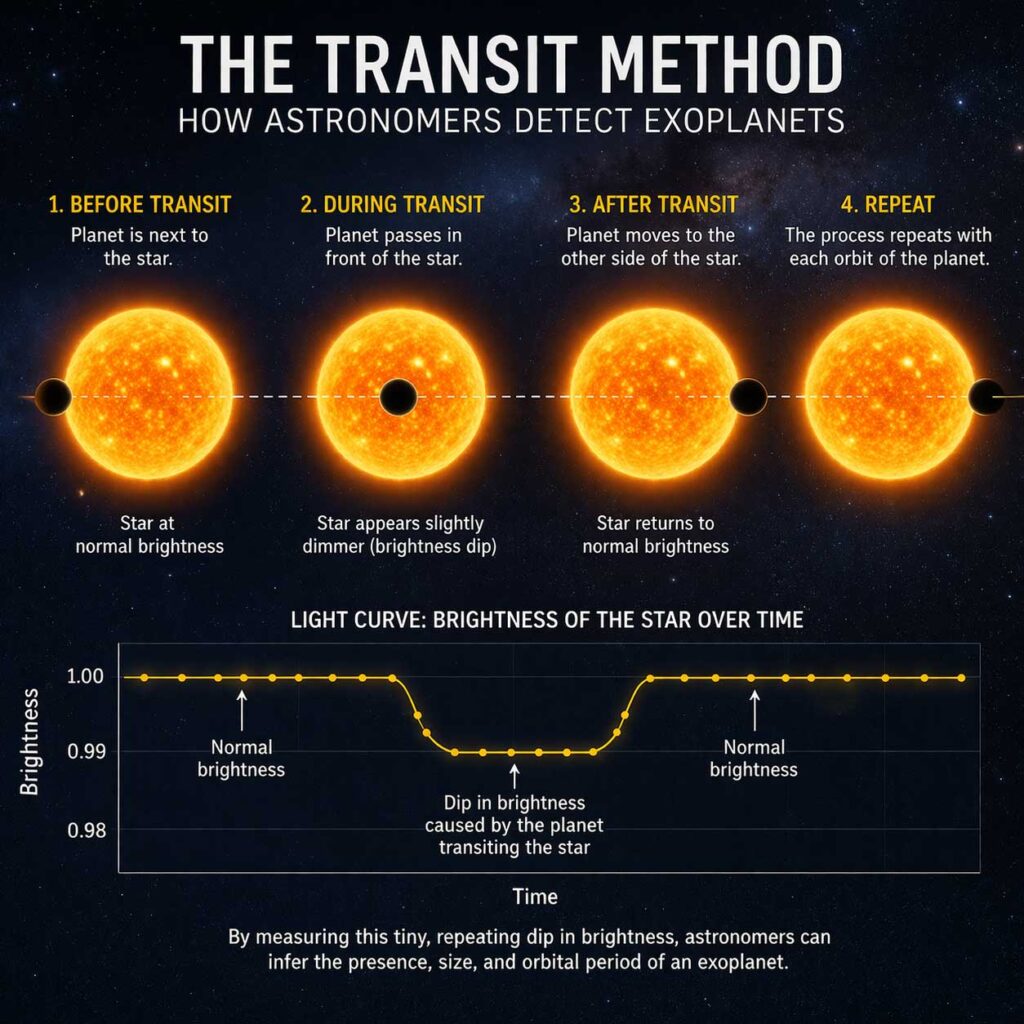
The transit method detects planets by observing the slight dimming of a star’s light when a planet passes in front of it.
The importance of the transit method extends beyond detection—it also allows scientists to study planetary atmospheres. When a planet transits its star, a small portion of starlight passes through the planet’s atmosphere, revealing clues about its composition. This technique has since been used to detect water vapor, methane, and other molecules on distant worlds.
How It Works:
- A planet crosses in front of its host star
- The star’s brightness dips slightly
- Scientists measure this dip
- Repeated dips confirm a planet’s orbit
This method allows astronomers to determine:
- Planet size
- Orbital period
- Distance from the star
OGLE-TR-56b helped prove that this technique could successfully detect planets across vast distances.
This scientific breakthrough connects to broader advancements explained in Bulgarian Science and Technology History .A World of Extreme Conditions
OGLE-TR-56b is not a place you would want to visit.
Due to its extremely close orbit, the planet experiences intense heat and pressure.
The concept of iron rain may sound like science fiction, but it is grounded in real physics. Under such extreme heat, elements behave in unfamiliar ways, forming exotic weather systems unlike anything on Earth. Studying these environments helps scientists better understand the limits of planetary formation and survival under extreme conditions.
Extreme Features:
- Surface temperatures reaching thousands of degrees
- Atmosphere likely filled with vaporized metals
- Violent atmospheric dynamics
One of the most fascinating theories about OGLE-TR-56b is the possibility of iron rain.
Iron Rain Phenomenon
Scientists believe that:
- Iron in the atmosphere vaporizes due to extreme heat
- As it cools, it condenses into liquid metal
- This results in rain made of molten iron
This phenomenon highlights just how alien and extreme exoplanets can be compared to Earth.
Explore more fascinating natural and scientific phenomena in Mysterious Places in Bulgaria.
More From Inventors
You May Be Interested To Read About
Preserving Bulgarian Heritage in the Digital Age
Bulgarian Drinks You Must Try
Why OGLE-TR-56b Matters
The discovery of OGLE-TR-56b marked a turning point in astronomy.
Key Contributions:
- Proved the transit method works reliably
- Expanded the known boundaries of planetary systems
- Opened the door to discovering thousands of exoplanets
OGLE-TR-56b also helped answer one of astronomy’s biggest questions: are planetary systems common? Its discovery, along with others in the early 2000s, confirmed that planets are not rare exceptions but rather a fundamental part of star systems. This realization has reshaped our understanding of the universe and strengthened the search for life beyond Earth.
You can also read about Bulgaria’s broader global influence in Famous Bulgarian Exports and Global Impact.
.
Before discoveries like this, scientists were unsure how common planets were in the universe. Today, we know:
👉 There are billions of planets in our galaxy alone
The Role of Dimitar Sasselov
Dimitar Sasselov is one of the leading figures in exoplanet research.
His Contributions:
- Advanced techniques for detecting distant planets
- Worked on major exoplanet discovery missions
- Promoted the search for Earth-like planets
He has also been involved in major initiatives such as:
His work helped shape the modern understanding of planetary systems beyond our own.
In addition to his scientific contributions, Dimitar Sasselov has played an important role in education and public outreach. Through lectures, books, and research programs, he has helped bring the excitement of space exploration to a global audience, inspiring young scientists to pursue careers in astronomy and physics.
Discover more influential figures in Great Bulgarian Minds That Changed the World .What Is a Hot Jupiter?

OGLE-TR-56b belongs to a class of planets called hot Jupiters.
Characteristics of Hot Jupiters:
- Gas giants similar in size to Jupiter
- Orbit extremely close to their stars
- Very short orbital periods
- Extremely high temperatures
These planets challenge traditional theories of planetary formation, which suggested gas giants should only form far from their stars.
Hot Jupiters like OGLE-TR-56b challenge traditional models of planetary formation. Scientists now believe that these planets may form farther from their stars and later migrate inward over time. This discovery forced astronomers to rethink long-standing theories about how planetary systems evolve.
Learn how scientific discoveries shape our understanding of the universe in Bulgarian Education and Scientific Achievements.
.
From OGLE-TR-56b to Modern Discoveries
Since 2002, exoplanet discovery has exploded.
Major Milestones:
- Thousands of planets discovered
- Identification of Earth-like planets
- Detection of atmospheres and weather systems
Modern missions like:
have built on early discoveries like OGLE-TR-56b.
Today, astronomers are not only detecting planets but also studying their atmospheres, climates, and even potential habitability. Missions like the James Webb Space Telescope are capable of analyzing the chemical composition of distant worlds, bringing us closer than ever to finding signs of life beyond Earth.
Use in Industry and Science
The discovery of OGLE-TR-56b has had lasting impacts across multiple fields.
1. Astronomy and Space Science
- Improved detection methods
- Better understanding of planetary systems
2. Technology Development
- Advanced telescopes and sensors
- Data analysis algorithms
3. Astrobiology
- Expanded the search for life beyond Earth
- Understanding extreme environments
4. Education and Public Interest
- Increased global interest in space exploration
- Inspired new generations of scientists
Beyond astronomy, the technologies developed for exoplanet research have practical applications on Earth. Advanced imaging systems, data processing techniques, and signal detection methods are now used in fields such as medical imaging, climate science, and artificial intelligence, demonstrating how space research benefits everyday life.
Explore how knowledge evolves over time in History of Bulgarian Innovation.
.
Are There Even Farther Planets Today?
Yes—today, scientists have discovered planets even farther away than OGLE-TR-56b.
However, at the time of its discovery, it was among the most distant known planets and one of the most important early confirmations of the transit method.
The Bigger Picture
OGLE-TR-56b represents more than just a distant world.
It symbolizes:
- Humanity’s curiosity
- The power of scientific innovation
- The beginning of a new era in astronomy
From a single detection in 2002, we now have:
- 👉 A universe filled with known planets
- 👉 New possibilities for life beyond Earth
- 👉 A deeper understanding of our place in the cosmos
OGLE-TR-56b is one of the most important early examples in exoplanet discovery, helping scientists refine the transit method and expand our understanding of distant planetary systems. This farthest planet from Earth discovered in the early 2000s continues to influence modern astronomy and the search for habitable worlds beyond our solar system.
As we continue to explore the universe, OGLE-TR-56b remains a symbol of early discovery and scientific ambition. It reminds us that even the most distant and hostile worlds can teach us valuable lessons about the cosmos—and about ourselves.
FAQs About OGLE-TR-56b
What is OGLE-TR-56b?
OGLE-TR-56b is a hot Jupiter exoplanet located about 4,900 light-years from Earth in the constellation Sagittarius. It was one of the earliest planets discovered using the transit method and played a key role in advancing exoplanet research.
Why is OGLE-TR-56b important?
OGLE-TR-56b is important because it was one of the first confirmed exoplanets detected using both the transit and Doppler methods. Its discovery proved that scientists could reliably detect planets orbiting distant stars, even thousands of light-years away.
How far is OGLE-TR-56b from Earth?
OGLE-TR-56b is located approximately 1500 parsecs, or about 4,900 light-years, away from Earth, making it one of the most distant planets known at the time of its discovery.
What type of planet is OGLE-TR-56b?
OGLE-TR-56b is classified as a hot Jupiter, a type of gas giant that orbits extremely close to its parent star and experiences extremely high temperatures.
Does OGLE-TR-56b really have iron rain?
Scientists believe OGLE-TR-56b may experience iron rain due to its extreme heat. Metals like iron can vaporize in the atmosphere and later condense into liquid droplets, falling as rain under certain conditions.
Who discovered OGLE-TR-56b?
The planet was discovered by the Optical Gravitational Lensing Experiment (OGLE) project in 2002 and later confirmed using spectroscopic methods. Bulgarian astronomer Dimitar Sasselov contributed significantly to the development of exoplanet detection techniques.
What is the transit method in astronomy?
The transit method detects planets by observing the slight dimming of a star when a planet passes in front of it. This technique allows scientists to determine the planet’s size, orbit, and other key characteristics.
Is OGLE-TR-56b the farthest planet ever discovered?
At the time of its discovery, OGLE-TR-56b was among the farthest known planets. Today, astronomers have identified planets located even farther away, but OGLE-TR-56b remains historically important.
Can humans visit OGLE-TR-56b?
No, OGLE-TR-56b is far too distant and extremely hostile. With temperatures reaching thousands of degrees and extreme atmospheric conditions, it would be impossible for humans to visit or survive there.
How did OGLE-TR-56b change astronomy?
The discovery of OGLE-TR-56b helped establish the transit method as a reliable way to detect exoplanets. It opened the door to the discovery of thousands of planets and transformed our understanding of the universe.
References
- Konacki, Maciej; et al. (2003). “An extrasolar planet that transits the disk of its parent star” (PDF). Nature. 421 (6922): 507–509. Bibcode:2003Natur.421..507K. doi:10.1038/nature01379. PMID 12556885.
- Udalski, A.; et al. (2002). “The Optical Gravitational Lensing Experiment. Search for Planetary and Low-Luminosity Object Transits in the Galactic Disk. Results of 2001 Campaign – Supplement”. Acta Astronomica. 52 (2): 115–128. arXiv:astro-ph/0207133. Bibcode:2002AcA….52..115U.
- Konacki, Maciej; et al. (2003). “High-Resolution Spectroscopic Follow-up of OGLE Planetary Transit Candidates in the Galactic Bulge: Two Possible Jupiter-Mass Planets and Two Blends”. The Astrophysical Journal. 597 (2): 1076–1091. arXiv:astro-ph/0306542. Bibcode:2003ApJ…597.1076K. doi:10.1086/378561.
- Hebb, L.; et al. (2009). “WASP-12b: THE HOTTEST TRANSITING EXTRASOLAR PLANET YET DISCOVERED”. The Astrophysical Journal. 693 (2): 1920–1928. arXiv:0812.3240. Bibcode:2009ApJ…693.1920H. doi:10.1088/0004-637X/693/2/1920.
- Harvard University and Smithsonian Institution (2003-01-08). “New World of Iron Rain”. Astrobiology Magazine. Retrieved 2010-01-25.
- Wikipedia article.
The contents of this page are sourced from Wikipedia article. The contents are available under the CC BY-SA 4.0 license.
Photo credit: Aldaron / Wikipedia