



Ivan Mitev is the Bulgarian doctor who discovered the sixth heart tone, a groundbreaking advancement that changed how cardiologists understand heart sounds and diagnosis.
Professor Ivan Mitev Ivanov (Bulgarian: Иван Митев Иванов) (4 October 1924 – 15 April 2006) was a Bulgarian pediatrician and cardio rheumatologist who discovered the sixth heart tone,[1] called the tone of Mitev.
He was awarded by Todor Zhivkov (leader of the People’s Republic of Bulgaria from 1954 until 1989) at a grand ceremony and dedicated to Mitev’s discovery was issued a special postage stamp – the first stamp dedicated to cardiology.
Who Was Ivan Mitev?
Ivan Mitev was a Bulgarian pediatrician and cardiologist best known for discovering the sixth heart tone, also called the Tone of Mitev. His work expanded the scientific understanding of heart sounds and improved diagnostic methods in cardiology, placing him among the most notable figures in modern cardiology and highlighting Bulgaria’s contribution to global medical science.
👉 Learn more about Bulgaria’s scientific impact → Bulgarian Scientists Who Changed Medicine.
Professor Ivan Mitev stands as one of Bulgaria’s most important medical innovators of the 20th century. A pioneer in pediatric cardiology and rheumatology, Mitev achieved global recognition for his groundbreaking discovery of the sixth heart tone—a previously undocumented cardiac sound that expanded the scientific understanding of heart physiology.
At a time when cardiology was still evolving as a precise diagnostic science, Mitev’s work pushed the boundaries of what physicians could detect through auscultation (listening to the heart). His discovery—known as the Tone of Mitev—placed Bulgaria on the global medical map and demonstrated how careful observation, clinical expertise, and persistence can lead to paradigm-shifting breakthroughs.
👉 Explore the broader context → Bulgarian Science and Technology History.
Early Life and Education
Ivan Mitev was born on October 4, 1924, in Bulgaria during a time of political instability and limited access to advanced medical resources. Despite these challenges, he demonstrated exceptional academic ability and intellectual curiosity from an early age.
His medical education took place during a period when Bulgaria’s healthcare system was rapidly modernizing and increasingly influenced by Western medical standards. This environment provided Mitev with both traditional clinical training and exposure to evolving scientific approaches.
Multidisciplinary Medical Training
Mitev pursued specialization in several key fields:
- Pediatrics
- Cardiology
- Rheumatology
This broad and interdisciplinary foundation played a crucial role in shaping his future work. By combining knowledge from multiple medical domains, he developed a deeper understanding of how different systems of the body interact—particularly in children.
Foundation for a Breakthrough
This unique combination of expertise allowed Ivan Mitev to recognize subtle cardiovascular phenomena that others often overlooked.
His education did not just prepare him to practice medicine—it prepared him to redefine it.
These early experiences laid the groundwork for his later discovery of the sixth heart tone, a contribution that would leave a lasting mark on cardiology..
Career and Medical Contributions
Rise as a Leading Pediatric Cardiologist
Ivan Mitev built his career in pediatric medicine, with a strong focus on pediatric heart disease—an area that, at the time, lacked extensive research and specialized expertise.
During the mid-20th century, pediatric cardiology was still emerging as a distinct medical field. Many of the advanced diagnostic technologies used today—such as echocardiography and cardiac imaging—were not yet available. Physicians had to rely heavily on clinical skills, observation, and auscultation to assess heart function.
A Clinician Ahead of His Time
Through years of dedicated clinical practice, Mitev developed a reputation for:
- Exceptional diagnostic precision
- Deep understanding of heart sounds and rhythms
- Innovative clinical observation techniques
He was known for his ability to detect subtle variations in cardiac function—differences that many others could not perceive.
The Path to Discovery
This refined skillset ultimately led to his most important contribution. By carefully analyzing nuances in cardiac rhythms, Mitev identified patterns and sounds that did not fit within established medical knowledge.
His attention to detail turned routine examinations into moments of discovery.
It was this rare combination of experience, curiosity, and precision that paved the way for the identification of the sixth heart tone, a breakthrough that would redefine aspects of cardiology.
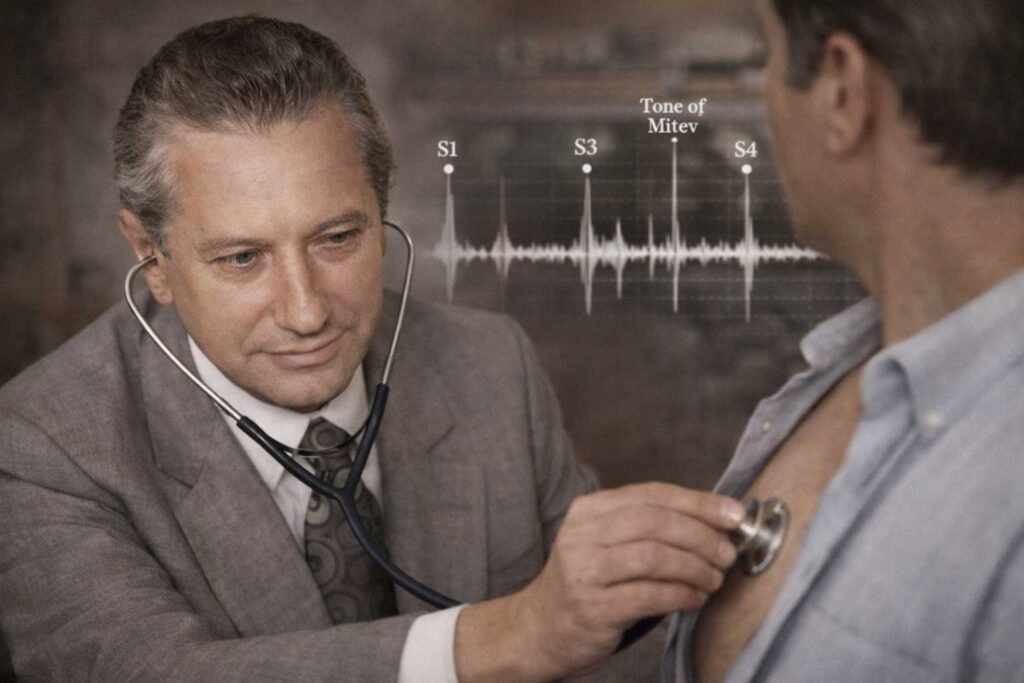
Ivan Mitev and the Discovery of the Sixth Heart Tone

Understanding Heart Sounds
Before the breakthrough made by Ivan Mitev, medical science recognized a limited number of heart sounds that formed the foundation of cardiac diagnosis.
These sounds, heard through auscultation with a stethoscope, correspond to specific mechanical events within the heart:
- S1 (First heart sound) – caused by the closure of the mitral and tricuspid valves, marking the beginning of systole
- S2 (Second heart sound) – produced by the closure of the aortic and pulmonary valves, signaling the end of systole
- S3 and S4 – additional sounds associated with ventricular filling and atrial contraction, often linked to specific physiological or pathological conditions
These heart sounds were initially identified through careful listening and later analyzed in greater detail using phonocardiography, a method that records the acoustic activity of the heart.
Affiliate Disclosure: This article may contain affiliate links. If you purchase through these links, we may earn a small commission at no extra cost to you.
Learn to Recognize Heart Sounds Like Ivan Mitev
| Product | Best For | Why It’s Useful | Rating | Check Price |
|---|---|---|---|---|
| Rapid Interpretation of Heart Sounds | Students | Focused training on detecting subtle tones | ⭐⭐⭐⭐☆ | 👉 Check Price on Amazon |
| Clinical Cardiology Made Ridiculously Simple | Beginners | Easy explanations of heart physiology | ⭐⭐⭐⭐⭐ | 👉 Check Price on Amazon |
| Cardiology Explained | Visual learners | Simple diagrams of heart sounds & cycles | ⭐⭐⭐⭐⭐ | 👉 Check Price on Amazon |
👉 Mastering heart sounds is the first step toward understanding discoveries like the sixth heart tone.
A Limited Framework—Until Mitev
For decades, this framework was considered complete. Physicians relied on these four primary sounds to assess heart function and detect abnormalities.
However, the work of Ivan Mitev would challenge this assumption—revealing that the heart produces even more complex acoustic signals than previously understood.
His discovery marked the beginning of a new chapter in cardiology, expanding both the theory and practice of cardiac diagnosis.
The Breakthrough
While examining pediatric patients, Ivan Mitev identified an additional cardiac sound that did not correspond to any known heart tone recognized at the time.
This new sound:
- Occurred during specific phases of the cardiac cycle
- Was detectable only under certain physiological conditions
- Required highly trained listening and clinical expertise to identify
Unlike the standard heart sounds, this subtle acoustic phenomenon could easily be missed without deep experience in auscultation—making the discovery even more remarkable.
Sixth Heart Tone (Tone of Mitev)
Mitev formally identified and described this sound as the:
Sixth Heart Tone, now known as the Tone of Mitev
A Turning Point in Cardiology
This breakthrough challenged established cardiology frameworks, which had long assumed a limited number of heart sounds. By introducing a new dimension to cardiac auscultation, Mitev:
- Expanded the scientific understanding of heart function
- Encouraged deeper investigation into cardiac acoustics
- Opened new avenues for diagnosing heart conditions
Why This Discovery Was Exceptional
At a time when advanced diagnostic tools were limited, Mitev’s achievement relied almost entirely on:
- Clinical observation
- Repeated patient examinations
- Mastery of auscultation techniques
He didn’t just hear something new—he understood its significance.
This moment marked a turning point, demonstrating that even well-studied systems like the human heart can still reveal hidden complexities.
How the Sixth Heart Tone Changed Medicine
The identification of a sixth heart sound by Ivan Mitev was a major advancement in cardiology, reshaping how physicians understand and interpret cardiac function.
1. Expanded Cardiac Physiology
Mitev’s work demonstrated that the human heart produces more complex acoustic signals than previously believed. By identifying an additional tone, he expanded the traditional framework of heart sounds and showed that cardiac activity includes subtler layers of mechanical and vibrational processes.
2. Improved Diagnostic Accuracy
The sixth heart tone provided physicians with deeper insight during clinical examinations, offering:
- Additional data for diagnosing cardiac abnormalities
- Better differentiation between normal and pathological heart conditions
This allowed for more precise evaluation, particularly in cases where standard heart sounds did not provide enough information.
3. Advancement of Pediatric Cardiology
Children’s cardiovascular systems often behave differently from those of adults, making diagnosis more challenging. Mitev’s discovery contributed to:
- Earlier detection of heart conditions in children
- Improved understanding of pediatric heart physiology
- More effective treatment planning
👉 See related medical contributions → Bulgarian Contributions to Modern Technology.
Why This Discovery Matters
By expanding both theory and practice, the Tone of Mitev reinforced an important principle in medicine:
Even subtle physiological signals can carry critical diagnostic value.
His work not only advanced cardiology but also strengthened the role of careful clinical observation in modern medical science.
Best Cardiology Books to Understand Heart Sounds
| Product | Best For | Why It’s Useful | Rating | Check Price |
|---|---|---|---|---|
| Cardiology Explained | Beginners | Simple and visual guide to heart function | ⭐⭐⭐⭐⭐ | 👉 Check Price on Amazon |
| Clinical Cardiology Made Ridiculously Simple | Students | Breaks down complex concepts easily | ⭐⭐⭐⭐⭐ | 👉 Check Price on Amazon |
| Rapid Interpretation of Heart Sounds | Medical learners | Focuses on auscultation & sound patterns | ⭐⭐⭐⭐☆ | 👉 Check Price on Amazon |
| Braunwald’s Heart Disease | Advanced | Gold-standard cardiology reference | ⭐⭐⭐⭐⭐ | 👉 Check Price on Amazon |
| The Only EKG Book You’ll Ever Need | Practical use | Connects heart sounds with ECG data | ⭐⭐⭐⭐⭐ | 👉 Check Price on Amazon |
👉 Explore more cardiology resources on Amazon →
Global Recognition and Validation

Although initially met with skepticism—as many groundbreaking discoveries are—the work of Ivan Mitev was gradually validated through scientific evidence and international engagement.
How His Discovery Was Confirmed
- Clinical studies
Ongoing observations in patients helped demonstrate the consistency and relevance of the sixth heart tone in specific conditions. - Phonocardiographic recordings
Advances in recording heart sounds allowed researchers to visually and acoustically analyze cardiac vibrations, providing more objective support for Mitev’s findings. - International collaboration
As knowledge spread beyond Bulgaria, collaboration with global medical researchers contributed to broader validation and discussion within the cardiology community.
Expanding Beyond Bulgaria
Over time, Mitev’s discovery gained recognition outside his home country. His work became part of the wider scientific conversation, influencing:
- Cardiology research developments
- Medical education and training programs
- The evolving understanding of heart sound physiology
From Skepticism to Scientific Contribution
Mitev’s journey from doubt to recognition reflects a common path in science:
Innovations that challenge established knowledge often take time to be fully accepted.
Today, his discovery is regarded as an important contribution to cardiology, reinforcing Bulgaria’s role in advancing global medical science.
Honors and National Recognition
Ivan Mitev’s achievements were celebrated at the highest levels of Bulgarian society, reflecting the national importance of his contribution to medical science.
He was officially honored by Todor Zhivkov, the leader of the People’s Republic of Bulgaria, during a grand state ceremony—an acknowledgment reserved for individuals whose work had significant national and international impact.
Unique Honors
- Commemorative Postage Stamp
A special stamp was issued to honor his discovery of the sixth heart tone—an extraordinary recognition in the field of medicine. - National Scientific Recognition
Mitev was celebrated as one of Bulgaria’s leading medical figures, with his work gaining both institutional and public acknowledgment. - Permanent Place in Medical History
His contributions were formally included in Bulgaria’s scientific and medical legacy, securing his place among the country’s most influential researchers.
A Historic First in Cardiology
Notably, this was the first postage stamp in Bulgaria dedicated specifically to cardiology, highlighting the significance of Mitev’s discovery not only as a scientific achievement but also as a moment of national pride.
His recognition demonstrates how a single medical breakthrough can transcend the laboratory—becoming part of a country’s cultural and scientific identity.
The Tone of Mitev in Modern Medicine
Is It Still Relevant Today?
While modern cardiology relies heavily on advanced imaging technologies such as:
- Echocardiography
- MRI
- CT scans
Heart sounds remain a fundamental diagnostic tool, especially in:
- Initial clinical assessments
- Low-resource healthcare settings
- Pediatric examinations
The discovery made by Ivan Mitev continues to hold value today. Although the Tone of Mitev is not part of routine diagnosis in most clinical settings, it is still referenced in:
- Advanced cardiology research
- Medical education and training
- Historical studies of diagnostic medicine
It serves as an important reminder of how much information can be gathered through careful listening and clinical expertise.
The Art of Auscultation
Mitev’s work underscores the enduring importance of auscultation—the practice of listening to internal body sounds, particularly the heart.
Even in today’s high-tech medical environment, the stethoscope remains one of the most iconic and widely used tools in medicine because:
- It provides immediate diagnostic clues
- It requires no electricity or complex equipment
- It allows real-time patient evaluation
- It creates a direct connection between physician and patient
Through his discovery, Ivan Mitev elevated auscultation from a routine clinical practice to a refined scientific skill. His work demonstrated that even subtle sounds—when properly understood—can reveal critical insights about human health.
Why This Still Matters
In an era dominated by machines and digital diagnostics, Mitev’s legacy reinforces a powerful principle:
Technology enhances medicine—but observation and listening remain its foundation.
His contribution bridges traditional clinical methods and modern innovation, proving that the human element in medicine is irreplaceable.
Challenges and Skepticism
Like many groundbreaking innovators, Ivan Mitev faced significant skepticism when he introduced the concept of a sixth heart tone.
At the time, cardiology operated within well-established frameworks that recognized only a limited number of heart sounds. Introducing an additional tone challenged long-standing medical assumptions and required the scientific community to reconsider accepted knowledge.
Key Challenges
- Established medical frameworks
Traditional cardiology did not account for a sixth heart tone, making Mitev’s discovery difficult for many to accept initially. - Questions about reproducibility
Some researchers struggled to consistently detect the tone, leading to doubts about whether it could be reliably observed across different patients and conditions. - Limited technology
Diagnostic tools at the time were not advanced enough to easily confirm subtle acoustic variations, making objective validation more difficult.
Overcoming Doubt
Despite these obstacles, Mitev remained committed to his research. Through continued clinical observation and the gradual improvement of diagnostic methods, more evidence began to support his findings.
Over time, the accumulation of data and increased awareness helped solidify the legitimacy of the Tone of Mitev, transforming early skepticism into scientific recognition.
A Common Pattern in Scientific Discovery
Mitev’s experience reflects a broader truth in science:
New ideas are often questioned before they are accepted.
His perseverance not only validated his discovery but also reinforced the importance of curiosity, resilience, and evidence-based research in advancing medical knowledge.
Stethoscopes Used to Detect Subtle Heart Sounds
| Product | Best For | Why It’s Useful | Rating | Check Price |
|---|---|---|---|---|
| Littmann Cardiology IV | Advanced | Exceptional clarity for subtle tones like Mitev’s | ⭐⭐⭐⭐⭐ | 👉 Check Price on Amazon |
| Littmann Classic III | Students | Reliable and widely used | ⭐⭐⭐⭐⭐ | 👉 Check Price on Amazon |
| MDF Acoustica Deluxe | Budget | Solid performance at lower cost | ⭐⭐⭐⭐☆ | 👉 Check Price on Amazon |
👉 Want to hear what Ivan Mitev discovered? A high-quality stethoscope makes all the difference.
Legacy in Bulgarian and Global Medicine

Ivan Mitev’s legacy extends far beyond the discovery of the sixth heart tone. His influence helped shape modern medicine in Bulgaria and contributed to the global understanding of pediatric cardiology.
1. Pioneer of Pediatric Cardiology in Bulgaria
Ivan Mitev played a foundational role in establishing pediatric cardiology as a recognized field in Bulgaria. At a time when diagnosing heart conditions in children was particularly challenging, he introduced more precise clinical methods and raised the standard of care. His work helped physicians better understand and detect cardiovascular diseases in young patients.
2. Educator and Mentor
Beyond his clinical achievements, Mitev was a dedicated teacher who trained and inspired generations of Bulgarian doctors. Many of his students went on to become leading medical professionals, continuing to advance research and improve healthcare systems. His impact as an educator ensured that his knowledge and methods would live on far beyond his own career.
3. National Scientific Icon
Ivan Mitev’s contributions symbolize Bulgaria’s place in global medical science. His discovery gained international attention and demonstrated that significant scientific breakthroughs can emerge from any part of the world. Today, he remains a respected figure in Bulgaria’s scientific history and a source of national pride.
Timeline of Key Events
- 1924 – Born in Bulgaria
- 1950s–1960s – Medical training and specialization
- 1960s – Discovery of the sixth heart tone
- 1970s–1980s – Recognition and validation
- 1980s – Honored by the Bulgarian government
- 2006 – Passed away, leaving a lasting legacy
Why Ivan Mitev Is Important in Cardiology
In a world dominated by advanced medical technology—AI diagnostics, imaging systems, and data-driven healthcare—Ivan Mitev’s story reminds us of something essential:
Great discoveries often begin with careful observation and deep curiosity.
Long before modern machines could visualize the heart in real time, Mitev relied on one of the most fundamental tools in medicine—the human ear guided by knowledge and experience. His discovery of the sixth heart tone proves that innovation is not always about having the most advanced equipment, but about asking the right questions and paying attention to what others might overlook.
Lessons for Modern Medicine
Mitev’s work continues to offer powerful insights for today’s physicians, researchers, and students:
- Innovation does not always require expensive tools
Some of the most important breakthroughs come from clinical observation, not technology. - Listening—literally and figuratively—can change science
Whether it’s hearing subtle heart sounds or questioning accepted theories, attention leads to discovery. - Small discoveries can have global impact
What began as a subtle, nearly imperceptible sound became a recognized contribution to cardiology worldwide.
A Timeless Scientific Mindset
In an era where medicine often depends on machines, Mitev’s legacy reinforces the importance of:
- Human intuition and experience
- Deep understanding of fundamentals
- Curiosity-driven research
His work bridges the gap between traditional clinical practice and modern scientific innovation—showing that even in today’s high-tech world, the foundations of medicine remain deeply human.
⭐ Top Picks for Learning Cardiology (Editor’s Choice)
- Best Overall: Littmann Cardiology IV
- Best Learning Book: Rapid Interpretation of Heart Sounds
- Best Budget Option: MDF Acoustica Deluxe
👉 Explore all recommended tools above ↑
Frequently Asked Questions (FAQ) About Ivan Mitev
Who was Ivan Mitev?
Ivan Mitev was a Bulgarian pediatrician and cardiologist who discovered the sixth heart tone, known as the Tone of Mitev.
What is the Tone of Mitev?
The Tone of Mitev is an additional heart sound beyond the traditionally recognized heart tones, identified through advanced auscultation.
Why is Ivan Mitev’s discovery important?
His discovery expanded the understanding of cardiac physiology and improved diagnostic accuracy in cardiology, especially in pediatric patients.
Was Ivan Mitev’s work internationally recognized?
Yes, his discovery gained scientific validation and recognition beyond Bulgaria, contributing to global cardiology research.
What honor did Ivan Mitev receive in Bulgaria?
He was officially honored at a state ceremony and commemorated with a special postage stamp dedicated to his discovery.
What is the sixth heart tone?
The sixth heart tone is a rare cardiac sound discovered by Ivan Mitev, adding complexity to the traditional classification of heart sounds.
How are heart sounds detected?
Heart sounds are detected using a stethoscope through a process called auscultation, which allows doctors to hear internal body sounds.
Is the Tone of Mitev used in modern medicine?
While not routinely used in everyday diagnosis, it remains important in advanced cardiology research and medical education.
Conclusion
Ivan Mitev represents the perfect combination of scientific curiosity, clinical precision, and persistence. His discovery of the sixth heart tone did more than expand cardiology—it proved that even the most familiar systems in the human body can still hold hidden insights.
From Bulgaria to the global medical stage, Ivan Mitev’s work continues to inspire physicians, researchers, and students. His legacy reminds us that innovation does not always begin with advanced technology—but with the ability to observe, question, and truly listen.
In medicine, sometimes the smallest sound can change everything.
References
- Ivan Mitev – Bulgarian physician and discovery of the sixth heart tone. Wikipedia.
https://en.wikipedia.org/wiki/Ivan_Mitev - Heart sounds – Overview of S1, S2, S3, and S4. Wikipedia.
https://en.wikipedia.org/wiki/Heart_sounds - Auscultation – Medical practice of listening to internal body sounds. Wikipedia.
https://en.wikipedia.org/wiki/Auscultation - Phonocardiography – Recording and analysis of heart sounds. Wikipedia.
https://en.wikipedia.org/wiki/Phonocardiogram - Pediatric cardiology – Study of heart conditions in children. Wikipedia.
https://en.wikipedia.org/wiki/Pediatric_cardiology - Cardiology – Medical specialty dealing with heart disorders. Wikipedia.
https://en.wikipedia.org/wiki/Cardiology - Stethoscope – Instrument used for auscultation. Wikipedia.
https://en.wikipedia.org/wiki/Stethoscope - Todor Zhivkov – Bulgarian political leader who honored Ivan Mitev. Wikipedia.
https://en.wikipedia.org/wiki/Todor_Zhivkov - Rangayyan, R. M., & Lehner, R. J. (1987). Phonocardiogram signal analysis: A review. Critical Reviews in Biomedical Engineering.
https://pubmed.ncbi.nlm.nih.gov/3323366/ - Tavel, M. E. (2006). Cardiac auscultation: A glorious past—and it does have a future! Circulation, 113(9), 1255–1259.
https://doi.org/10.1161/CIRCULATIONAHA.105.591123 - Mangione, S., & Nieman, L. Z. (1997). Cardiac auscultatory skills of internal medicine and family practice trainees. JAMA, 278(9), 717–722.
https://doi.org/10.1001/jama.1997.03550090047030 - Leatham, A. (1958). Auscultation of the heart. The Lancet, 272(7055), 703–708.
https://doi.org/10.1016/S0140-6736(58)91356-5 - Shaver, J. A., Salerni, R., & Reddy, P. S. (1985). Normal and abnormal heart sounds in cardiac diagnosis. Current Problems in Cardiology.
https://pubmed.ncbi.nlm.nih.gov/3886846/ - Durand, L. G., & Pibarot, P. (1995). Digital signal processing of heart sounds. Critical Reviews in Biomedical Engineering.
https://pubmed.ncbi.nlm.nih.gov/7587223/ - Reed, T. R., Reed, N. E., & Fritzson, P. (2004). Heart sound analysis for symptom detection. Medical & Biological Engineering & Computing, 42(6), 737–745.
https://doi.org/10.1007/BF02345207 - Springer, D. B., Tarassenko, L., & Clifford, G. D. (2016). Logistic regression-HSMM-based heart sound segmentation. IEEE Transactions on Biomedical Engineering, 63(4), 822–832.
https://doi.org/10.1109/TBME.2015.2475278 - Sakamoto, T., & Yamada, T. (1995). Heart sounds and murmurs. Japanese Circulation Journal, 59(9), 571–586.
https://pubmed.ncbi.nlm.nih.gov/7474299/ - Tavel, M. E. (1996). Clinical phonocardiography and external pulse recording. American Journal of Cardiology.
https://pubmed.ncbi.nlm.nih.gov/8812589/ - Watrous, R. L. (2006). Computer-aided auscultation of the heart. Annals of Biomedical Engineering, 34(3), 445–456.
https://doi.org/10.1007/s10439-005-9064-9 - Kumar, D., Carvalho, P., Antunes, M., & Henriques, J. (2011). Heart murmur classification using complexity signatures. IEEE Transactions on Biomedical Engineering, 58(8), 2305–2313.
https://doi.org/10.1109/TBME.2011.2148715