


Bulgarian science and technology history spans centuries of innovation—from ancient Thracian knowledge to modern breakthroughs in computing, medicine, and space science—making Bulgaria one of the most impactful small nations in global scientific development. It includes early Thracian medical practices, medieval scholarly achievements like the Cyrillic alphabet, and modern breakthroughs in microbiology, computing, physics, and space science. Bulgarian scientists have made globally significant contributions, including the discovery of Lactobacillus bulgaricus, advances in crystal growth theory, and the development of early computing systems such as the Pravetz computers.
This article covers the complete timeline of Bulgarian scientific achievements, major discoveries, key scientists, and the future of innovation in Bulgaria.
From ancient Thracian civilizations practicing early forms of medicine and astronomy to the intellectual golden age of the First Bulgarian Empire, Bulgaria has long been a center of knowledge and cultural development. The creation of the Cyrillic alphabet by disciples of Saint Cyril and Methodius played a crucial role not only in literacy but also in the transmission of scientific ideas across Eastern Europe—marking one of the earliest technological milestones in Bulgarian history.
In the modern era, Bulgarian scientists have made groundbreaking contributions across multiple disciplines. Discoveries such as Lactobacillus bulgaricus revolutionized microbiology and probiotic research, while advancements in physics and chemistry laid the foundation for technologies used worldwide today. Bulgarian engineers and innovators have also contributed to early computing systems, aerospace development, and medical breakthroughs that continue to impact global industries.
Today, Bulgarian researchers are active participants in the international scientific community, working at leading institutions such as Harvard University and the University of Chicago. The country’s growing technology sector, software engineering expertise, and startup ecosystem position Bulgaria as an emerging hub for innovation in Europe.
👉 This evolution reflects a broader trend explored in Bulgarian Contributions to Modern Technology, where historical foundations meet cutting-edge advancements.
In this comprehensive guide, you will explore the full scope of Bulgarian scientific achievement—from ancient discoveries and medieval scholarship to 20th-century technological breakthroughs and the future of innovation in Bulgaria.
What is Bulgarian Science and Technology History?
Bulgarian science and technology history refers to the development of scientific knowledge and innovation in Bulgaria, from ancient Thracian practices to modern advancements in microbiology, computing, and space science. It includes key discoveries such as Lactobacillus bulgaricus, crystal growth theory, and early computer systems like the Pravetz computers.
Why This Matters Today
Understanding Bulgarian science and technology history helps explain how a small nation has contributed to global innovation in medicine, computing, and engineering—fields that shape everyday life today.
Early Foundations of Science in Bulgaria

Ancient Thracian Knowledge
Long before the emergence of modern scientific disciplines, the lands of present-day Bulgaria were inhabited by the Thracians—a civilization known for its sophisticated understanding of nature, healing, and craftsmanship. Their knowledge, passed down through generations, represents one of the earliest foundations of science and technology in Bulgaria.
The Thracians developed practical systems of knowledge in several key areas:
Herbal Medicine and Early Healing Practices
Thracian healers relied heavily on plants and natural remedies to treat illnesses. Using locally available herbs, roots, and minerals, they created early forms of medicinal treatments that resemble modern pharmacological principles.
👉 Many historians consider these practices a precursor to Bulgaria’s later breakthroughs in microbiology and medicine, including discoveries related to probiotics and natural compounds.
Astronomy and Celestial Observation
The Thracians closely observed the sky, tracking solar and lunar cycles to guide agriculture, religious rituals, and seasonal planning. Evidence from archaeological sites suggests an awareness of:
- Seasonal equinoxes and solstices
- Star patterns and constellations
- Cyclical time measurement
These observations reflect an early form of astronomical science, linking nature, timekeeping, and survival.
Metallurgy and Advanced Craftsmanship
Thracian metalworkers were among the most skilled in the ancient world, producing intricate gold and bronze artifacts that required advanced techniques for their time.
Their achievements included:
- Precision casting and metal shaping
- Alloy development (gold, silver, bronze)
- Functional tools and ceremonial objects
👉 The famous Thracian gold treasures demonstrate not only artistic excellence but also an early understanding of materials science and engineering principles.
👉 These laid the groundwork for later discoveries in pharmacology and microbiology.
Scientific Legacy of the Thracians
Archaeological discoveries across Bulgaria confirm that the Thracians applied empirical observation and experimentation—key elements of scientific thinking. Their use of medicinal plants, environmental awareness, and technical craftsmanship laid the intellectual groundwork for later developments in:
- Pharmacology and microbiology
- Astronomy and natural sciences
- Engineering and materials technology
👉 This early knowledge base connects directly to later achievements explored in Bulgarian Science and Technology History and supports Bulgaria’s long-standing tradition of innovation.
Medieval Bulgarian Science and Knowledge Centers

The Rise of Intellectual Life in Medieval Bulgaria
During the First and Second Bulgarian Empires (7th–14th centuries), Bulgaria emerged as one of the most important cultural and intellectual centers in medieval Europe. This period marked a significant transformation in Bulgarian science and technology history, as knowledge became organized, preserved, and widely disseminated.
At the heart of this transformation was the adoption and development of written language, education systems, and scholarly institutions that laid the groundwork for future scientific progress.
The Cyrillic Alphabet: A Technological and Intellectual Breakthrough
One of the most important achievements of medieval Bulgaria was the development of the Cyrillic script by the disciples of Saint Cyril and Methodius.
Why This Was Revolutionary:
- Enabled mass literacy in the Slavic world
- Allowed translation of scientific, religious, and philosophical texts
- Standardized communication and record-keeping
- Facilitated knowledge transfer across generations
👉 The Cyrillic alphabet was not just a linguistic tool—it functioned as an early information technology system, making it possible to store, replicate, and distribute knowledge efficiently.
This innovation positioned Bulgaria as a cultural bridge between East and West, preserving classical knowledge during a time when much of Europe faced intellectual decline.
Monasteries as Centers of Science and Learning
Monasteries in medieval Bulgaria were far more than religious institutions—they served as early universities and research centers.
Key Functions of Monasteries:
- Preservation of ancient Greek and Byzantine scientific texts
- Translation of works in medicine, astronomy, and philosophy
- Education of scholars, scribes, and clergy
- Development of libraries and scriptoria
Monks meticulously copied manuscripts by hand, ensuring that critical knowledge survived centuries of political instability.
👉 These institutions played a crucial role in maintaining continuity in scientific knowledge and intellectual traditions.
The Preslav and Ohrid Literary Schools
Two of the most important knowledge centers in medieval Bulgaria were the:
Preslav Literary School
Located in the capital of the First Bulgarian Empire, Preslav became a hub for:
- Linguistic development
- Scientific translation
- Philosophical and theological studies
Ohrid Literary School
Founded by disciples of Saint Clement of Ohrid, this school trained thousands of students and contributed significantly to literacy and education across the Slavic world.
Their Scientific and Cultural Impact:
- Standardization of the Cyrillic script
- Expansion of education systems
- Transmission of knowledge across Eastern Europe
- Early organization of scholarly disciplines
👉 These schools functioned as proto-academic institutions, similar in purpose to later European universities.
Knowledge Fields in Medieval Bulgaria
Although science was not yet divided into modern disciplines, medieval Bulgarian scholars explored several key areas:
Medicine
- Herbal remedies based on ancient traditions
- Study of human anatomy through translated texts
- Practical healing methods used in monasteries
Astronomy
- Calendar calculations for religious and agricultural use
- Observation of celestial cycles
- Influence from Byzantine and ancient Greek astronomy
Philosophy and Logic
- Study of classical Greek thinkers
- Development of theological and philosophical reasoning
- Early forms of analytical thinking
The Role of Bulgaria in Preserving European Knowledge
During the Middle Ages, much of classical knowledge risked being lost. Bulgaria played a crucial role in preserving and transmitting this knowledge.
Through translation and manuscript copying, Bulgarian scholars ensured the survival of:
- Ancient Greek scientific works
- Byzantine scholarly traditions
- Early medical and astronomical knowledge
👉 This intellectual preservation directly contributed to the later development of science in Europe.
Legacy of Medieval Bulgarian Science
The medieval period established the foundations for Bulgaria’s later scientific achievements by:
- Creating a literate and educated society
- Preserving essential scientific knowledge
- Building institutional frameworks for learning
- Encouraging intellectual inquiry and scholarship
👉 This legacy connects directly to later breakthroughs explored in Bulgarian Scientists Who Changed Medicine and Modern Bulgarian technology advancements.
Science and Knowledge During the Ottoman Period and the Bulgarian National Revival

The Ottoman Period: Preservation Over Progress (14th–18th Century)
Following the fall of the Second Bulgarian Empire in the late 14th century, Bulgarian lands came under Ottoman rule for nearly five centuries. This period significantly altered the trajectory of Bulgarian science and technology history, shifting the focus from active innovation to cultural and intellectual preservation.
Unlike Western Europe, where the Renaissance and Scientific Revolution were accelerating advancements in science, Bulgaria faced limitations in formal education, institutional development, and scientific research.
Key Characteristics of the Period:
- Limited access to higher education and scientific institutions
- Suppression of organized scholarly activity
- Reduced technological development compared to Western Europe
- Reliance on oral traditions and localized knowledge
Monasteries as Guardians of Knowledge
Despite these challenges, Bulgarian monasteries continued to play a crucial role in preserving knowledge.
Institutions like the Rila Monastery became centers of:
- Literacy and education
- Manuscript preservation
- Cultural identity and historical memory
Monks safeguarded religious texts, historical chronicles, and fragments of scientific knowledge, ensuring continuity during centuries of political and cultural suppression.
👉 Without this preservation, much of Bulgaria’s earlier intellectual heritage might have been lost.
Survival of Practical Knowledge
Although formal scientific progress slowed, practical knowledge continued to evolve in everyday life.
Key Areas of Continuity:
- Agriculture: Crop rotation, seasonal planning, and land management
- Medicine: Herbal remedies and traditional healing practices
- Craftsmanship: Woodworking, metalworking, and textile production
👉 These practices maintained a foundation of applied science and technology, even in the absence of formal institutions.
The Bulgarian National Revival: Rebirth of Science and Education (18th–19th Century)

The Bulgarian National Revival marked a turning point in the development of science and intellectual life. Beginning in the 18th century, this period saw a cultural awakening and a renewed focus on education, knowledge, and national identity.
Reintroduction of Education and Scientific Thinking
One of the most important developments of the Revival was the establishment of secular schools teaching subjects beyond religion.
New Subjects Introduced:
- Mathematics
- Physics (basic principles)
- Geography and natural sciences
- Philosophy and logic
These schools represented the first step toward modern scientific education in Bulgaria.
Key Figures of the Revival
Paisius of Hilendar
His work Slav-Bulgarian History helped awaken national consciousness and emphasized the importance of knowledge and education.
Petar Beron
Beron introduced modern education methods and wrote the famous “Fish Primer,” which included basic scientific knowledge for students.
The Rise of Printing and Knowledge Dissemination
The introduction of printing technology during the Revival transformed the spread of knowledge.
Impact of Printing:
- Mass production of books and educational materials
- Translation of European scientific works
- Standardization of knowledge across regions
👉 This marked Bulgaria’s transition from manuscript culture to early information systems, similar to developments in Western Europe.
Connection to European Science
During the National Revival, Bulgaria began reconnecting with broader European intellectual movements.
Bulgarian students studied abroad and brought back knowledge in:
- Medicine
- Engineering
- Natural sciences
This exchange played a critical role in aligning Bulgaria with the scientific advancements of the Enlightenment and early industrial era.
Why This Transition Matters
The Ottoman period and National Revival together form a crucial bridge in Bulgarian science and technology history:
Ottoman Period:
- Preserved knowledge and identity
- Maintained practical scientific traditions
National Revival:
- Reintroduced formal education
- Restarted scientific development
- Connected Bulgaria to European progress
👉 Without this transition, the scientific breakthroughs of the 20th century—such as those by Bulgarian microbiologists, physicists, and engineers—would not have been possible.
The Birth of Modern Bulgarian Science (20th Century)

The Golden Age of Bulgarian Science
The 20th century represents the Golden Age of Bulgarian science and technology, a period marked by rapid industrialization, state investment in education, and groundbreaking discoveries that placed Bulgaria on the global scientific map.
During this time, Bulgaria transitioned from a developing nation into a recognized center for research, engineering, medicine, and computing innovation. Scientific institutions expanded, technical universities were established, and Bulgarian researchers began contributing to international breakthroughs across multiple disciplines.
👉 This era laid the foundation for Bulgaria’s modern role in global innovation and technology.
Microbiology and Medicine Breakthroughs
One of the most important pillars of Bulgarian science and technology history is its contribution to microbiology and medicine. During the 20th century, Bulgarian scientists made groundbreaking discoveries that continue to influence global healthcare, pharmaceuticals, and nutrition science.
Stamen Grigorov and the Discovery of Lactobacillus bulgaricus
Stamen Grigorov’s discovery of Lactobacillus bulgaricus revolutionized microbiology and established Bulgaria as a global leader in probiotic research.
👉 Learn more: Lactobacillus Bulgaricus Explained.
Why It Matters:
- Foundation of modern probiotic science
- Essential for global yogurt production
- Major influence on gut health and digestive research worldwide
Dimitar Paskov and the Development of Galantamine
Another major breakthrough came from Dimitar Paskov, who played a key role in developing galantamine—a drug derived from natural plant compounds.
Impact:
- Widely used in the treatment of Alzheimer’s disease
- Supports memory and cognitive function
- Demonstrates the power of plant-based pharmaceutical research
Ivan Mitev and Cardiology Innovation
Ivan Mitev contributed significantly to medical science by discovering the sixth heart tone, an important advancement in cardiac diagnostics.
Impact:
- Improved early detection of heart conditions
- Enhanced understanding of heart physiology
- Contributed to modern cardiology practices
Why This Matters for Bulgarian Science
These discoveries highlight Bulgaria’s global impact in:
- Microbiology and probiotics
- Pharmaceutical innovation
- Cardiology and medical diagnostics
👉 Discover more breakthroughs: Bulgarian Scientists Who Changed Medicine.
Health & Science Tools
👉 Looking to explore this field yourself? These tools can help you get started:
Affiliate Disclosure: Some links on this page are affiliate links, which means we may earn a small commission at no extra cost to you if you make a purchase. These commissions help support our work in creating high-quality, free content. We only recommend products and resources that are relevant and useful to our readers.
| Product | Best For | Why It Matters | Check Price |
|---|---|---|---|
| Probiotic Supplements | Gut Health | Inspired by Lactobacillus research | 👉 Check Price on Amazon |
| Biology Books | Learning | Understand microbiology basics | 👉 Check Price on Amazon |
| Microscopes | Students | Explore bacteria like Grigorov | 👉 Check Price on Amazon |
Physics, Materials Science, and Engineering

The 20th century also marked a major breakthrough period for Bulgarian physics, chemistry, and engineering, with discoveries that directly influenced modern technologies such as photocopying, semiconductors, and aviation systems.
Georgi Nadjakov and the Photoelectret Discovery
Georgi Nadjakov discovered the photoelectret state, a phenomenon in which materials retain electrical polarization after exposure to light.
👉 This breakthrough became a foundational principle behind modern photocopying technology later commercialized by companies like Xerox.
Impact:
- Enabled the development of photocopying and printing technologies
- Advanced research in electrical materials and photoconductivity
- Contributed to modern imaging and office technology systems
👉 Related innovations: Bulgarian Inventions That Changed the World.
Ivan Stranski and Crystal Growth Theory
Ivan Stranski is widely recognized as the father of crystal growth theory, a fundamental area of materials science.
His contributions are essential to:
- Semiconductor manufacturing
- Nanotechnology development
- Surface chemistry and thin-film growth
- Modern electronics and microchip production
👉 His work remains a cornerstone of today’s digital and technological infrastructure.
Assen Jordanoff and Aviation Engineering
Assen Jordanoff made significant contributions to early aviation engineering, helping shape aircraft design and pilot training systems.
Impact:
- Influenced modern aeronautical engineering principles
- Developed pilot training manuals used internationally
- Contributed to advancements in aircraft design and safety systems
👉 His work helped bridge the gap between early aviation and modern aerospace innovation.
Why This Matters for Bulgarian Science
These achievements demonstrate Bulgaria’s global influence in:
- Physics and photoconductivity
- Materials science and semiconductors
- Aviation and engineering innovation
👉 Together, these breakthroughs helped shape modern electronics, computing, and aerospace industries worldwide.
Engineering & Physics
| Product | Best For | Why It Matters | Check Price |
|---|---|---|---|
| Engineering Books | Students | Learn core concepts | 👉 Check Price |
| Electronics Kits | Hobbyists | Understand semiconductors | 👉 Check Price |
| Drone Kits | Aviation Fans | Inspired by Jordanoff | 👉 Check Price |
The Bulgarian Computing Revolution

The Pravetz Computer Revolution (1960s–1980s)
Between the 1960s and 1980s, Bulgaria emerged as a major technological force in Eastern Europe, earning the nickname:
👉 “The Silicon Valley of the Eastern Bloc”
During this period, the country developed a strong foundation in computer engineering, electronics, and software development, positioning itself as a leader in early digital innovation.
Key Achievements of the Bulgarian Computing Revolution
- Development of the Pravetz computer series, one of the most widely used computer systems in Eastern Europe
- Large-scale production of hardware, microprocessors, and electronic components
- Export of computing systems across the Eastern Bloc
- Integration of computers into education, research institutions, and industry
- Growth of early software development and programming expertise
👉 See more: Bulgarian Inventions That Changed the World.
Impact on Global Technology
Bulgarian engineers and scientists played an important role in shaping early computing systems, contributing to:
- Industrial automation and manufacturing systems
- Educational computing and digital literacy
- Software engineering foundations
- Expansion of computer accessibility across Eastern Europe
👉 This era positioned Bulgaria as a leader in early computing technology and digital infrastructure, influencing the region’s transition into the digital age.
Why This Matters in Bulgarian Science and Technology History
The Pravetz computer revolution represents a critical turning point where Bulgaria moved from traditional scientific contributions into modern technological innovation.
👉 It bridges the gap between:
- 20th-century scientific discoveries
- Today’s IT and software-driven economy
👉 Explore more innovations: Bulgarian Inventions That Changed the World.
Computing & Tech Learning Tools
| Product | Best For | Why It Matters | Check Price |
|---|---|---|---|
| Retro Computing Books | History lovers | Learn evolution of computers | 👉 Check Price |
| Coding Courses | Beginners | Start programming career | 👉 Check Price |
| Raspberry Pi Kits | DIY tech | Build your own mini computer | 👉 Check Price |
Bulgarian Contributions to Space and Advanced Technology

From Cold War Space Research to Modern Astronomy
Bulgaria has played a meaningful role in the development of space science and advanced technology, particularly during the Cold War era and continuing into modern astronomical research. Despite its size, the country contributed to key innovations that supported international space programs and scientific discovery.
Cold War Era: Bulgaria in Space Research
During the Cold War, Bulgaria collaborated closely with the Soviet Union, becoming one of the few nations actively involved in space-related research and missions.
Key Contributions Included:
- Participation in Soviet-led space missions
- Development of space food technologies used by astronauts
- Research in satellite instrumentation and aerospace systems
- Contributions to life-support and biological experiments in space
👉 These efforts positioned Bulgaria among the technologically advanced nations of its time, particularly within the Eastern Bloc.
Modern Astronomy and Global Research
Dimitar Sasselov
A leading astronomer working at Harvard University, Dimitar Sasselov represents Bulgaria’s continued influence in global space science.
His contributions include:
- Discovery and study of exoplanets
- Research on the origin of life in the universe
- Participation in international space and telescope missions
👉 His work connects Bulgarian scientific heritage to cutting-edge research in astrophysics and planetary science.
Impact on Science and Technology
Bulgarian contributions to space and astronomy have influenced:
- Space exploration and international collaboration
- Satellite technology and instrumentation
- Space biology and life-support systems
- Modern astrophysics and exoplanet research
👉 These achievements demonstrate how Bulgaria has transitioned from a regional scientific contributor to a global research participant.
Why This Matters
This chapter of Bulgarian science and technology history highlights the country’s ability to:
- Contribute to complex international programs
- Innovate in highly specialized scientific fields
- Maintain relevance in modern space research
👉 Explore more innovations: Bulgarian Contributions to Modern Technology.
Space & Astronomy
| Product | Best For | Why It Matters | Check Price |
|---|---|---|---|
| Telescopes | Beginners | Explore astronomy | 👉 Check Price |
| Space Books | Learning | Understand universe | 👉 Check Price |
| Star Maps | Hobbyists | Night sky exploration | 👉 Check Price |
Social Sciences and Learning Innovation
Georgi Lozanov and the Development of Suggestopedia
Bulgaria’s contributions to science are not limited to the natural sciences—its impact on psychology, education, and learning methodologies is equally significant. One of the most influential figures in this field is Georgi Lozanov, who developed the revolutionary learning method known as Suggestopedia.
What is Suggestopedia?
Suggestopedia is a teaching method designed to enhance learning by creating a relaxed and stimulating environment that improves memory, concentration, and comprehension.
Core Principles:
- Use of music and rhythm to aid memory retention
- Creating a stress-free learning environment
- Encouraging subconscious learning processes
- Combining emotional engagement with information absorption
👉 The method challenges traditional education systems by focusing on how the brain naturally learns best.
Global Recognition and Impact
Suggestopedia gained international recognition and was evaluated and supported by UNESCO as an innovative educational approach.
Impact Worldwide:
- Adoption in language learning programs
- Influence on accelerated learning techniques
- Integration into modern educational psychology practices
- Inspiration for new teaching methods focused on cognitive performance
Why This Matters in Bulgarian Science and Technology History
Lozanov’s work demonstrates that Bulgarian innovation extends beyond laboratories and engineering into human cognition and learning science.
His contributions helped shape:
- Modern educational psychology
- Advanced teaching methodologies
- Accelerated learning systems
👉 Discover more innovations: Bulgarian Inventions That Changed the World.
Learning & Brain Performance
| Product | Best For | Why It Matters | Check Price |
|---|---|---|---|
| Learning Books | Students | Improve memory | 👉 Check Price |
| Brain Training Apps | Productivity | Faster learning | 👉 Check Price |
| Study Planners | Organization | Better focus | 👉 Check Price |
Bulgaria in the Modern Technology Era
Post-1990 Growth and Transformation
Following the political and economic changes after 1990, Bulgaria transitioned from a centrally planned system to a market-driven economy. This shift opened the door for rapid development in technology, innovation, and global business integration.
Over the past three decades, Bulgaria has built a strong reputation in several high-growth sectors:
Key Growth Areas:
- Software engineering – highly skilled developers working for global companies
- Artificial Intelligence (AI) – emerging startups and research initiatives
- Outsourcing and IT services – Bulgaria as a preferred destination for tech outsourcing
- Fintech and SaaS platforms – growing presence in digital products and services
👉 These sectors have positioned Bulgaria as a competitive player in the global digital economy.
Modern Tech Ecosystem
Today, Bulgaria is widely recognized for its dynamic and fast-growing technology ecosystem, with a strong focus on innovation, entrepreneurship, and international collaboration.
Why Bulgaria Stands Out:
- Highly educated and technically skilled workforce
- Competitive operating costs compared to Western Europe
- Strong presence of international tech companies
- Growing startup culture and venture investment
Sofia: A Rising European Tech Hub
The capital city, Sofia, has emerged as one of the most promising technology hubs in Europe.
Sofia’s Advantages:
- Home to major software companies and startups
- Expanding coworking spaces and innovation centers
- Increasing investment in tech and digital infrastructure
- Active developer and entrepreneurial communities
👉 Sofia is often compared to other emerging European tech hubs due to its rapid growth and talent pool.
Global Impact of Bulgaria’s Tech Sector
Modern Bulgarian technology contributes to:
- Global software development and outsourcing
- AI and machine learning innovation
- Digital transformation across industries
- Startup ecosystems in Europe
👉 This evolution represents the continuation of Bulgarian science and technology history, bridging past achievements with future innovation.
👉 Explore deeper insights into Bulgarian Contributions to Modern Technology.
Tech & Productivity Tools
| Product | Best For | Why It Matters | Check Price |
|---|---|---|---|
| Coding Courses | Beginners | Start a career in tech | 👉 Check Price |
| Productivity Apps | Professionals | Improve workflow efficiency | 👉 Check Price |
| Laptop Accessories | Remote Work | Essential for modern tech jobs | 👉 Check Price |
Why the 20th Century Was a Golden Age
This period stands out because it combined:
- Strong government investment in science
- Expansion of education and technical training
- Collaboration with international scientific communities
- Real-world application of research in industry
👉 The result was a surge in Bulgarian scientific achievements, inventions, and global influence.
Timeline of Bulgarian Science and Technology
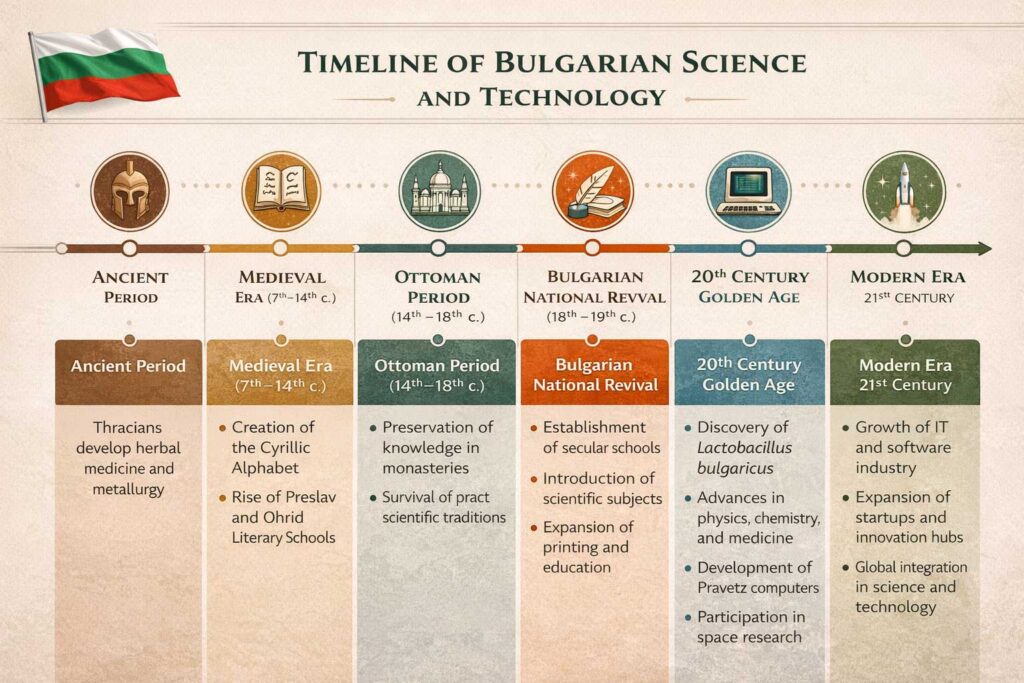
The timeline of Bulgarian science and technology history includes ancient Thracian knowledge, medieval advancements like the Cyrillic alphabet, preservation during the Ottoman period, educational growth in the National Revival, major scientific breakthroughs in the 20th century, and modern development in IT and innovation.
Quick Timeline Overview
| Period | Timeframe | Key Developments | Scientific Impact |
|---|---|---|---|
| Ancient Period | Before 7th c. | Thracians develop herbal medicine and metallurgy | Foundations of pharmacology, materials science, and early astronomy |
| Medieval Era | 7th–14th c. | Creation of the Cyrillic alphabet; Preslav and Ohrid literary schools | Literacy, knowledge preservation, and scientific transmission |
| Ottoman Period | 14th–18th c. | Preservation of knowledge in monasteries; survival of practical scientific traditions | Continuity of culture and applied science |
| Bulgarian National Revival | 18th–19th c. | Establishment of secular schools; introduction of scientific subjects; expansion of printing | Rebirth of education and scientific development |
| 20th Century Golden Age | 1900s | Discovery of Lactobacillus bulgaricus; advances in physics, chemistry, and medicine; Pravetz computers; space research | Global scientific influence and technological leadership |
| Modern Era | 21st c. | Growth of IT and software industry; startups and innovation hubs; global integration | Emergence as a modern tech and innovation center |
Global Impact of Bulgarian Science
Bulgarian science and technology have had a profound influence far beyond the country’s borders. Across multiple disciplines, Bulgarian discoveries and innovations have shaped industries, improved lives, and contributed to the advancement of global knowledge.
Despite its size, Bulgaria has consistently produced scientists and innovators whose work has become part of the foundation of modern science, medicine, and technology worldwide.
Key Areas of Global Influence
Medicine and Microbiology
Led by pioneers such as Stamen Grigorov and Dimitar Paskov, Bulgaria has contributed significantly to:
- Probiotic science and gut health research
- Pharmaceutical treatments for neurological diseases
- Advancements in medical diagnostics
👉 These breakthroughs continue to impact healthcare systems around the world.
Technology and Innovation
Georgi Nadjakov’s discovery of the photoelectret state laid the groundwork for technologies later used by companies like Xerox.
- Foundation of photocopying and printing technology
- Contributions to imaging and electronic systems
- Influence on modern office and communication tools
Chemistry and Materials Science
Ivan Stranski’s work in crystal growth theory is essential for:
- Semiconductor manufacturing
- Nanotechnology development
- Modern electronics and microchips
👉 His research continues to power today’s digital world.
Aviation and Engineering
Assen Jordanoff contributed to early aviation advancements:
- Aircraft design and aerodynamics
- Pilot training systems
- Foundations of modern aviation engineering
Space Science and Astronomy
Dimitar Sasselov has played a key role in:
- Discovery of exoplanets
- Astrophysics and space research
- International space collaborations
👉 His work connects Bulgarian science directly to cutting-edge global space exploration.
Education and Learning Innovation
Georgi Lozanov revolutionized learning with Suggestopedia, recognized by UNESCO.
- Accelerated learning techniques
- Influence on modern education systems
- Improved teaching methodologies worldwide
Why This Matters
Bulgarian innovations have influenced:
- Medicine (Grigorov, Paskov)
- Technology (Nadjakov → Xerox)
- Chemistry (Stranski)
- Aviation (Jordanoff)
- Space science (Sasselov)
- Education (Lozanov)
👉 These contributions demonstrate that Bulgarian science is deeply integrated into global progress, proving that innovation is not defined by size—but by impact.
👉 Explore more breakthroughs: Bulgarian Inventions That Changed the World.
👉 Dive deeper: Bulgarian Scientists Who Changed Medicine.
How Does Bulgaria Compare Globally?
While Bulgaria may not have the scale of scientific powerhouses like the United States, Germany, or Japan, it stands out for its high-impact discoveries, specialized expertise, and strong technical workforce.
👉 Bulgaria’s advantage lies not in volume—but in precision, innovation, and efficiency.
Key Strengths of Bulgaria
1. High Impact per Scientist
Bulgarian researchers have produced discoveries with global influence, such as:
- Lactobacillus bulgaricus → worldwide probiotic industry
- Photoelectret → foundation for modern photocopying
- Galantamine → global Alzheimer’s treatment
👉 Compared to larger countries, Bulgaria excels in impact-driven innovation.
2. Strong Technical Talent
Bulgaria is known for:
- Highly skilled software engineers and developers
- Strong mathematics and science education
- Competitive IT outsourcing sector
👉 This makes Bulgaria comparable to emerging tech hubs in Europe.
3. Cost-Efficient Innovation
Compared to Western countries:
- Lower development costs
- High-quality output
- Attractive destination for tech companies
👉 Bulgaria offers high ROI innovation, especially in software and engineering.
👉 Learn more: Bulgarian Contributions to Modern Technology.
Where Bulgaria Differs from Major Powers
| Category | Bulgaria | Global Leaders (USA, Germany, Japan) |
|---|---|---|
| Scale of research | Smaller | Massive funding & infrastructure |
| Number of institutions | Limited | Extensive global networks |
| Innovation focus | Specialized, high-impact | Broad, large-scale innovation |
| Tech workforce | Highly skilled, cost-efficient | Large, highly funded |
| Global influence | Targeted impact | Dominant global presence |
Bulgaria vs Eastern Europe
Compared to neighboring countries, Bulgaria has:
- Stronger historical computing industry (Pravetz)
- Competitive IT outsourcing sector
- Growing startup ecosystem
👉 It ranks alongside countries like Poland and Romania as a key Eastern European tech hub.
Why Bulgaria Still Matters Globally
Even today, Bulgaria contributes to:
- Global software development
- Artificial Intelligence innovation
- Medical and biotech research
- Space and scientific collaboration
👉 Its role is evolving from regional contributor to global innovation partner.
Bulgaria compares to larger countries in science and technology by focusing on high-impact discoveries, strong technical talent, and cost-efficient innovation. While it has fewer resources than countries like the United States or Germany, Bulgaria excels in specialized fields such as microbiology, computing, and engineering, making it an important global contributor.
👉 Explore: Bulgarian Inventions That Changed the World.
The Future of Bulgarian Innovation
Emerging Fields Driving Bulgaria Forward
As Bulgaria continues to evolve in the 21st century, its role in global science and technology is expanding rapidly. Building on a strong foundation of education, research, and technical expertise, the country is positioning itself at the forefront of several high-impact industries.
Key Emerging Fields:
- Artificial Intelligence (AI) – growing ecosystem of startups, research labs, and machine learning specialists
- Biotechnology – advancements in pharmaceuticals, health sciences, and bioengineering
- Renewable Energy – development of sustainable energy solutions, including solar and wind technologies
- Space Research – continued participation in international space programs and scientific collaborations
A New Generation of Innovators
Modern Bulgaria benefits from:
- A highly educated and technically skilled workforce
- Strong university programs in science and engineering
- Increasing integration into global research networks
- A growing startup culture and innovation-driven economy
Cities like Sofia are becoming hubs for technology, entrepreneurship, and scientific advancement, attracting both local talent and international investment.
👉 Explore more: Bulgarian Contributions to Modern Technology.
Why the Future Looks Promising
Bulgaria continues to produce world-class scientists, engineers, and innovators who are shaping the future of:
- Global technology and software development
- Medical research and biotechnology
- Sustainable energy solutions
- Space exploration and astrophysics
👉 This ongoing progress reflects a seamless continuation of Bulgarian science and technology history, connecting past achievements with future breakthroughs.
FAQs: Bulgarian Science and Technology History
What is Bulgaria known for in science?
Bulgaria is known for its significant contributions to microbiology, physics, medicine, and computing. One of the most important discoveries is Lactobacillus bulgaricus, identified by Stamen Grigorov, which laid the foundation for modern probiotic research. Bulgaria is also recognized for advancements in crystal growth theory, photoconductivity, and early computer manufacturing.
Who is the most famous Bulgarian scientist?
Stamen Grigorov is widely regarded as one of the most famous Bulgarian scientists due to his discovery of the bacteria responsible for yogurt fermentation. His work had a global impact on microbiology, nutrition science, and gut health research, making Bulgaria internationally recognized in this field.
Did Bulgaria contribute to computing?
Yes, Bulgaria played a major role in the development of computing in Eastern Europe. The country produced the Pravetz computer series, which became widely used across the Eastern Bloc. These systems helped establish Bulgaria as a leading technology and electronics producer during the late 20th century.
What is Bulgaria’s role in modern technology?
Today, Bulgaria is an emerging European technology hub, known for its strong IT sector, software engineering talent, and outsourcing services. Bulgarian developers and startups contribute to fields such as:
- Artificial Intelligence (AI)
- Fintech and SaaS platforms
- Cloud computing and cybersecurity
Cities like Sofia are increasingly recognized as innovation centers in Europe.
What are some Bulgarian medical discoveries?
Bulgaria has made several important contributions to medical science, including:
- Lactobacillus bulgaricus – foundation of probiotic science
- Galantamine – used to treat Alzheimer’s disease
- Sixth heart tone – discovered by Ivan Mitev, improving cardiac diagnostics
👉 Related: Bulgarian Scientists Who Changed Medicine.
What are Bulgaria’s biggest technological achievements?
Bulgaria’s biggest achievements include early computing systems (Pravetz), microbiology breakthroughs, and contributions to space research and engineering.
Has Bulgaria contributed to space exploration?
Yes, Bulgaria has participated in space programs, developed space food technologies, and contributed to satellite research and astronomy.
Why is Lactobacillus bulgaricus important?
It is one of the most important bacteria in the world for fermentation and gut health, forming the basis of yogurt production and probiotic science.
Is Bulgaria important in global innovation today?
Yes, Bulgaria is increasingly important in global innovation, especially in software development, IT outsourcing, and startup ecosystems.
Conclusion
Bulgarian science and technology history is a powerful testament to the country’s enduring impact on the world. From ancient Thracian knowledge and medieval scholarship to groundbreaking discoveries in microbiology, physics, computing, and space science, Bulgaria has consistently contributed to global progress.
👉 Bulgaria proves that even a small nation can shape the future of global science and technology.
👉 Innovation in Bulgaria is not defined by size—but by vision, resilience, and intellectual ambition.
Bulgarian scientific achievements continue to influence modern technology, medicine, and global innovation. As new generations build on this legacy, Bulgaria remains a dynamic and evolving force in science and technology—proving that even a small nation can leave a lasting mark on the world stage.
Continue Exploring Bulgarian Innovation
👉 Bulgarian Contributions to Modern Technology
👉 Bulgarian Scientists Who Changed Medicine
👉 Bulgarian Inventions That Changed the World
References
- Grigorov, Stamen (1905). Étude sur une fermentation lactique produite par le bacille bulgare. Institut Pasteur. https://gallica.bnf.fr/
- Nadjakov, Georgi (1937). Sur une nouvelle espèce de polarisation permanente des diélectriques. Comptes Rendus de l’Académie des Sciences de Paris, 204, 1865–1866. https://gallica.bnf.fr/
- Nadjakov, Georgi (1938). Über eine neue Art von Elektreten: Photoelektreten. Physikalische Zeitschrift, 39(6), 226–227. https://onlinelibrary.wiley.com/
- Paskov, Dimitar (1959). Isolation and pharmacological study of galantamine. Bulgarian Academy of Sciences. https://www.bas.bg/
- Stranski, Ivan (1938). Zur Theorie des Kristallwachstums. Zeitschrift für Physikalische Chemie. https://www.degruyter.com/
- Sasselov, Dimitar (2012). The Life of Super-Earths. Basic Books. https://www.hup.harvard.edu/
- Lozanov, Georgi (1978). Suggestology and Outlines of Suggestopedy. Gordon and Breach Science Publishers. https://unesdoc.unesco.org/
- Beron, Petar (1824). Fish Primer (Bukvar s razlichni poucheniya). https://www.nationallibrary.bg/
- Paisius of Hilendar (1762). Slav-Bulgarian History. https://www.slav.uni-sofia.bg/
- Bulgarian Academy of Sciences. History of Bulgarian Science and Technology. https://www.bas.bg/
- UNESCO (1980). Suggestopedia Evaluation Report. https://unesdoc.unesco.org/
- Harvard University. Dimitar Sasselov Faculty Profile. https://astronomy.fas.harvard.edu/
- Xerox Corporation. History of Xerography and Photocopying Technology. https://www.xerox.com/
- Computer History Museum. Eastern European Computing and Pravetz Systems. https://www.computerhistory.org/
- Encyclopaedia Britannica. Bulgaria: Science and Technology Development. https://www.britannica.com/
- European Commission. Innovation and Technology in Bulgaria. https://ec.europa.eu/
- World Health Organization (WHO). Probiotics and Health Research. https://www.who.int/
- National Statistical Institute of Bulgaria. Science, Technology, and Innovation Data. https://www.nsi.bg/