


Bulgaria is one of the most underestimated countries in Europe—yet its global impact is far greater than most people realize. Positioned at the crossroads of civilizations, Bulgaria has influenced language, science, culture, and geopolitics for more than a millennium. From the creation of the Cyrillic alphabet used by hundreds of millions of people to breakthroughs in computing, medicine, and microbiology, Bulgaria has quietly helped shape the modern world.
Understanding why Bulgaria matters to the world is not just about looking at history—it is about recognizing a nation whose contributions continue to influence global systems, cultural identity, and technological innovation today. Despite its size, Bulgaria remains a country with lasting influence, bridging the past and the future in ways that are both visible and often overlooked.
Understanding why Bulgaria matters to the world helps reveal a country whose influence extends far beyond its borders.
Bulgaria’s global importance goes far beyond its size, influencing language, culture, and innovation across continents.
What Makes Bulgaria Important to the World?
Bulgaria matters to the world because it has shaped global language, science, culture, and geopolitics. It is the birthplace of the Cyrillic alphabet, used by over 250 million people, and has influenced global innovation in computing, medicine, and food science while maintaining a strategic position between Europe and Asia.
A Strategic Crossroads That Shaped Civilizations
Bulgaria’s location is not accidental—it is one of the most strategically valuable regions in Europe.
Beyond trade and migration, Bulgaria’s location also made it a strategic military and political frontier for centuries. Empires fought to control this region because it offered access to key routes between Europe and Asia, making it one of the most contested territories in European history.
Even today, this geographic advantage continues to shape Bulgaria’s role in energy transit, transportation corridors, and regional diplomacy. This strategic positioning is a key reason why Bulgaria matters to the world, both historically and in modern global logistics and geopolitics.
👉 To understand its global importance, start with the foundation—its geography: Geography of Bulgaria.
For thousands of years, this territory has connected:
- Europe and Asia
- The Mediterranean and Eastern Europe
- Trade routes between empires
Because of this, Bulgaria became a meeting point for:
This constant interaction made Bulgaria a transmission hub of ideas, religions, and technologies.
👉 Why this matters globally: The exchange of knowledge that passed through Bulgaria helped shape European civilization itself.
One of the Oldest Continuously Existing Nations

Founded in 681 AD, Bulgaria is among the oldest countries in Europe with an unbroken name and identity.
What makes Bulgaria particularly unique is not just its age, but its cultural continuity. Despite periods of foreign rule, including nearly five centuries under the Ottoman Empire, Bulgarian identity, language, and traditions were preserved through religion, literature, and community life.
This resilience helped Bulgaria re-emerge as a modern nation-state while maintaining deep historical roots—something very few countries in the world have achieved so successfully.
👉 Explore the full timeline and key events that shaped the nation: History of Bulgaria.
Its historical importance includes:
The First Bulgarian Empire
- Major power in Southeast Europe
- Cultural and religious influence across Slavic lands
- Center of literacy and scholarship
The Second Bulgarian Empire
- Revived Bulgarian statehood and identity
- Flourishing arts, architecture, and governance
- Strong diplomatic and military presence
The history of Bulgaria’s importance lies in its role as a cultural and political center that shaped Eastern Europe for centuries.
This historical legacy is a major factor in explaining why Bulgaria matters to the world.
👉 Global significance: Bulgaria helped define the political and cultural structure of Eastern Europe.
The Cyrillic Alphabet: A Global Contribution

One of Bulgaria’s most powerful global contributions is the Cyrillic alphabet, developed within the Bulgarian cultural sphere and later spread across Eastern Europe. It allowed local populations to practice Christianity in their own language, strengthening national identity and literacy.
Today, Cyrillic remains one of the world’s major writing systems, reinforcing Bulgaria’s lasting impact on global communication, education, and cultural development.
Created by the disciples of Saints Cyril and Methodius, the script was developed in the Bulgarian cultural sphere and later spread across Eastern Europe.
Today, the Cyrillic alphabet is used by over 250 million people worldwide, making it one of the most influential writing systems in history.
Why this matters globally:
- Used by over 250+ million people
- Official script in multiple countries
- Foundation for literacy, governance, and identity
The Cyrillic alphabet origin in Bulgaria marks one of the most significant contributions to global communication systems. Few contributions better demonstrate why Bulgaria matters to the world than the global use of the Cyrillic alphabet.
👉 Impact: Few nations can claim to have shaped how millions of people read, write, and communicate.
Scientific Contributions That Changed the World

Bulgaria has produced groundbreaking scientists whose work affects daily life worldwide.
Modern Bulgaria continues to build on this scientific legacy, especially in fields like information technology, artificial intelligence, and engineering. Bulgarian developers and engineers are highly sought after globally, contributing to major international companies and startups.
This ongoing innovation shows that Bulgaria is not only historically important—but also a growing force in the future of global technology.
Modern innovations further reinforce why Bulgaria matters to the world in today’s technological landscape.
Many Bulgarian scientists and inventions have played a key role in advancing modern technology, medicine, and research.
Key figures:
- John Vincent Atanasoff– Co-inventor of the first electronic digital computer
- Stamen Grigorov – Discovered Lactobacillus bulgaricus, essential for yogurt
- Dimitar Paskov – Developed treatments for neurological conditions
The Bulgarian contributions to world history and development include major advances in science, technology, and cultural identity.
👉 Discover more breakthroughs and global innovations here: Bulgarian inventions that changed the world.
Broader contributions:
- Space technology (including astronaut food systems)
- Chemistry and pharmacology
- Mathematics and computing
👉 Global importance: These innovations directly influence modern medicine, nutrition, and technology.
A Cultural Bridge Preserving Ancient Traditions

Bulgaria is one of the few countries where ancient traditions are still actively practiced.
Another reason Bulgaria’s culture matters globally is its authenticity. Many traditions practiced today—such as Kukeri rituals or Martenitsa customs—have roots that go back thousands of years, making them among the oldest continuously practiced traditions in Europe.
This cultural preservation provides valuable insight into early European civilizations, making Bulgaria an important reference point for historians, anthropologists, and cultural researchers worldwide.
The Bulgarian heritage global impact is evident in its lasting traditions, language, and influence on world history.
👉 Dive deeper into traditions, rituals, and identity: Why Bulgaria’s Culture Is So Unique.
Cultural elements that matter globally:
- Folk dances like horo
- Symbolic embroidery traditions
- Seasonal rituals and festivals
- Orthodox Christian heritage
The Bulgarian culture influence can be seen in traditions, music, and customs that continue to inspire and preserve European heritage.
Cultural preservation is another important reason why Bulgaria matters to the world.
👉 Why this matters: Bulgaria acts as a living museum of European heritage, preserving traditions lost elsewhere.
Natural Resources with Global Impact

Bulgaria is globally recognized for its natural resources—especially rose oil. This is one of the key reasons why Bulgaria matters to the world today.
Beyond rose oil, Bulgaria is also known for its high-quality agricultural products, including herbs, honey, and dairy—especially yogurt, which has become globally recognized for its probiotic benefits.
👉 Discover how one of the world’s most valuable natural products is made: Bulgarian Rose Oil Production Explained.
These natural products are not only economically valuable but also contribute to global wellness, beauty, and food industries, further strengthening Bulgaria’s international presence.
Why Bulgarian rose oil matters:
- Key ingredient in luxury perfumes
- One of the most expensive natural oils
- Requires thousands of roses per kilogram
Additional resources:
- Mineral springs (spa industry)
- Fertile agricultural land
- Biodiverse ecosystems
Natural resources like rose oil also explain why Bulgaria matters to the world economically.
👉 Global impact: Bulgaria supplies high-value natural resources used worldwide.
A Key Player in Modern Geopolitics
Bulgaria continues to matter in today’s global system. Bulgaria’s role has become even more important in recent years due to shifting geopolitical dynamics in Eastern Europe. As a border country of the European Union, it plays a critical role in managing migration, trade, and regional security.
Its participation in international alliances ensures that it remains a stable and strategic partner in an increasingly complex global environment.
It is a member of:
- European Union
- NATO
Why this matters:
- Strategic location near Eastern Europe and the Middle East
- Important for energy transit routes
- Contributes to regional stability
Bulgaria’s role in Europe remains crucial, contributing to regional stability, economic cooperation, and cultural preservation.
Its strategic position is a major reason why Bulgaria matters to the world in modern geopolitics.
👉 Bulgaria plays a quiet but crucial role in European security and cooperation.
Tourism, Economy, and Global Growth

Bulgaria is gaining global attention as a travel and investment destination. In addition to tourism, Bulgaria is becoming an attractive destination for foreign investment due to its low costs, skilled workforce, and growing tech sector. Cities like Sofia and Plovdiv are emerging as hubs for startups and digital businesses.
This combination of tourism and economic growth positions Bulgaria as one of the most promising emerging destinations in Europe.
👉 Planning a visit? Explore the best destinations: Top Cities to Visit in Bulgaria.
Why it matters:
- Affordable European destination
- Rich cultural and historical landmarks
- Growing digital nomad appeal
- Expanding infrastructure and business climate
👉 Impact: Bulgaria is becoming increasingly relevant in global tourism and economic development.
Why Bulgaria Matters More Than Ever Today
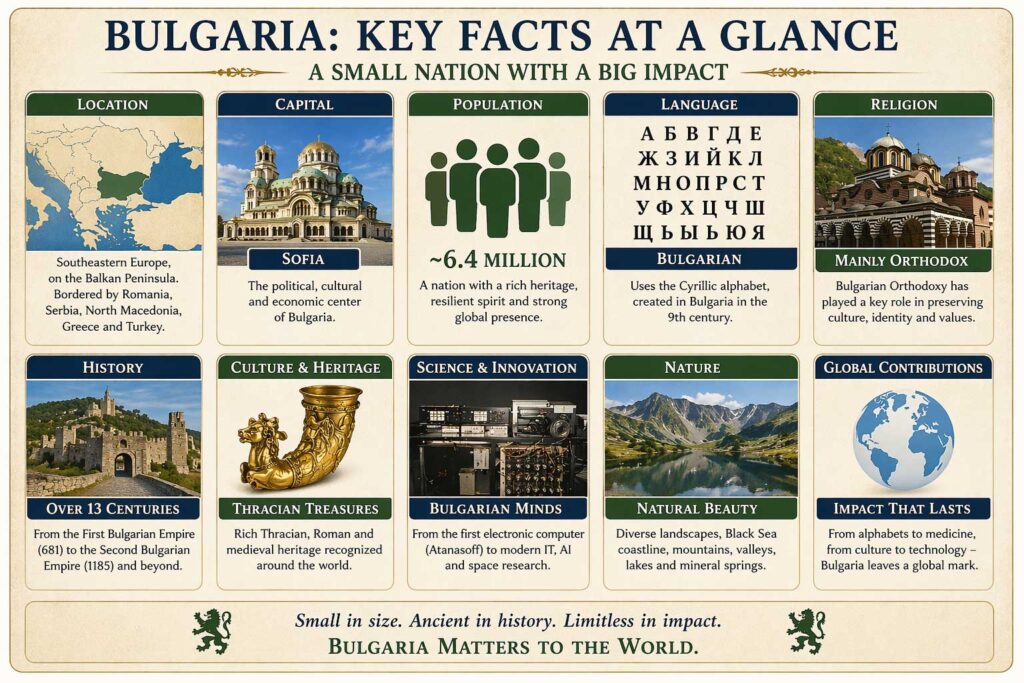
Bulgaria’s importance is not just historical—it is ongoing.
It matters because:
- It shaped European identity and literacy
- It contributed to science and technology
- It preserves cultural heritage
- It supports global industries
- It plays a strategic geopolitical role
In today’s rapidly changing world, countries that can balance tradition with innovation are the ones that remain relevant—and Bulgaria is a strong example of this balance. While deeply rooted in history, the country is actively participating in modern global systems through technology, trade, and international cooperation. Its growing IT sector, expanding infrastructure, and integration into European markets are clear signs of forward momentum.
At the same time, Bulgaria’s cultural and natural assets are becoming increasingly valuable in a world that is rediscovering authenticity and sustainability. From organic agriculture and traditional foods to eco-tourism and heritage preservation, Bulgaria offers what many modern societies are seeking—connection to history, nature, and identity. This positions the country as not only historically important, but also highly relevant in future global trends.
Finally, Bulgaria’s strategic location continues to give it geopolitical importance, especially in the context of European security, energy routes, and regional stability. As global dynamics shift, countries like Bulgaria—stable, connected, and culturally rich—play a quiet but essential role in maintaining balance and cooperation across regions.
Bulgaria’s Influence on Global Food and Health
Bulgaria has had a surprising yet significant impact on global nutrition—especially through yogurt. The discovery of Lactobacillus bulgaricus by Stamen Grigorov helped establish yogurt as a scientifically recognized probiotic food, transforming it from a traditional staple into a globally valued health product.
What makes Bulgarian yogurt unique is the natural balance of bacteria and traditional fermentation methods that have been preserved for generations. Unlike many industrial products, authentic Bulgarian yogurt is still closely tied to its origins, maintaining its nutritional integrity and beneficial properties.
Today, Bulgarian yogurt is widely regarded as one of the healthiest in the world, known for supporting gut health, boosting immunity, and improving digestion. Its influence extends far beyond Bulgaria, shaping global food industries, dietary trends, and the growing demand for natural, probiotic-rich foods.
Beyond yogurt, Bulgaria is also known for its herbal traditions, organic produce, and nutrient-rich foods that reflect a deep connection to nature and sustainability. These elements position Bulgaria as an important contributor to modern health and wellness movements.
👉 Discover the nutritional power behind traditional foods in Bulgarian Superfoods and Their Health Benefits.
Bulgaria’s Growing Tech and Startup Ecosystem

In recent years, Bulgaria has become one of Eastern Europe’s fastest-growing tech hubs. With a strong foundation in mathematics, engineering, and computer science, the country produces highly skilled developers who contribute to global platforms, enterprise software, and cutting-edge innovations.
Startups in fintech, SaaS, artificial intelligence, and logistics are putting Bulgaria firmly on the map as a rising technology destination. Companies originating from Bulgaria are increasingly competing on a global level, attracting international investment and expanding into major markets across Europe and the United States.
Another key advantage is Bulgaria’s cost efficiency combined with high technical expertise. This unique combination allows startups to scale faster while maintaining strong product development, making the country especially attractive for entrepreneurs and remote-first companies. Cities like Sofia, Plovdiv, and Varna are evolving into dynamic tech ecosystems with coworking spaces, accelerators, and a growing startup culture.
Looking ahead, Bulgaria’s tech sector is expected to continue its rapid growth, driven by innovation, global connectivity, and a new generation of entrepreneurs. This makes it not only a contributor to global technology—but an emerging force shaping its future.
The growing tech ecosystem is redefining why Bulgaria matters to the world in the digital age.
Today, Bulgaria’s IT sector contributes over 7% of the country’s GDP, making it one of the fastest-growing industries in the region.
👉 Discover some of the most successful and fast-growing companies in Bulgarian Tech Companies You Should Know.
FAQ About Why Bulgaria Matters to the World
Why is Bulgaria important globally?
Bulgaria is important globally because of its major contributions to language, science, culture, and geopolitics. It is the birthplace and spread center of the Cyrillic alphabet, used by over 250 million people, and has produced key innovations in computing, medicine, and microbiology. Its strategic location between Europe and Asia also makes it important for trade, energy routes, and regional stability.
What did Bulgaria contribute to the world?
Bulgaria contributed the Cyrillic alphabet, which is used across Eastern Europe and beyond, as well as breakthroughs in computing through John Vincent Atanasoff. It also made major advances in microbiology through Stamen Grigorov and in medicine through Dimitar Paskov. In addition, Bulgaria has preserved unique cultural traditions and contributed to global industries like perfumery with its famous rose oil.
Is Bulgaria important in Europe?
Yes, Bulgaria is one of the oldest countries in Europe, established in 681 AD, and has played a key role in shaping Eastern European history and identity. Today, as a member of the European Union and NATO, Bulgaria contributes to regional security, economic cooperation, and cultural heritage across the continent.
Why is Bulgaria unique?
Bulgaria is unique because it has preserved ancient traditions, folklore, and cultural practices that have disappeared in many other parts of Europe. Its continuous national identity, combined with its influence on global language through the Cyrillic alphabet and contributions to science and innovation, make it one of the most distinctive and historically rich countries in the world.
Where is Bulgaria located and why does it matter?
Bulgaria is located in Southeast Europe, at the crossroads between Europe and Asia. This strategic position has made it historically important for trade, cultural exchange, and geopolitical influence, connecting major civilizations for thousands of years.
What is Bulgaria most famous for worldwide?
Bulgaria is most famous for the Cyrillic alphabet, Bulgarian yogurt (Lactobacillus bulgaricus), rose oil used in luxury perfumes, ancient history, and rich cultural traditions that are still preserved today.
Conclusion: A Small Nation with a Global Legacy
Bulgaria proves that influence is not determined by size—but by impact.
From the creation and spread of the Cyrillic alphabet to groundbreaking contributions in science, medicine, and technology, Bulgaria has played a far greater role in shaping the modern world than most people realize. Its ancient empires helped define the cultural and political landscape of Europe, while its traditions continue to preserve a living connection to the past.
Today, as a member of the European Union and NATO, Bulgaria remains an important player in regional stability, economic development, and global cooperation—proving that its relevance is not just historical, but ongoing.
What makes Bulgaria truly unique is its balance between continuity and progress. It is a country where centuries-old traditions coexist with modern innovation, where cultural identity remains strong while adapting to a rapidly changing world.
Understanding why Bulgaria matters to the world is about recognizing a nation that has quietly—but powerfully—helped shape global civilization, and continues to influence it in ways that are often unseen, yet deeply significant.
🌍 Support Bulgaropedia
Bulgaropedia is dedicated to sharing Bulgaria’s history, culture, and global contributions with the world — completely free and accessible to everyone.
If you found this article helpful, consider supporting the project. Every contribution helps us create more high-quality content, visuals, and in-depth research.
👉 Join the mission to bring Bulgaria’s story to the world.
❤️ Support with a Donation 📘 Get the Bulgaropedia EbookSupport Bulgaropedia & Explore More
Bulgaria’s story deserves to be seen, understood, and shared with the world.
If you found this article valuable, you can help keep Bulgaropedia growing and bringing high-quality content to a global audience.
Support the Mission
Bulgaropedia is an independent project dedicated to preserving and promoting Bulgarian history, culture, and global contributions.
👉 Your support helps us:
- Create in-depth, research-driven content
- Produce high-quality visuals and educational resources
- Keep Bulgaropedia free and accessible to everyone
👉 Support Bulgaropedia with a donation (any amount helps)
📘 Get the Bulgaropedia Ebook (Coming Soon)
Want everything in one place? We’re creating a premium Bulgaropedia ebook that brings together Bulgaria’s most important knowledge in one powerful resource.
- Bulgaria’s most important historical moments
- Key cultural traditions and symbols
- Scientific achievements and global contributions
👉 Join early access and be the first to get it when it launches
Continue Exploring Bulgaropedia
Dive deeper into Bulgaria’s global impact:
- 👉 What Is Bulgaria Famous For?
- 👉 Bulgarian Scientists Who Changed the World
- 👉 Bulgarian Traditions and Customs Explained
- 👉 Geography of Bulgaria
Why This Matters
By reading, sharing, and supporting Bulgaropedia, you’re helping bring global attention to a country with a rich history, powerful contributions, and a story that deserves recognition.
👉 Explore more. Learn more. Share Bulgaria with the world.
This article is based on historical research, academic sources, and data from international institutions.
References
- Encyclopaedia Britannica. “Bulgaria – History, Geography, & Facts.” https://www.britannica.com/place/Bulgaria
- European Union. “Bulgaria – Country Profile.” https://european-union.europa.eu/principles-countries-history/country-profiles/bulgaria_en
- UNESCO. “World Heritage Sites in Bulgaria.” https://whc.unesco.org/en/statesparties/bg
- NASA. “John Vincent Atanasoff and the First Computer.”
- National Geographic. “The Origins of the Cyrillic Alphabet.” https://www.nationalgeographic.com/history
- World Health Organization (WHO). “Traditional Foods and Probiotics Research.” https://www.who.int
- Bulgarian Ministry of Tourism. “Why Visit Bulgaria.” https://bulgariatravel.org
- World Bank. “Bulgaria Overview.” https://www.worldbank.org/en/country/bulgaria
- CIA World Factbook. “Bulgaria.” https://www.cia.gov/the-world-factbook/countries/bulgaria/
- Sofia Tech Park. “Innovation and Technology in Bulgaria.”